Tuesday, December 10, 2019

Entrepreneurs


On Black Friday I worked with a small business owner who was closed for the day.  While we worked, I also interviewed her.

She was gearing up for Small Business Saturday after being closed both Thanksgiving and the day after.  She and her business partner wanted to give their employees those days off, plus they needed the day to prepare for increased internet sales.  Their physical location in the West Loop was closed, but on the internet the door is always open.  Black Friday is one of the few days in the year they offer products at sale prices.

The woman I interviewed has a smart phone app that shows online orders in real time.  The sale started at midnight.  At 12:01 product began virtually flying off the shelves.  She showed me the graphic.  During the short time I looked at her screen sales increased.  She was smiling.

"There are some whopping big orders in there.  I think some customers are doing all their Christmas shopping at once."

She put her phone down.  There was other work to do.

“What are we doing here?” I asked.

We were seated beside a plastic tub of granular looking white stuff with purple running through it. Beside it was a  box of jars with lids.

“We’re going to fill these jars with a sugar scrub, label and pack them.  I was a little short on a wholesale order from a nearby  business, Flowers for Dreams.  They create and deliver flower arrangements, and are are launching a program that offers add on products to their floral orders by incorporating products from other businesses like them.

They wanted something unique from us that related to their services.  So, I custom made a scrub that uses lavender buds along with essential oils and sugar.  We simply call it Flowers for Dreams Scrub. They need a couple dozen more jars.”

She began sifting the material through her fingers, blending it together, fluffing it up.

“What’s in it?”

“Well, sugar of course.  Pure plain white sugar is the base.  Then ground lavender buds, sunflower oil, apricot kernel oil, and natural vitamin e.  I finish it off with essential oils; lavender, jasmine, neroli and ylang ylang.”

Lavender and Jasmine I understood.  I decided not to ask about neroli and ylang ylang.

“The ground lavender can clump up a little in the sugar.  As we’re jarring this up if you see clumps just  break them up between your fingers.”

She was using a cylindrical measuring cup that was sized perfectly for the jar.  She gave me a big spoon.

“If I had another of these cups, I’d give it to you.  I pack them very tightly because they can settle when they’re shipped.  Hate to have customers open jars that aren’t full.  Press down hard with that spoon please.”

We were in one room on the third floor of Feather Loft LLC, an old repurposed building in Chicago in the West Loop by the Metra tracks.  It used to be a feather warehouse.

Now it is rented out by the room.  Her simple 12 x 15 space; high ceiling, original brick exterior walls and hardwood floors, is a storehouse for raw materials, a workshop where skin care products are made, and a lab to develop and test new products.  Other loft units are used by artists and musicians.  The possibilities are endless.  Each has good light, big windows, and they are affordable.

“So, you make all your products by hand like this?  Nothing purchased and passed on from somewhere else?”

“Everything that has our label on it is made right here in this room.  I mean we sell jade rollers, small brushes for masks, and accessory items.  But every product of ours: the lip balm, the butters, the deodorant, the soaps, soaks, scrubs, oils- everything with our logo on it, is put together just like this.  Sometimes I have helpers like you, but I make it all.”

The space I visited is pretty much a one-woman operation, and the woman I interviewed likes it that way.  Around her are five-gallon buckets of oil, sacks of dry goods, jars of things I couldn’t recognize.  And by the window is her work space; scales and simple tools, a single industrial hot plate, beakers and containers, books that hold recipes, a laptop computer, and lots of raw material.  That's where her real work gets done.
“We began in 2011 by making soap in my business partner’s apartment.  We went to high school together.  From the start we wanted to make all natural, environmentally sound products totally out of food grade ingredients that were good for people.  It was a challenge.  We mixed ingredients in giant pitchers and poured them into waxed orange juice cartons.

One of our first bars was Lemon Poppy.  It was scrubby.  We asked friends to try it and they liked it.  We started selling on Etsy but soon my partner put up a basic web site and internet orders increased.”

The woman I interviewed graduated with a food science degree from University of Illinois in 2006.  She worked in a lab for a company that managed private discount labels, testing contents to make sure they met standards and were labeled correctly.  Later she was one of the first lab and quality control technicians at the new Lagunitas Brewery by Douglas Park on Chicago’s west side.  Soap was a sideline.  But profitable.

“We made a Buddy Bar soap for pets named after my business partner’s beagle.  We continued to put food products in soaps for texture and collaborated with a local coffee roaster called Dark Matter coffee to make a nice bar.  After making all kinds of soaps, we began making oils and solid products we called butters.  The orders kept growing. Then we added salt soaks and sugar scrubs, and they slowly gained sales.  My boyfriend made me better reusable soap molds.  I liked it.

But then my business partner talked me into renting retail space.  It scared me to death.  I didn’t know why we would want to spend the money when we had so little overhead and were selling product anyway.  She convinced me we would never get to the next level if we didn’t take risk.  So, I closed my eyes and said yes.

We moved into a tiny street level space in Roscoe Village near the corner of Damen and Addison.  I started making product in the basement.  It was such a relief not to carry ingredients up into a second-floor apartment.  My Uncle Denny made us benches for a waiting area that doubled as storage boxes.  A friend made us inside signage that mirrored what was on our label.  We installed an awning with our logo on it.  For the first time our brand was visible on a Chicago street.  We had walk in traffic and regular customers.
 
We also bought three chairs and started giving facials and foot soaks using our products.  We hired some help very part time.  It was a new day for the business.  I was anxious but after a time it all began to click.  And all the while internet sales were increasing.”

As we talked, we were filling jars with Flower for Dreams scrub.

“How do you get all this sugar up here?”

“I carry it on my shoulder.  50-pound bags.”

“That’s three floors up.  I thought I saw a freight elevator out there.”

“It’s sort of a theoretical freight elevator.  You’re supposed to make an appointment with the building manager.  He unlocks it and runs the elevator.  But I can never seem to find a time that works for both of us.  So, I do it myself.  The next space I rent will be bigger.  Ground floor with an overhead door that can accept pallets.”

She’s learned to plan ahead.

“Bang that jar on the edge of the tub so it settles.  You have a little void in that one.  And when you start putting put the lids on make sure there are no grains of sugar in the threads of those jars.  It keeps the cap from sealing well.  Here.  Wipe them off with this towel.”

She was particular about every detail of the work.  When I had all the lids on, I thought we were done.

“Now for the labels.”

She walked to a giant peg board holding  spools of adhesive white labels with black letters displaying the company’s brand and meticulously detailing product ingredients.  From the board she took two spools to the work counter and spread them out a thick black towel.  She laid one of the jars filled with Flowers for Dreams scrub on its side on the towel.

“OK feel the side of these jars.  You’re going to notice two little ridges.  You may not see them, but you’ll feel them when you run a fingernail over them.  They mark the exact halves of the jar.  We want one label on one side between those ridges and another opposite it on the back side.  No labels on the ridges.  They don’t stick as well.  Put them on the jar equal distance from the space below the lid and the bottom.  Make sure they’re straight.”

She showed me how.  She was fast but careful.  I would have slapped them on.  That was clearly not her style.

“Where do you get these labels?”

The story on the labels says something about this small company’s values.

“We made our own labels on a home printer using peel off Avery labels for years, but we knew at some point we would need to outsource that.  They weren’t waterproof.  They didn’t look professional.

We asked around and found this guy Juan on Western Avenue who had a small business making big signs and window decals.  He had never made labels but figured out how to modify his process.  The stickers came out on huge wide sheets like Christmas wrapping.”

“Not at all like these,” I said, picking up a roll of stickers, perfectly sized for the width of the label, easily stored on the pegboard.

“Nope.  These are from StickerMule, a new on-line company catering to small businesses.  They have great online tools and good customer service.  But we still like to buy local from other small businesses whenever we can.”

I was putting on my third label.

“That one’s a little crooked.  Here, let me fix that.  I can get them off easier than you.”

“You really are particular about these labels.”

“Yeah, I am.  The people we sell to want to know exactly what they put on their skin.  We need to list every ingredient accurately, in descending order of amount, in plain language, and make it easy to read.  We’re proud of our ingredients.  We take a lot of time to make sure they work well together and get people the results they’re looking for.  They’re not inexpensive, because we choose ingredients based on quality not cost. That approach is working.”

We finished the labels on the scrub jars and moved on to our second task; filling, capping, labeling and packing 8 ounce bottles of Tea Tree Cleansing Oil.

“This product is one of our biggest sellers.  It’s selling so well we’ve gone to larger bottles.  We sold it in only 2 and 4 ounce bottles and noticed people ordering multiple bottles.  Like a 2 ounce and a 4, or a couple of 4 ouncers.  So, we offered it in 8 ounce bottles for less and now that’s our most popular size.”

“What does 8 ounces cost?”

“$30.”

“Wow.  I just buy Bag Balm at Farm and Fleet.”

“That’s petroleum based you know.  Has some lanolin, and a touch of Hydroxyquinoline sulfate, but mostly it’s petroleum jelly.”

“So, how is Tea Tree Cleansing Oil used?”

“It’s a deep facial cleanser, great for removing make up.  You spread the oil all over your face, steam your face with a hot cloth, and wipe everything off.  It’s a healthy alternative to soap for your face.”

“So, what’s in this oil that makes it work?”

“I experimented with this mix for a long time.  The ingredient that does the most work is castor oil.  That oil is super thick and great at dissolving skin sebum, our natural face oil.  But you can’t use straight castor oil because it’s too strong and by itself would dry out the skin.  So, I use sunflower oil as the base, and blend it with jojoba to improve the texture.

Then I add Tea Tree oil to give it a nice fresh scent, and also acts as an anti-bacterial.  Finally, I add meadow foam seed oil, a premium oil that prevents oxidation and ensures shelf life naturally.  After lots of trial and error I think I arrived at a really good blend.”

 “OK.  So how did you get from Roscoe Village to the West Loop?”

“Our place in Roscoe village was too small, and people were coming from other places in the city to get to us.  We weren’t necessarily serving Roscoe people.  We needed to move.  And if we were going to move, we wanted to get to an area that had a lot of foot traffic, drew a lot of people to the neighborhood to work, and was a desirable destination.”

“So, you found that in the West Loop, but you had to move several times, right?”

“Yes.  We tried a spot in Fulton Market for about a year, but wanted to get closer to the action in the West Loop.  We hired a lawyer and worked with a real estate broker through a series of pop ups while negotiating a deal on our current space in a historic building that needed a lot of work. At some point during that time I quit my job and worked the business full time.  In October we opened a space that carries a ten-year lease.  We designed it ourselves with an architect.

We learned a lot.  And we’re pleased with the neighborhood.  It has great restaurants, new hotels, and lots of consumers who are drawn to our brand.”

“What is your brand?”

“We’re a food grade skin care and wellness company.  We make a full line of natural skin care products by hand, offer wellness programming in our space, a ten-seat mask bar which is a facial class led by an instructor.  The mask bar, used by both individuals or groups, is designed so people can make and apply their own mask using products we sell.

We offer varied wellness programming from yoga to meditation to calligraphy, dance and more.  We maintain flexible event space people rent for celebrations, parties, corporate events, often with catered food.  They sometimes pair up an event with seats at the mask bar.  And, as always, there are in store and online sales of products.  We want to create an inclusive wellness community.”

“You have a lot going on.”

“Yep.  It’s not just soap in orange juice cartons anymore.”

“How many staff?”

“Eight, in addition to my business partner and I, and volunteers oddly enough.  People are drawn to our space, offer to help in various ways, and we let them.”

“So, 2020 is the start of your tenth year in business.”

“It is?  Yeah, I guess it is.  Wow.  We’ve been too busy to count.”

“Congratulations.”

“Thanks.  And thanks for the interview.  You asked questions I hadn’t thought of.”

“Well, I have a real interest in both you and your future.  I like watching you grow.”

I labeled my last bottle of oil, put it in a carton, and closed it up.

“Can I help you carry this stuff down to your car?”

“You don’t have to, but if you  want to, I’ll let you.”

Full Disclosure: The woman I interviewed is my daughter Maureen McClure.

She and her business partner, Elizabeth Leipold, both formerly from Ottawa, Illinois, own and operate 

You can visit their store in Chicago at 847 West Randolph or visit them at their very cool website by clicking here: Scratch Goods.  If you do, tell them Moe’s Dad sent you.

Wednesday, December 4, 2019

Learning from Mistakes

After being in Chicago for three days over Thanksgiving, and lazing around in the house for two more, I returned to the shack Monday morning and built a fire in the stove.  I do that nearly every winter morning when I’m home and in my routine.

It’s a tiny stove, made in the San Juan Islands at a place called Navigator Stove Works.  I bought their “Sardine” model, smallest in a line that includes “Cod” and “Halibut” stoves as well.  The stoves were designed and marketed to heat small spaces below deck on sailboats.  Turns out they also work great in a small space like the shack.
    
Half a brown paper  grocery bag, pinecones, thin pine sticks, a single heavy chunk of wood and my little stove is full.   It’s a formula for fire.  I leave a piece of bag sticking up near the top.  Before I light a wooden match, I check the air intake on the side of the stove, open it wide if its throttled back, strike the match, let the flame grow a moment or two outside the stove, then reach in and light the paper.  I put the lid back on the stove, turn to the computer, and go on with my day.


When I hear the pine crackling inside the stove beside me, or feel warmth on my shoulder, I know it is burning as it should and I add wood.  Monday, I heard or felt nothing.  I pulled off the lid to reveal unburnt fuel and wisps of smoke.  That rarely happens.  When it does the paper burns and my kindling doesn’t catch.  When I lit a second match and applied it directly to a pinecone, I realized the paper was still there.  What the heck?

I relit the paper, making sure this time it caught and was burning well, and replaced the lid.  My computer was booted up to Outlook and I began to check e mail.  After a time, I realized I still had no heat.

I removed the stove lid to the same scenario.  Smoke and unused fuel.  How could that be?  I sat back in my chair.  My formula for fire had failed me.  I had good dry fuel, the fuel had access to air, and I started it with a strong flame.  It had to burn.  It always did.

And then I remembered.

Before I left for the holiday, we had high winds.  Leaves were racing past the shack and piling up on the saplings at the edge of the ravine.  Trees were swaying side to side outside the shack and wind whistled across the top of the stovepipe that carries smoke up from the stove and lets it pass through the roof.

I closed the flue.  Something I rarely if ever do.  Somehow, I thought it wise to keep that air from blowing down into a cold stove and the shack while I was gone.  I’m not sure why.

The damper that closes the flue is just a circle of tin inside the round 4” stove pipe.  It is fastened to a rod that extends outside the pipe on both sides above the stove.  On the rod is a handle.  Turn the handle horizontally and the tin circle inside the stovepipe is flat, shutting off air from entering or escaping the stove.  Turn it vertically and the tin circle is straight up and down presenting no obstacle to escaping air and smoke.  Simple little deal.

I thought I knew exactly what the fire in my stove required, but I left out a critical fact.  Fire requires air to burn, but not simply an air supply.  Fire can’t exist without air flow. Intake means nothing without exhaust.   While I checked the air intake on the side of the stove, I ignored the other side of the equation, a way for that air and smoke to escape and allow more air in.

I opened the flue, applied a third match inside my stove, and in less than a minute a fire was roaring, and smoke was floating away through the trees outside the shack.  I smiled.  

Forgetting the flue and not recognizing the need for air flow in my stove was a small thing, but it reminded me how I can and do at times ignore facts.  In this case it was a law of physics, a basic component needed for combustion.  In other situations, or at other times, we may overlook or fail to acknowledge basic needs.  Perhaps our own.  More likely those of others.

I was reminded to think clearly, and not ignore what I know as fact. 

Thursday, November 14, 2019

The Road to Belfast


Tooling around Ireland is not like traveling in the States.  Distance is abbreviated.   You can drive from coast to coast, from way south Cork to way north Ballycastle, in 5 hours and 10 minutes.  We could have driven straight east from Donegal to Belfast, west coast to east, in just over two hours.  Instead, we looped up north.  We found we had plenty of time.  Besides, we had places to go and things to see. 

When it comes to Americans driving in Ireland right is right and left is just plain wrong.  It took my friend Ken and I quite a while driving north from Donegal to turn that little switch in our brains that allowed us to feel comfortable going down the road.  The roundabouts were a challenge.  It felt for all the world that bearing left would throw us head long into a collision that would kill us all. While old habits, in this case 50 plus years of driving in the right lane, die hard-I’m glad to report they do finally die.  Happily, they expired before we did.


From Ardara in Donegal we took the road to a large city on the border of the Republic of Ireland and the island’s northern six counties.  The name of that large city on the border of Donegal County and its neighboring county to the east, one of the six counties that make up Northern Ireland, is disputed.  If you are a loyalist, which refers to loyalty to the Queen of England, and usually synonymous with being Protestant, you call that city, and its county, Londonderry.  If you do not recognize or accept the partition of your island into two parts, you are most likely Catholic.  In that case you ditch the London prefix and call it Derry.  Politics, religion, and use of language intertwine.  Let’s call it Derry.  If nothing else its shorter. 

I don’t pretend to understand the passion behind the semantics, but then I didn’t experience “the troubles” nor am I steeped in an Irish history created by centuries of oppression, strife, rebellion and violence.  I don’t feel what those living on that beautiful island feel, or what family lore was left to Irish children for generations.  I just try to be sensitive to everyone and learn.


We drove a rented BMW SUV on the wrong side of the road to Derry, where we promptly got lost.    It’s a city of 85,000.  At the first glimpse of a possible exit, we headed straight out of town.  People tell us it was a mistake skipping Derry, and if I go back, I’ll try to rectify that.  But you can’t see everything.


As we drove from the Republic of Ireland into what is called by some Northern Ireland we tried to determine when and where we crossed the line that separates the two government authorities, which use different currency, and all the things that borders do to divide both land and people.  We never found it.  It was invisible.  At some point while lost in Derry we went into a gas station/convenient store and they didn’t take Euros, instead accepting our credit card and pointing out where we might find an ATM to get some pounds.  Also, the road signs changed from kilometers to miles.


Our transition from one human engineered geographical construct to the other was completely seamless.  We couldn’t even tell where checkpoints used to be.  The peace accord of 1998 accomplished that.  The prospect of re-establishing a hard border to establish customs and trade control, instead of the one we so effortlessly crossed, between the Republic of Ireland which will remain in the European Union and the Norther six counties which will ostensibly leave with England, is one of the main Brexit worries and a key political obstacle.  For good reason I’d say.  It would be a step back for all of Ireland, and I found no appetite for that among any of the people with whom I talked, no matter where they lived or went to church.


The closer we got to the sea, the more beautiful the Irish countryside became.  We headed straight to the town of Bushmills.  It was a pilgrimage of sorts.  We were headed to a whiskey distillery that is dear to my heart, and most likely my liver.  It was the Bushmills Distillery, which lays claim as the oldest distillery in the world, granted license by King James I of England in 1608.  My guess is plenty of whiskey was made in stills all over Ireland and the neighboring British isles prior to that but someone produced an old official license for Bushmills and the marketing spin took over from there.


We took the tour, our second of the week, having done the same at the site of the former Jameson whiskey distillery on Bow Street in Dublin.   Jameson moved its distillery in 1975 to Midleton in County Cork where every drop of that nice liquor in the green bottles is now made.  It maintains the Dublin facility as a warehouse and a first-rate tasting room and tour site.  The Bow Street experience features an historic old building and a fancy tour with slide show, dramatic music, dimmed lights.  Besides the tasting at the end, we learned things.  Here’s what makes whiskey from Ireland distinctly Irish.
  
The Irish don’t use peat in their distilling process, unlike the Scots.  Scotch Whisky (notice the spelling, no e in the last syllable) gets it distinctive taste from peat used as fuel to toast barley.  Barley is wet down and allowed to germinate slightly, then toasted to stop germination.  Irish whiskey uses malted barley too but omits the peat. 


Irish whiskey is distilled three times, at least the leading brands-Jameson and Bushmills, whereas scotch and bourbon rarely are.  Jameson differs slightly in its grain mix.  At one time in Ireland malted barley was taxed.  In order to keep costs down Jameson began using unmalted barley and corn.  Then they liked the taste and continued.  Jameson also blends pot still whiskey with that made using a column still.  That’s a little technical but they think it makes a difference.


Most all makers of whiskey use charred oak barrels, usually from Kentucky, sometimes from France, and for the fancier smoother stuff they switch the maturing whiskey to used barrels that once held a sweeter liquor like sherry, port wine, or rum. Years of aging and the type of cask whiskey is stored in makes the biggest difference in a whiskey’s taste.


Bushmills whiskey, my favorite, comes from Antrim County where the McClures came from, or at least lived for a while.  The walk through the Bushmills distillery was more of a working tour, going from building to building as workers were present and the distilling process was taking place in its various stages.


The finishing room where the whiskey casks are aged is my favorite. Annual temperature variation, in climates with cold winters and hot summers, pushes the liquid into the wood when it is hot, contracts when it is cold, and in so doing picks up flavor from the barrel and the char. You can’t beat the smell in the finishing room.  As whiskey ages it loses volume through evaporation.  The whiskey that is lost when the wood barrels breathe is called the angel’s share.  That’s what you smell in the finishing room.  Heavenly.


I asked the guide which came first, the town or the distillery.  Bushmills the town was first.  Long before whiskey was made there, mills which ground grain were powered by the river Bush.  Hence the name.


Only 100% malted barley is used to make Bushmills whiskey.  The barley is grown near Cork, where the soil makes the grain sweeter.  Every drop of Bushmills whiskey ever made was, and continues to be, produced in that one original distillery on the north coast of the island known as Ireland.  Here is the original building, or so they say.


It was my fourth distillery tour, so I had a pretty good idea of the process.  But on this tour, I had a question I was itching to ask.  I waited till the tour was finishing and asked if of my tour guide privately.
  
“Some of my Catholic friends back in Illinois don’t like to drink Bushmills because they say its Protestant whiskey, whereas Jameson is Catholic.  One friend claims you have never hired a Catholic here at your distillery.  Any truth to that?”


He turned his head and grimaced.  I hoped I hadn’t offended him.  But he turned back with a collected sort of look.  He began calmly. 

“You can go home and tell your friends that’s BULLSHIT.  Oh, make no mistake at one time it was true.  Absolutely. The still was Protestant owned and that’s where the jobs went.  But that all ended in the 1960’s.  We’re a modern country with equal hiring practices.  For example, I’m Catholic.  So is our master distiller, the man with the top job here.  Our workforce reflects the diversity of our country in that regard, and Bushmills is proud of that.  But we can’t seem to live the rumour down.  That damned story has lived on in the States way too long.  Help me spread the word that it’s false, would you?”


“I’ll see what I can do.”


In the gift shop I bought a 16-year old single malt Bushmills that is finished in a Spanish Oloroso sherry cask.   A very thoughtful person bought me a bottle for my retirement, and as stingy as I was with it, that bottle was long ago emptied.  I haven’t found it since.  Colleen took my picture in the tasting room having a glass of it.  It felt like coming home.  Over the years I’ve bought enough Bushmills I feel like I own a piece of the place.


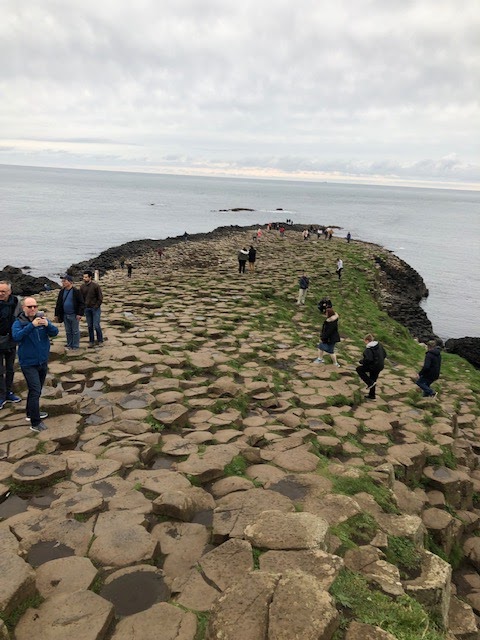
From Bushmills we drove up and along the coast, a short three miles away, to the Giant’s Causeway, a distinctive geological area and UNESCO world heritage site caused by volcanic activity.   There at the edge of Antrim County molten basalt pushed through chalk beds to form an extensive lava plateau.  As the lava cooled, it contracted like mud does when it dries.  The lava fractured vertically into pillars and horizontally into hexagonal and octagonal stone biscuits, often joined by ball and socket joints.  The tallest pillars are 39 feet tall, and the lava in the cliffs is 92 feet thick in places.  The tops of the columns form what look like stepping stones, symmetrical cobblestones if you will, leading from the cliffs into the sea to disappear under the water.


This volcanic activity happened way before Irish whiskey, Guinness, potatoes, flat wool caps, corned beef and cabbage, horse racing, the Irish sweepstakes, smiling eyes, leprechauns, religion of any stripe, songs or even tunes.  It took place before language or people to speak it.  Homo Sapiens showed up in Europe 45,000 years ago.  The Giant’s Causeway was formed during the Paleocene era, 50-60 million years ago.  And I thought the Bushmills distillery was old. 

With it being Ireland, the people who eventually lived there created a legend around the Giant’s Causeway.  Here’s the story.

In Gaelic mythology the Irish giant Fionn macCumhaill (English translation Finn MacCool) was challenged to a fight by the Scottish giant Benandonner.  Finn accepted the challenge and built the causeway across the North Channel to Scotland so the two giants could meet.  In one version of the tale (Irish legends are famous for having more than one ending) Finn defeats Benandonner handily.  In another Finn hides from the Scottish giant after realizing Benandonner is much bigger than he.  Finn’s wife disguises Finn as a baby and tucks him in a large cradle.  When Benandonner see the size of the “baby”, he reckons the father, Finn, must be a giant among giants and flees back to Scotland in fright, destroying the causeway behind him so that Finn could not chase him down.
  
Across a sea channel not far away are identical basalt columns, part of the same lava flow, at Fingal’s Cave on the Scottish isle of Staffa.  They lend credence to both stories. You can count on the Irish for always having a story, sometimes two. 

We stayed till late afternoon at the seashore with tourists from all over the world, drawn by the unique and unusual geology of the Giant’s Causeway.  Sometimes the most fascinating attractions are the natural ones.

Before the sun set, we made our way to Belfast.  It had been a long but very good day.


Tuesday, October 29, 2019

Tales from Donegal


I was told a powerful family story from the past by a man living in Ireland.  It helped me understand the Ireland of my ancestors, and how that past shaped the character of Irish people in both Ireland and those places to which they immigrated.

In 1902 in a small town in County Donegal on the western coast of Ulster, now part of the Republic of Ireland and the European Union but in 1902 still under England’s thumb, a decision was made by a family living on a farm outside the small town of Ardara.  The oldest son, fast becoming a man and wanting to marry, would farm the land.  As for the younger boys, there was little opportunity for them.  Their small farm could only feed so many.  Times were hard.  It was decided the best course was for two of the boys to make the voyage to America.  Travel arrangements were made, and they prepared to leave.

I assumed, why I don’t know, that Irish men and women who left their homes went gladly, hungry for adventure, thirsty for the chance to work, buy land, and prosper.  That might have been the case for some, perhaps most, but this family told their story differently.  The boys picked to leave for America didn’t want to go.  They didn’t feel like lucky chosen ones.  All the support they had ever known in their short lives came from the people on that small farm and the community around it.  The feared life in a far-off place that didn’t include that support.

But they accepted the decision, boarded the ship, and after waving good-bye from the ship’s rail, turned their backs on those who loved them but sent them away.
  
Sixty-six years later a middle-aged woman made a journey alone back to Ireland.  Guided by her father’s detailed directions she was dropped in the early morning by a narrow lane that wound through fields and farms on the way to Ardara.  The lane intersected a larger road where she turned left as her father had told her. Walking alone she looked for a thatched roofed cottage at the base of a hill where her father told her she would find the farm on which he was born. Unsure of her whereabouts, she saw three men working in the field near there and made here way towards them.


An old man and his two sons were cutting peat.  To take peat from the bog you first take off the heather, then the topsoil, no more than a foot or two, and any clay you find under it.  When all that is gone the peat is exposed.

An old man at the bottom of the bog was cutting  peat into rectangular sods with a special type of spade called a slane.  His eldest son heaved the sods from the bottom of the pit to ground level.  His second oldest then loaded the sods onto a wheelbarrow and took them to a flat accessible area where he stacked the turf.  In the ground this fuel is peat, when it is removed and stacked it is turf.  Think of it as coal in an early stage before it hardens.

They were cutting peat and stacking turf for the next winter.  It would dry in the stacks for a full year.  It was hard work, but it was how they warmed their house and cooked their food.  Irishmen had cut peat and stacked turf on that farm every year for as long as they knew.  1968 was no different.  The son stacking peat in the barrow spoke to the others.

“A woman has climbed the fence and is walking towards us.”

“Who would she be?”

“I couldn’t tell you.”

“Help me up.”

His father left his spade in the bog, took his son’s hand, and with his help hauled himself up and out of the bog.  He put a hand over his eyes, squinted, and took a long look at her for himself.  As she came closer, he yelled across the field, first in Gaelic.

“A Chuisle Mo Chroi!  (O pulse of my heart!) I know who you are.  You need not say a word.  Welcome home.”

He walked towards her and they embraced.

“You must be my uncle.  How did you know who I was?”

“As sure as I know the back of my hand, I can see my brother’s face in yours.  You’re home with your family now niece, and us with you.  Let me introduce you to your cousins.”

As she shook her cousins’ hands, one of them said

“Well it appears at least one of our uncles made it to America.  Who would your father be?”

And with that the talking began and the stories flew.  During all the years that passed since two brothers boarded the ship that day in 1902 there had been no communication of any kind between them and their family in Ireland.  Then, in an instant, their family was whole once again.
  
That family has been in contact ever since, with letters and visits back and forth.  From that story I gained an appreciation for the pain and heartache caused by the huge movement of the Irish to Canada, America, and elsewhere.  And long ago my family was part of it.  The world is a smaller place now, and the desperation that forced that migration, at least for Ireland, is largely over.

So, am I the first of my great grandfather’s grandsons to come back since he boarded the ship in 1860? How did Robert McClure feel when Ireland faded in the distance, the ship hit open sea, and he was gone for good? There is so much I don’t know.

Ardara is the perfect place to see both the old and the new in today’s Ireland.  The town, with the help of the Irish government and the EU, has taken pains to preserve the buildings, the streets, the feel of the town as it used to be.  They have a nice diamond, which we would call the town square, a nearby river walk, and narrow cobblestone streets.  But their greatest resource is friendly charming people.  I’m prejudiced, because I’m a farm kid who lived near a little town, and will forever be convinced that nothing beats the feel of a small community.

By sheer chance the three days we scheduled in Ardara (it looks like it would be pronounced R dar a, but the locals say R dra) coincided with the annual Johnny Doherty music festival.  Johnny was a famous fiddler from Ardara.  There is a statue of him on the Diamond.  I took a picture of his statue but he looks  gray, cold, and quite stiff in marble.  Here’s a photo of Johnny in his later years.  Life becomes him.


 We heard live music every day.  The festival headliners were “Four Men and a Dog”, a musical group from all over Ireland.  We saw them play at the small downtown hotel ballroom.  They were amplified, on a stage, playing both traditional and non-traditional tunes and songs, and they were terrific.  The band (6 men, no dog) included an electric piano, accordion, two fiddlers, a great guitarist and vocalist, and a bodhran player.  One of the fiddlers occasionally switched to a banjo.

We had seats in the front row near the speakers.  We were blown away. They are famous in Ireland, but we had never heard of them.  They get to the states at times, though it sounds like its mostly the east coast.  Lots of talk about Boston.

The next night we saw the Friel Sisters, three young women who sing like angels.  Anna plays the flute, Sheila the Uilleann pipes, and Clare the fiddle.  They brought along a young man who played the Bozouki, a Greek stringed instrument played like a guitar.  The sisters have roots in Ardara, so it was like coming home for them.  They interacted so well with the crowd, sharing recent news about themselves.

Sheila explained the difference between Uilleann (Irish) and Scottish bagpipes.  Scottish pipers are always blowing into a stem that fills a bladder they squeeze under their arm to force air through the drones which hang down around the bag and the chanter which they finger as you would a flute.  Uilleann pipes use a bellows they pump with their right arm forcing air through a hose around their back to a bladder under their left arm. It allows them the freedom to sing.  And of course, the Irish think their pipes are far superior.

I always thought of bagpipes as novelty instruments, used for marching, but those Irish Uilleann pipes were a key part of their small quartet.  Sheila changed the tone of the instrument by raising and lowering the chanter, breaking a seal on a piece of vinyl on her leg.  When she did it let out a louder wail.  It was a haunting and beautiful part of their sound.  They did pretty vocals, but they rocked as well.  Especially Clare on the fiddle.  We were upstairs in a room with maybe 75 people.  Such an intimate concert.

Throughout our time in Ardara we would see people during the day on the street, and in the evening in the restaurants, whom we had seen at the pubs and music venues.  They would recognize us and  speak to us.  One day we found benches on a river walk that winds through town and butted up against a motel.


As we sat a father and his two sons were in the mostly vacant adjoining parking lot hitting a ball back and forth to each other with short bats.  The ball got away.  I ran it down and threw it back to one of the boys.  The father spoke to us from across the parking lot.

“Say, didn’t we see you at the concert last night?”

“Yes you did.  You were sitting in the row behind us.”

“Great band doncha think?”

“We loved them.”

“They’re famous.  Hard to see them.  So good they came to Ardara.”

“Are you from here?”

“No, we live down by Kilkenny but my wife is from up the road.  We’re here mostly to see the Friel Sisters tonight.  These boys are their second cousins.”

He sensed we were Americans.  How I don’t know.  We asked him questions about what he was doing with those bats.

“My boys are on a hurling team.  We’re practicing passing.  Do you want to try it?”

I did.  It’s like hitting a baseball, except you hold the bat cross handed.  It’s a dead ball about the size of a baseball.  My friend Ken tried it too.  The boys laughed at us a little, and their Dad didn’t approve.  One, the red head, lowered his eyes and blushed when his Dad gave him “the look.”  His cheeks turned red as apples.

We talked for half an hour.  Irish sports vs. American sports, where various sports are more popular in his country, Irish history, American politics.  He figured Elizabeth Warren was the new front runner among the Democrats.  He figured for sure the Democrats would elect the next president and relayed how shocked he, his family, and all his friends were when the current man who sits in the white house was elected.  He was very well informed on the U.S..
  
It was a sunny afternoon.  After a while the boys drifted away and resumed their game.  We continued our chat about food, places in the U.S., you name it.  Travel to countries where language is not a barrier offers great opportunity for visitors to really connect with others in the world.

On Sunday morning my wife and I went to Catholic mass in the old church on Ardara’s main drag.  It is surrounded by graves.  Good crowd at church.  No music, no incense, no frills. Three altar girls and an old Irish priest.  His message, on welcoming immigrants and aiding the poor, was refreshing.  When we passed the peace in the pews we felt warmly greeted.  I took communion.  I always do.  God has not yet struck me dead.

When mass ended, we ran into our host from the B&B who showed us his family’s graves and talked about those that occupied them.  Ardara, like many towns in that area, was known for its weavers and their woolen sweaters and coats.  I checked the directory of names that was provided at the entrance to the cemetery and then joined my wife at a shop across the street.

I bought a sturdy tweed sport coat.  I think it will last me till I go out and even longer.  As the shop keeper was ringing me up, I asked about the names in the cemetery.

“I checked the names on the map of graves for the cemetery and was surprised not to see my name.  There were all sorts of Mc’s and Mac’s but not a single McClure.”

“No,” she said softly, “there wouldn’t be.”

“Why is that?”

“Well that’s a Protestant name, and you were in a Catholic cemetery.”

“You know just by my name that my family is Protestant?  No chance of a Catholic McClure?”

She smiled.

“No, unless someone along the way converted.  You may find McClures in other cemeteries, but you could look for a fair long time before you come upon one taking their eternal rest next to a Catholic church.”

I didn’t know what to say and she could see that.  She went on.

“Remember now, we’ve had peace in Ireland since 1998.  Twenty-one years.  The troubles never affected us directly much here in Ardara.  But we were and always have been keenly tuned, each to the other, as to religion.  I’m very thankful that’s over, as all of us are, and we’ve relaxed in many ways, but habits change slowly.  We can’t erase our past.  We simply deal with it.  Separating Catholics from Protestants, not only in life but also in death, was part of it.  Still is.”

“Thanks for explaining.  I might have figured that for myself if I had thought for just a minute.”

“Thank you, Mr. McClure, for understanding.  Be glad you don’t think that way and ask as many questions as you like.”

Every day I was in Ireland I learned a little more.  If you travel to Ireland consider visiting County Donegal.  It is wildly beautiful, but its physical beauty is far surpassed by the loveliness of its people.  

Friday, October 25, 2019

Who are You Going to Shoot?


Forgive me for breaking up my stories from Ireland but I’m back home now taking a fresh look at the country I live in and its politics.  I’ll send you ‘Tales from Donegal’ very soon. It is half-written.  This one is done.

I have quite a few FaceBook friends and have gained more over the years by slowly finding people from my past. One group is people from the small Central Illinois town where I went to public school.  I graduated with 26 other students.

I always felt like I knew everyone in that community, and they knew me.  That was not true then and is even less true now.  Lots of us have moved away and others have taken our places.  But I find individuals, both living there and elsewhere, and when I do, I ask them to be friends.  Usually, they say yes.

I can’t help but think of those people as they were when we were both young, 50 or more years ago.  We’ve both changed a lot, and by reading their posts I learn more about them; what they did or still do for a living, the make-up of their families, what political beliefs they hold.

I want to stay close to them for who they are, not what their politics happen to be, or their interests.  We can’t help but have a lot in common because our childhoods were remarkably the same, or at least it seems to me they were.  We didn’t look for each other’s differences back then.  We assumed, or at least I did, that we were all in this thing adults called “life” together.  We’re all from the same place after all.  Same school, same town, same cornfields.

I unfriend very few people  Occasionally I reject the really over the top political posers on either side, right or left, who keep sharing false or questionable posts.  I welcome exposure to how those who differ from my beliefs feel, and how they react to the events we both experience.  I’m a liberal democrat, but plenty of my friends are not.  We’re still friends.  At least I think we are.  But sometimes they go silent and I fear politics has come between us.

That happens sometimes.  I had this exchange with a former friend from my hometown, an actual friend from high school and then a FaceBook friend for a few years.  He was a couple of years older than me, a Vietnam Vet (I was lucky not to be drafted), and a staunch defender of the second amendment.  He posted something along these lines.

“If the libtards try impeaching our president, we’re going to have to get our AR 15’s out and take control of the situation.”

Don’t quote him or me, but that was the sentiment.   A threat of violence, exercising his second amendment rights if our government used a constitutional process to remove a sitting president from office. 

This is a guy I know.  I played basketball with him.  Good guy.  I didn’t believe he would resort to those tactics, gun violence against people who disagree with him politically, joining a violent right-wing mob in the streets.
 
So, I replied with this message to make him think and perhaps spark an answer and a discussion:

“Who are you going to shoot?”

He didn’t reply.  In fact, after I saw nothing from him for weeks, I checked his status and discovered he unfriended me.  I guess I crossed a line of some kind in his mind like a few people have in mine.  He didn’t want to hear any more of what I had to say.  And now we have no opportunity to trade views of any kind.  I hope he’s doing OK.  We were kids together after all.

I thought it was some random sentiment until this week when once again the same idea popped up in an unlikely place, Major League Baseball.   An umpire posted this on his twitter feed

“I will be  buying an AR-15 tomorrow, because if you impeach MY PRESIDENT this way, YOU WILL HAVE ANOTHER CIVAL WAR!!!!!!!!!”

He quickly took it down, but not before it became national news. MLB is concerned enough with its image that it is taking his threat seriously.  He’s issued an apology.  The standard spin is happening.  The story has not yet died.  But there it is again.  Impeach my guy and I start shooting.
 
Years ago, I used to argue with gun rights advocates about the growing mass shootings and lack of background checks.  Once, with a particularly frank friend, after more than a few beers, he shared his sort of background belief in a low voice.  Like he was telling me a secret.  The heart of the matter.  He was a former cop.

“You know why we’re free, don’t you?  The government knows we’re armed to the teeth.  They can’t screw with Americans or their rights, because they know what would happen.”

“What would happen?”

“We’d get our guns out and the country would go up for grabs.”

“You mean in England, and Ireland, and Belgium, and Japan and most other developed countries where governments have kept a lid on guns, they’re not free?  They still have working democracies.  It seems to be going well for them.  Why are they so different than us?”

“Oh, you poor naïve liberal bastard you.  Haven’t you learned anything?  Power comes from the barrel of a gun.  Give up your guns and you’re dead.  That’s why the second amendment is so important.  If they come for us, they’re going to have a fight on their hands.”

“Oh, come on.  If they really come for us, they also have the army, air force, navy, and marines.  I don’t think its likely a bunch of scared white men shooting guns in the streets are going to make a difference.  The thing that is going to make the difference is voting.  Free and open elections.  Using democracy the way it was intended.”

“Damn it, McClure.  I thought you were smarter than that.  I need another beer.”

Those conversations often dead-end and friends agree to disagree.  All the same, I thought, on that topic, he was crazy.  He thought I was a naïve pacifist.  I thought he held on to a violent fantasy. 
   
Apparently, that idea is still alive.  On Tuesday the 22nd of October Rick Wiles, senior pastor at Flowing Streams Church in Florida made this remark on his right-wing TruNews TV program. 

Cowboys, mountain men, and “guys that know how to do violence” would start attacking and “hunting down Democrats”.  

He says a lot more.  He is particularly critical of Beto O’Rourke for proposing a ban on assault rifles and advocating the removal of not for profit status for churches who discriminate against our LGBTQ populations.  Beto is not popular with the Reverend at all.  As are all democrats who have “never accepted the election of our current commander in chief.”

I watched that broadcast, which was slickly produced I have to say.  Nice promo, computer graphics, background music.  You would think you were watching a network news special.  He started with a monologue then brought on a guest.  The lighting was good.  They wore nice suits with ties.  Here are their greatest hits.

    •           We (I couldn’t tell how he defined “we”.  Democrats and Republicans?  Democrats and Christians?) are two different people sharing the same land.
    •          The Civil War has already begun.  The policies are laid out.  The conflict has begun.  It’s just that no shots have yet to be fired. 
    •  Our brothers the Southern Baptists and the Charismatics are preparing to defend their churches, and their homes, with militias if needed.
    •     Christians in America are under assault.
    •          I am not a violent man and I don’t want to cause harm, but I will defend the cross, the bible, and the church with my blood if necessary.  
I don’t go looking for these sites, except when I start to do research on a blog post.  I hadn’t heard of Breitbart News until our current president was elected and I became acquainted with former Breitbart exec Steve Bannon and his thoughts on America and its future.  Breitbart is almost mainstream now.  But you don’t have to seek out the right's internet addresses to hear a call to violence.  You can get it on the evening news.

Heck, you can hear it from the president of our country.  They’re veiled threats, but threats all the same.  Here are parts of a POTUS speech delivered in Pittsburgh to the Shale Insight conference, an annual energy industry event focused on fracking in the Marcellus shale basin, a region in the key voting states of Ohio and Pennsylvania, on Wednesday the 23rd.  A protestor interrupted his speech and our president responded this way, speaking ostensibly to the security guards but mostly the crowd.

“Don’t hurt him.  Don’t hurt him, please.  They don’t know they’re dealing with very tough people in this room.”

Wild applause and laughter.

“Oh, they don’t know who they’re dealing with.  They don’t know who they’re dealing with.  They just don’t understand.  All right.  Go home to mom.”

More laughter.

“Explain to mom that you tried to take on very powerful people and many of them physically as well as mentally.  That is not a good thing to do-not in this room.  Be careful.”

Big guys with hard hats were sitting near the President on the stage, grinning broadly. 

During his 2016 campaign, the presidential candidate that would go on to win the election but lose the popular vote was occasionally more explicit, at one point telling supporters at a rally if they assaulted a protestor, he would pay their legal bills.  At another rally he said, of another protestor, he would like to “punch him in the face.”

After incidents in which protesters at his rallies were assaulted, Trump modified his language.  He embraces physical toughness as a virtue and has demonstrated few qualms about those who speak out against him being handled roughly.  But he has mastered the ability to say what he means in a way that he can claim to have meant the opposite.  Like a hostage forced to read a letter on TV prepared by his captors to the folks back home. 

Our president embraces the idea that he’s the representative of the toughest Americans, people who would do battle for him if necessary.  In an interview with Breitbart News in March of this year, the president made the point more explicitly.

“I can tell you I have the support of the police, the support of the military, the support of the Bikers for Trump-I have the tough people, but they don’t play it tough, until they go to a certain point, and then it would be very bad, very bad.”

I don’t really think my boyhood friend is part of that group.  I want to think his post was intended to be provocative.  Bluster and bravado.  But could that certain point, which the leader of our nation referred to earlier this year, which he claims would be very bad, be an impeachment vote in the house? 

And if it is, I still want an answer to my question.   Who are the tough people with guns going to shoot?  Could it be me? 

Friday, October 18, 2019

Chasing Ghosts and Irish Pubs


I went to Ireland on the trail of two men, William James McClure, (1815-1895) who was born, lived, and died in Antrim County, Ireland and his son Robert Montgomery McClure, who came to America from there at age 18.  I just learned William’s name, and that of his wife Sarah (1815-1914), about a month ago.  His name and his dates of birth and death are absolutely all I know about him.


I’m a bit more familiar with Robert Montgomery (1842-1893) who was born in Ballymena (or was it Ballymoney?  My father always mentioned the two towns together) and sailed at age 18 for America.  
I know he had an arrangement before he left Ireland in 1860.  His passage was paid by a friend or relative, James Gillan, originally from Antrim County who was farming near Tremont, Illinois.  It was agreed that Robert would work on Gillan’s farm until his debt, payment of his passage, was paid.  As far as I know he did that, working seven years for Gillan, and then married his daughter Sara and moved to the Colfax, Illinois area where he bought land and farmed.  Facts.

But I know Robert Montgomery as a man, a person, hardly at all.  My Dad told me his father described my great grandfather, the Irishman, as “stern” and left the raising of the children largely up to his wife, applying discipline himself, harshly, only when needed.  I know one single story about the Irishman Robert pulling my grandfather Willie from the freezing water of a pond where they were cutting ice.  That’s it.

My great grandfather was father to William James McClure (named after his grandfather in Ireland), who farmed near Danvers and had a son named Dean, who did the same.  Dean was my Dad.  Simple straight line there.

William James McClure                              Great Great Grandfather

Robert Montgomery McClure                   Great Grandfather

William James McClure                              Grandfather

Dean Lyle McClure                                      Father

David Bruce McClure

Five generations of McClures, two born in Ireland, three in America, with a sixth underway.  Dean, my Dad, told me a lot about his father William, whom they called him Willie.  He farmed with horses, bought a steam threshing machine he would take on a threshing run to farms almost to Iowa, played the harmonica, threw horseshoes, and loved practical jokes.  I have a feel for him.

But Robert Montgomery who left for America and his father, William James who stayed in the Ballymena/Ballymoney area, are largely ghosts.  I know of them, but nothing about them.  I was out to change that. 

I’ve learned the hard way how this works.  We learn of the dead from the living, mostly through stories spoken and remembered.  After those with the first-hand memories die, unless they pass on stories that people remember, or have words or pictures printed on paper or preserved digitally, they are lost to the past.  By going to Ireland, I hoped to shore up our McClure history, this time writing it down.  On a tombstone in a cemetery between Ballymena and Ballymoney I read this inscription on some unrelated grave - “Forever Remebered.”  That’s a lovely thought but it just isn’t true.

As luck would have it, days before I left for Ireland, I ran into an old friend who had just returned.  He had visited a small country church where an ancestor was believed to have been married.  As he described it, he “could feel a piece of that man’s heart” as he stood near the altar where his ancestor once stood.  I longed to find a similar place and experience that feeling.

We landed in Dublin.  The ghost McClures were out of range.  The family I came from were Scots Irish, and as far as I know our whole story was written in the North in Antrim County.

But Dublin is big and beautiful.  We had two nights there.  Dublin gave up its treasures to us, mostly musical.  On one of those nights we went on a musical pub crawl with two musicians through the streets of old Dublin in and around the Temple Bar district.

All the music we  heard and musical lore we learned came to us in the upstairs rooms of three pubs.  Sometimes they call these rooms snugs, small rooms fitting 25 people or so, at low tables with squat stools.  “Nearer the floor for when you topple” was the reason given for their size.  At each a small bar in the corner served pints, half pints, and whiskey.  The musicians sat among us on slightly higher stools.  We started in Temple Bar.  I don’t remember the name of the pub.  They collected our tickets and explained the evening before us.

The man doing the talking and playing guitar introduced the band – Sarah. All told there were but two musicians.  The one who did most of the talking played the guitar and that flat Irish drum called a bodhran.  Sarah played the flute, not a silver flute but a wooden Irish flute, and occasionally a penny whistle made of tin.  I was hoping for a bigger band, a fuller sound., until I heard them play.  I was amazed at the music they got out of those instruments, and the number of notes that filled those three rooms.


Two or three songs and we were off through the streets of Dublin to the Ha’Penny Pub, then over the River Liffey on this beautiful pedestrian bridge to Brannigans.

According to the guitar player, who talked more as people bought him more drinks, true Irish folk music is never amplified and rarely played on stages.  The best music, he believed, is shared by friends and patrons in pubs in what are called “sessions.”  Musicians gather to play, inspired by their love of music,  with the hope that pints would appear at their table. 

“Don’t be fooled.  We all know the same tunes, a sheet of music on a stand you will never see, and we play our hearts out trying to make the tunes sound better.  Always the same chord changes, the same basic progression, but with a relentless push to put on our own touches. Tis well and good that people listen, but the session players don’t give a damn about you.  They’re there for themselves and each other, hopin’ against hope it all comes out right.”

Not only did the musicians play their instruments, they talked. And talked.  It was Ireland after all.   Here’s what we learned from them about Irish music.  Tunes are instrumental.  Songs have words.  There is a bright line between the two.  Irish musicians never claim they are going to play a tune and break into singing.  It’s just not done.

The tunes are of two basic types, reels and jigs.  For musicians, I gather it’s much about time signature. Jigs are 6-8 time, while reels are 4-4.  The numbers mean little to me, it’s about how they sound.  Thankfully they translated the math to English.  Jigs, in this case a single jig, say the word jiggedy (3 syllables) with the accent on jig in a repeating pattern.  JIG e ty, JIG e ty, JIG e ty.  And then there are variations, double jigs (carrots and cabbages), slip jigs, and slides.  Way over my head.

There’s also horn pipes, in the nautical tradition, and polkas, and mazurkas and all types of tunes and songs.  Polkas are helped by an accordion of course.  We never saw a full up Lawrence Welk style piano accordion but rather the little button box kind of squeeze boxes.  The musicians explained there are only three truly Irish instruments:, the harp (usually a small 13 string harp called a cruit), the Irish (different than Scottish) bagpipes called uilleann or union pipes,  and the bodhran.  There is also something called a timpan, played with a bow and a plectrum, rarely heard these days. 

The wooden Irish flute is hard to claim as Ireland’s own because flutes were played all over the world since music has been played.  I’d put the bodhran in that category too.  It looked very similar to a flat drum I’d seen played in Morocco that they claimed was theirs.  Why we want to split hairs on these things is beyond me.  You’ll hear banjo in Irish music, fiddles almost always, and any umber of instruments.  But the pub crawl musicians were purists.  The guitarist didn’t apologize for his non-Irish instrument though.

Jigs began and still are, when played more slowly, dance tunes for, you guessed it, Irish jigs.  There is little percussion in Irish folk music because originally  the tapping slapping shoes of dancers with their feet flying and their arms straight down at their sides originally kept the time.  A dancer joined the band at Brannigans and did all his steps on 3'x3'' square of plywood.  The story on not moving their arms is that the bartenders in Ireland used to dance behind the bar for money, and there wasn't enough room to put their arms out.  When they came out from behind the bar they couldn't change.  I'm not sure I believe that, but that's what I was told.

Reels are the hard driving tunes of Irish folk music in 4-4 time.  Phonetically that’s a UK bus repeated over and over “double decker, double decker, double decker.”  Reels are also played, usually more slowly, for Irish traditional dances called “Ceilis”.  We saw some Ceili dancing later in the trip.  Think square dancing.

Played fast, reels become the raucous rocking traditional Irish music you probably think of first.  Something about reels makes me want to drink.  Well jigs too.  Irish music in general.  Perhaps music in general.  OK, yes, I’ve been known to feel the urge to drink in deathly quiet rooms.  I admit it.  But nothing makes me want to drink more than Irish music.

Click this Irish reel done right and let’s end with a session.  


Next up, Stories from Donegal.