Whenever I find myself mostly in the company of old people, I think of my Dad. Sometime long after I left home, when my parents were in their seventies, the little town of Danvers organized a Senior Citizens day when the community’s old people would gather each week at the fire station, do some kind of pot luck lunch, and play cards. My Mom was all enthused. My Dad, himself then old, wouldn’t go. His standard line was “Who wants to be around all those old people anyway?” He said the same thing about Florida by the way. That line kept him out of going to a lot of places, which was fine by him. He liked staying home on the farm.
I’ve been staying home a lot myself over the past year. But once in a while I do take advantage of my fairly open schedule to do things I wouldn’t have done while I was working. For example, over the past few months my wife and I have gone to the symphony in Chicago a couple of times. Quite the place, Symphony Hall, and going there quite the experience.
We first went to see the LaBeque sisters, Katia and Marielle, on a Sunday afternoon in early April. I’d heard a recording of theirs by pure chance at the home of a friend, a mailman who appreciates all kinds of music. How he found them I don’t know. They play grand pianos face to face, these sisters, and I thought I’d take a chance on them. I was able to get a deal on floor seats not far from the stage. I didn’t really know what to expect.
Maybe it was the section we were in, but the concert goers that afternoon were OLD. Very old and extremely well dressed. How they look so nonchalant, even slouchy, in such elegant threads is beyond me. When I get dressed up, especially these days, I feel kind of stiff. Boxed in and anxious. These old folks strolled in casually like they were going to a ball game in the bleachers, except they were dressed to the nines. I half expected them to break out peanuts salted in the shell.
Strolled might be the wrong word. There were plenty of walkers, none with neon yellow tennis balls on the legs that I could see, and an occasional wheel chair. The ushers removed their appliances to the back and inquired at intermission if they needed them back. They took care of that old crowd really well. But wow, the clothes.
Lots of fur, lots of Italian suits, and plenty of white haired men with soft colored handkerchiefs stuffed casually into the chest pocket of their jacket. Wrinkled women with lots of jewelry wore lavish silk scarves intricately looped and arranged around their necks and shoulders. But still they managed to look bored. I was glad I at least wore khakis. I took my Cubs hat off fairly quickly. It was Chicago after all. I didn’t think you could go wrong with a Cubs hat. I was wrong.
As I might have told you before,here in the shack while I write I’ve been getting into piano players who record without vocalists. Do you think they’d rather be called pianists? I don’t think I would. Ever since another friend gave me a bunch of his jazz CD’s I’ve had a veritable musical buffet of piano players to pick from. Anyway, at the shack I’ve been listening to all these piano players, pianists maybe, but I have to think the jazz guys would rather be known as players. I listen to people I’ve heard before in a new way, Herbie Hancock, Ramsey Lewis, and Dave Brubek, along with others I have just now found; McCoy Tyner, Gil Evans, Oscar Peterson. And one guy that especially stands out named Art Tatum. What is it about Art Tatum that makes him different I wondered? Where did he get that sound?
I’m blessed to be around a lot of accomplished musicians at my church. I asked one of our keyboard players (pipe organ on Sunday, piano at choir practice, sometimes both.)
“What it was about Art Tatum? Why does he sound so good?”
“Art Tatum? He has the best left hand in the business.”
“Left hand?” I’m musically illiterate. She might as well have been talking about the rules of cricket, or quantum physics.
“Left hand. Yeah.” She noticed my blank response, knows from choir practice I’m illiterate, and she is patient. She explained it slowly and simply.
“So on piano the left hand keeps the beat, drives the tempo. It’s the steady hand. The right hand carries the melody, does the riffs. That’s the hard part you know, getting one hand to do one thing while the other does another. It’s the right hand the listener notices more. But Art Tatum. Art Tatum does things with his left hand that no one else does. You can do it, if you practice a lot, but it’s sort of magical, and so difficult, the way Art Tatum plays. And it’s all about his left hand. You can hear it. So much range. So quick but still steady. Yeah. Art Tatum.” Her eyes looked up, her face tilted back, and she shook her head. I could tell she was a fan of Art too.
So I’ve got it figured, in my illiteracy, that if Art Tatum does that well with one hand, the LaBeque sisters do that same thing with one whole piano. While she does her sister takes the right hand part with all of her 88 keys. You get a lot punch with two pianos. They play together wonderfully, these sisters.
When the concert began their pianos, black Steinway grands, were cradled together curve to curve like spoons. One LaBeque woman came from the right side of the stage, the other from the left. I never knew which was which. I asked around but no one knew. What does it matter? They took their places opposite one another with flair. One dressed in red, the other black. the each had long shiny black hair which they tossed while performing.
They started by playing three preludes by George Gershwin; Prelude No. 1, Blue Lullaby, and Spanish Prelude. The only thing I ever heard of his was Rhapsody in Blue. These pieces were more formal, but equally beautiful. I wanted to applaud after each song. I quickly found out that was, like my Cub hat, de rigueur as they might say, out of bounds as I would. For no apparent reason, we had to wait till the whole set was over to clap. Heck I wanted to clap in the middle of the song, to compliment them right after the best parts, the way you clap after the guitar player in a rock band takes the lead and shreds, playing an insane number of notes. But none of that at Symphony Hall. I learned the rules fairly soon. I may be a farm kid but I catch on quick.
The energy they brought to the stage was infectious. They, each of them separately, smiled at the fast jumpy parts, closed their eyes when it got too beautiful. They played the meaty parts hard, popping the keys, rising off the bench sometimes, giving it a mean face. They looked across the keys at each other a lot. On the soft slow parts they swayed ever so slightly, sometimes leaning back and turning their faces up, like the keyboard player at church when she imagined the sound of Art Tatum. They enjoyed what they were doing. I know how that feels. I’m enjoying writing this right now. They brought something special to Gershwin I think. Watching them play, in addition to hearing their music, brought something special to the crowd.
Next they played four untitled pieces, four Movements for Two Pianos, by a guy named Phillip Glass. It was spare. The program called it “minimalist” a term Glass apparently hates. It’s sort of hypnotic music, lots of repetition. I thought it was terrific. I can’t imagine how, with the LaBeque women choosing it and playing it, it would be anything else. When I got home I found one of Glass’ CD’s among the many given me, “Glassworks” recorded in 1981. It’s equally good. The four pieces played by the LaBeques were pastoral, rhythmic, and serene. It put the old people to sleep in droves.
As the LaBeque sisters played, passing the left handed and right handed roles back and forth, carrying out these long slow progressions of Phillip Glass, I began to hear strange noises around me. Whooshes of air, nasal thrumming, out and out snores. I looked around. Old people were conked out left and right. A tiny woman in the row in front of me had her head on her larger husband’s shoulder, slumped forward, her white hair fanned out onto his heavy wool herringbone tweed, her mouth hanging open. It was after all going on four o’clock in the afternoon. Back home she might have been sawing logs in the wing back chair, her feet on a fancy ottoman. Here in Symphony Hall she was getting her rest just the same. God bless the old farts. Occasionally one would wake up, wipe drool daintily from his or her chin, and check the program to see where exactly they were and what was playing. On the whole most of our section slept right through Phillip Glass. My wife and I felt young.
It was then I thought of my Dad. He didn’t talk a lot about his past. But as a young man, after his father died, his mother moved with him and his siblings off their farm in Danvers to the city, rented a house in Oak Park, and they all got good jobs downtown. Good thing. Soon after they arrived the depression hit. Dad worked downtown at U.S. Gypsum, his brother at Sears, his sisters at other good firms. I thought of him as such a farmer, it was hard to imagine him in Chicago. He moved back to Danvers and farm life soon after his first child was born. Just once, he told me about going to the symphony.
“Sometimes I would just go there after work on a whim, walk up to the ticket window, and see if I could get a cheap seat. Didn’t matter what they were playing. I’d go all by myself, sit in that big hall, and marvel at the sound. I’d never heard such music. I didn’t know it could be that beautiful.” And so I felt close to my Dad sitting there these many years later, beauty filling the air for me as it once did for him.
The crowd woke up with the last set played by the LaBeque sisters. They played the best songs from “West Side Story” by Leonard Bernstein. And boy did they play it. It was all I could do to keep from singing along. They played “Jet Song” in boogie woogie that made me want to dance. They were accompanied in the West Side Story set by two percussionists, Gonzalo Grau from Caracas, Venezuela on congas and Raphael Sequinier from France on a more traditional trap set. Both walked away from their instruments and clapped, feet stomping the stage boards, synchronously, infectiously, dual hand clappers, with dual pianos, on “America.” I remember a guy in Spain, all by himself waiting for a train on the platform, clapping softly, rhythmically, and stamping his foot to a tune in his head. But on stage at symphony hall? Woven in with hard playing pianos, you’ve never heard hand clapping anything like it.
The LaBeque sister, Katia and Marielle, with the percussionists (not drum players I don’t think) Gonzalo and Rafael, played all the good stuff from West Side Story that you know. “Maria”, “Mambo”, “Cha Cha”, “I Feel Pretty”, “Tonight”, “Somewhere”. All the music, none of the words. The words played in our heads. The LaBeques playing those beautiful pianos. The hall filled with joy.
And so I continue on day after day, taking retirement slowly, staying home a lot but doing new things now and again, like driving to Chicago and listening to music with well dressed but tired old folks on a Sunday afternoon. There’s a lot to do out there. I’m finding more all the time.
Friday, May 23, 2014


Friday, May 16, 2014
For Some, Winter Never Ends
I’ve been working on a project, writing the history of an old organization, which defies brevity. It’s taking a lot of time. So last week’s blog post was a shortened earlier YSB essay on mushroom hunting. I’ve been retired almost a year so I took the hook out of that story and simply ran with the mushroom part. I should have left it alone.
In the original essay I used the time span, from being a little boy finding mushrooms to being an older man hunting them in the woods, along with the full lives of my parents as the backdrop for a lives cut short by untreated mental illness. I wrote that piece following a young man’s death that affected me very much years ago. For a long time following that I wore a rubber bracelet on my wrist to help people realize the best way to prevent suicide is to treat depression. I’ve since taken it off. It’s silly though to think you can quit being actively involved in social work and lose your concerns. In many ways social work never ends, because once you know how lives can be affected, and improved, you see needs all around you. I used to think those insights and concerns were an occupational hazard. Turns out they’re a permanent condition.
As I was editing that story we lost another person to the preventable affliction we call suicide. In reality the cause of death in the aggregate is mental illness. It’s the same, and just as deadly, as dying of cancer. It’s the second time people close to me have lost their life to suicide since I retired. It happens too often. It is made worse by knowing it doesn’t have to happen at all.
While you were at work, on a Thursday morning, nineteen people attended his funeral, with a few more acquaintances paying their respects during the visitation before. Nineteen living souls huddled in the front few rows of one of our area’s oldest and biggest churches, a gaping emptiness behind us. A man with a beautiful voice sang sacred songs, a sorrowful young priest said the mass, altar boys attending them lit candles, prepared the incense, rang the mysterious bells, and carried the cross ahead of the casket. The funeral home people kept it all organized He was almost unnoticed, I thought as I watched it take place, in both life and death. Such a quiet and unassuming life and such a violent and awful death.
He was an older man, a few years younger than me, who lived in a small house on a seldom traveled blacktop road among farm fields in the country. I have an affinity for people who live in the country, even though I left the farm 44 years ago. I equate it with peace and tranquility. Quiet and beauty, or silence and isolation, were this man’s daily companion since he was four years old. Fifty five years ago his parents built that house and moved there, with their only son, from town. After the funeral I drove to the house. From his living room window last week he would have seen no houses but rather fresh black dirt just now showing long green lines of sprouted corn. From the kitchen window in the back, past a white board fence, he would have seen a line of trees angling across the field, trees that leafed out in the past two weeks. After a steady diet of windy snow covered fields and bare icy branches on the trees, the unchanging landscape of that winter that seemed to never end, didn’t he see the world changing around him? Wasn’t he warmed and encouraged by spring? Couldn’t he feel the world coming back to life? I guess not. We won’t know.
He left no note. He reached out in a fashion at the end, clumsily, turning down offers of assistance, assuring others he was fine. His world was small. In his retreat from the wider world he settled into caring for his mother, who in her old age developed dementia. I think of him and all the hours he spent in that house. He must have felt desperate for human contact, but unable to initiate it. We can’t really understand the thinking of those who lose all hope, and consider the future as a life sentence of overwhelming pain. It’s like a foreign language. If we know help is needed by someone considering suicide we can provide it. Sometimes we don’t do enough. Sometimes our help is not accepted. But regardless we are left with the emptiness of lives ended prematurely that could have been so different. It is such loss. It is such a needless loss.
I’m a selfish man. While I don’t know what my future will bring I think that unless I am boxed in by some predictable and painful death in my finals days I will not cut my life short. For starters, I would miss my next meal. I would not know how it turns out with the Cubs. I would lose precious time with my family. But I should not, we should not, be so smug as to believe we could not be similarly afflicted. We are after all together in this boat of humanity. To escape personal pain, my friend risked inflicting pain on those around him. Was he thinking of us? I don’t think so. He had to leave. He took the only way out he could find. I don’t blame him.
He could have gone to the emergency room of any hospital, his personal physician, a mental health professional, any caring person, admitted he was considering harming himself, and been afforded treatment. Psychotropic drugs, much better drugs than ever before, psychotherapy, and the attention and care of others could have saved his life, perhaps changed it forever. Perhaps not. But I wish he would have tried. He tried to live life all alone. I think very few of us are equipped to do that, maybe none of us. Suicide is not a sign of weakness. It is a sign of mental illness which more often than not can be overcome with help.
Take care of yourself. Take care of those around you. And enjoy every day of this beautiful spring. After that? Enjoy summer, fall, and winter. Repeat. Life is a gift. Unwrap it and use it till it’s gone.
In the original essay I used the time span, from being a little boy finding mushrooms to being an older man hunting them in the woods, along with the full lives of my parents as the backdrop for a lives cut short by untreated mental illness. I wrote that piece following a young man’s death that affected me very much years ago. For a long time following that I wore a rubber bracelet on my wrist to help people realize the best way to prevent suicide is to treat depression. I’ve since taken it off. It’s silly though to think you can quit being actively involved in social work and lose your concerns. In many ways social work never ends, because once you know how lives can be affected, and improved, you see needs all around you. I used to think those insights and concerns were an occupational hazard. Turns out they’re a permanent condition.
As I was editing that story we lost another person to the preventable affliction we call suicide. In reality the cause of death in the aggregate is mental illness. It’s the same, and just as deadly, as dying of cancer. It’s the second time people close to me have lost their life to suicide since I retired. It happens too often. It is made worse by knowing it doesn’t have to happen at all.
While you were at work, on a Thursday morning, nineteen people attended his funeral, with a few more acquaintances paying their respects during the visitation before. Nineteen living souls huddled in the front few rows of one of our area’s oldest and biggest churches, a gaping emptiness behind us. A man with a beautiful voice sang sacred songs, a sorrowful young priest said the mass, altar boys attending them lit candles, prepared the incense, rang the mysterious bells, and carried the cross ahead of the casket. The funeral home people kept it all organized He was almost unnoticed, I thought as I watched it take place, in both life and death. Such a quiet and unassuming life and such a violent and awful death.
He was an older man, a few years younger than me, who lived in a small house on a seldom traveled blacktop road among farm fields in the country. I have an affinity for people who live in the country, even though I left the farm 44 years ago. I equate it with peace and tranquility. Quiet and beauty, or silence and isolation, were this man’s daily companion since he was four years old. Fifty five years ago his parents built that house and moved there, with their only son, from town. After the funeral I drove to the house. From his living room window last week he would have seen no houses but rather fresh black dirt just now showing long green lines of sprouted corn. From the kitchen window in the back, past a white board fence, he would have seen a line of trees angling across the field, trees that leafed out in the past two weeks. After a steady diet of windy snow covered fields and bare icy branches on the trees, the unchanging landscape of that winter that seemed to never end, didn’t he see the world changing around him? Wasn’t he warmed and encouraged by spring? Couldn’t he feel the world coming back to life? I guess not. We won’t know.
He left no note. He reached out in a fashion at the end, clumsily, turning down offers of assistance, assuring others he was fine. His world was small. In his retreat from the wider world he settled into caring for his mother, who in her old age developed dementia. I think of him and all the hours he spent in that house. He must have felt desperate for human contact, but unable to initiate it. We can’t really understand the thinking of those who lose all hope, and consider the future as a life sentence of overwhelming pain. It’s like a foreign language. If we know help is needed by someone considering suicide we can provide it. Sometimes we don’t do enough. Sometimes our help is not accepted. But regardless we are left with the emptiness of lives ended prematurely that could have been so different. It is such loss. It is such a needless loss.
I’m a selfish man. While I don’t know what my future will bring I think that unless I am boxed in by some predictable and painful death in my finals days I will not cut my life short. For starters, I would miss my next meal. I would not know how it turns out with the Cubs. I would lose precious time with my family. But I should not, we should not, be so smug as to believe we could not be similarly afflicted. We are after all together in this boat of humanity. To escape personal pain, my friend risked inflicting pain on those around him. Was he thinking of us? I don’t think so. He had to leave. He took the only way out he could find. I don’t blame him.
He could have gone to the emergency room of any hospital, his personal physician, a mental health professional, any caring person, admitted he was considering harming himself, and been afforded treatment. Psychotropic drugs, much better drugs than ever before, psychotherapy, and the attention and care of others could have saved his life, perhaps changed it forever. Perhaps not. But I wish he would have tried. He tried to live life all alone. I think very few of us are equipped to do that, maybe none of us. Suicide is not a sign of weakness. It is a sign of mental illness which more often than not can be overcome with help.
Take care of yourself. Take care of those around you. And enjoy every day of this beautiful spring. After that? Enjoy summer, fall, and winter. Repeat. Life is a gift. Unwrap it and use it till it’s gone.
Friday, May 9, 2014
Mushroom Hunting
I went mushroom hunting yesterday. Ottawa had its Morel Fest, this year teamed with home brewed beer tasting, last weekend, just about a week early. Didn’t matter much though, they had a great turn out. We’d yet to have a really hot day, the kind that when they happen, in early May, make the mushrooms pop up. Morel mushrooms grow wild in the woods around here. I don’t go expecting to find a lot of mushrooms, because I’m not that good at it. I go mostly to put myself in the woods in early spring. It reminds me of growing up.
We had permanent pasture on our dairy farm and one corner of the pasture was timber. We maintained a fence through that north end of the farm and it ran through our woods. There is a family story my folks used to tell about mushrooms and me. Before I had started school my parents took me out to the timber to fix fence. That was a chore saved for the spring to repair any damage to the fence before putting the cows to pasture when the grass greened up. As the story goes I wandered off into the timber while my Mom and Dad were working on the fence and when I returned I had a baseball cap full of morel mushrooms, the big creamy ones not the little grays. Mom used to tell the story and she would say that the first thing my Dad did when he saw the mushrooms was to kneel down, look me right in the eye and say “David, where did you get these?” I led them back to the spot where we found gobs more of them. My Mom and Dad looked at each other, laughed, and hugged me. Their laughter echoed through the timber. Later that night my Mom split a mess of those morels in two with a paring knife, floured them, and fried them in butter. She served them hot and salted. We smiled, the three of us, as we ate them in the kitchen.
So I’m in the ravine behind my house, walking slowly, looking at the ground. I can’t concentrate. That’s why I’m not a good mushroom hunter. To do it right you scan the ground slowly, imagining the shape of a mushroom, sweeping back and forth with your eyes, looking closely at the leaves, the twigs, trying to pick up that spongy top of a morel. The mushrooms are nearly the same color as the timber floor. It’s tricky. I get distracted.
The best mushroom hunting happens when you can barely see the first purple on the red bud trees. Some of the other trees are just showing green, but you can still see through them. It’s beautiful. If you are lucky enough to get a hot day soon after a rain the mushrooms pop up, some say, overnight. I have a hard time keeping my gaze on the ground. I love this time of year. I keep looking at the trees. I sit down on a stump and let the quiet take over. Its spring and life is good. I look at the back of my hands. They are starting to look old. Brown spots are beginning to show under the skin below my knuckles.
Off in the distance I see some May apples coming up. A farmer up the road, Bait Correll, always looked for May apples when hunting mushrooms. He thought May apples grew in the same rich dirt that grew morel mushrooms. Bait never took anyone with him to hunt mushrooms because he wanted to keep his spots secret. My Mom, whom Dad always said was a lot better mushroom hunter than he, looked for dead elm trees that had shed their bark. Her idea was the bark on the ground helped the mushrooms grow. They had lots of different theories, those people who long ago hunted morels in the woods around Danvers. If they were alive today they would be over 100 years old. They lived their whole lives on those little farms, milking cows, raising kids, hunting mushrooms, enjoying life.
It starts to spit a little rain while I am on the stump so I get up and start back to the house. I look only half heartedly for mushrooms on the way back. Actually the morels were pretty safe from me. I look for dead trees that could be cut for firewood. It will be a job to get them up the slope and into my yard. I’ll save that work for another day, maybe in the fall. This day, this beautiful spring day, is one made for thinking, and remembering, and finding mushrooms if I’m lucky. But really, I think I have both found and eaten more than my share of morels during this life. This year I’ll let those mushrooms, wherever they are, grow for someone else.

We had permanent pasture on our dairy farm and one corner of the pasture was timber. We maintained a fence through that north end of the farm and it ran through our woods. There is a family story my folks used to tell about mushrooms and me. Before I had started school my parents took me out to the timber to fix fence. That was a chore saved for the spring to repair any damage to the fence before putting the cows to pasture when the grass greened up. As the story goes I wandered off into the timber while my Mom and Dad were working on the fence and when I returned I had a baseball cap full of morel mushrooms, the big creamy ones not the little grays. Mom used to tell the story and she would say that the first thing my Dad did when he saw the mushrooms was to kneel down, look me right in the eye and say “David, where did you get these?” I led them back to the spot where we found gobs more of them. My Mom and Dad looked at each other, laughed, and hugged me. Their laughter echoed through the timber. Later that night my Mom split a mess of those morels in two with a paring knife, floured them, and fried them in butter. She served them hot and salted. We smiled, the three of us, as we ate them in the kitchen.
So I’m in the ravine behind my house, walking slowly, looking at the ground. I can’t concentrate. That’s why I’m not a good mushroom hunter. To do it right you scan the ground slowly, imagining the shape of a mushroom, sweeping back and forth with your eyes, looking closely at the leaves, the twigs, trying to pick up that spongy top of a morel. The mushrooms are nearly the same color as the timber floor. It’s tricky. I get distracted.
The best mushroom hunting happens when you can barely see the first purple on the red bud trees. Some of the other trees are just showing green, but you can still see through them. It’s beautiful. If you are lucky enough to get a hot day soon after a rain the mushrooms pop up, some say, overnight. I have a hard time keeping my gaze on the ground. I love this time of year. I keep looking at the trees. I sit down on a stump and let the quiet take over. Its spring and life is good. I look at the back of my hands. They are starting to look old. Brown spots are beginning to show under the skin below my knuckles.
Off in the distance I see some May apples coming up. A farmer up the road, Bait Correll, always looked for May apples when hunting mushrooms. He thought May apples grew in the same rich dirt that grew morel mushrooms. Bait never took anyone with him to hunt mushrooms because he wanted to keep his spots secret. My Mom, whom Dad always said was a lot better mushroom hunter than he, looked for dead elm trees that had shed their bark. Her idea was the bark on the ground helped the mushrooms grow. They had lots of different theories, those people who long ago hunted morels in the woods around Danvers. If they were alive today they would be over 100 years old. They lived their whole lives on those little farms, milking cows, raising kids, hunting mushrooms, enjoying life.
It starts to spit a little rain while I am on the stump so I get up and start back to the house. I look only half heartedly for mushrooms on the way back. Actually the morels were pretty safe from me. I look for dead trees that could be cut for firewood. It will be a job to get them up the slope and into my yard. I’ll save that work for another day, maybe in the fall. This day, this beautiful spring day, is one made for thinking, and remembering, and finding mushrooms if I’m lucky. But really, I think I have both found and eaten more than my share of morels during this life. This year I’ll let those mushrooms, wherever they are, grow for someone else.

Thursday, May 1, 2014
Computer Hell
It started one morning when my daily e mail messages didn’t appear in Outlook. I quickly checked my I Phone. E mails were coming to my smart phone but not to my laptop. After repeated attempts at sending/receiving in Outlook I discovered an error message, 0x800CCCIA. When I googled the error message, Yahoo appeared instead. As I entered the search terms in the box a short video clip, constantly repeating, of a large woman throwing me a kiss appeared on the screen. Something is terribly wrong I thought.
But I did complete the search for the error message. I was provided an elaborate set of instructions explaining how and where to go to repair the error. I was deep into a long list of steps when it directed me to click Tools, then Settings, then a tab that said “Advanced.” I thought to myself “I have no business being in an advanced area.”
There was a time, when I was working, that I wouldn’t have gone this far. I would have looked at the error message on my screen, called Tracee, and said “Would you come in here? I have a problem.” God, what a blessing it is to have smart people working with you. Now I have no one. It’s only me. Bravely, I pushed on. This kind of stuff makes me nervous.
Turns out I was right to be nervous. When I clicked the advance tab a bunch of stuff appeared that looked almost foreign. I went back to the step by step directions.
• Uncheck the box that requires encrypted connection SSL.
• For Outgoing change the port to 587
• Select TSL in the Drop Down Box
• Click OK-Next-Finish
I did all that. I went back to Outlook, hit Send/Receive and got the same error message. It didn’t work. I was not receiving e mail. To make matters worse, I had no contacts, no e mail addresses, nada, zip. I had over 500 contacts accumulated over the years. I was panicked at the thought of losing them. For example I had lost all of you. My family was in there. They were still in my phone, but I had to get them back to Outlook. That’s where I did my real communicating. But I remembered what Tracee often said. “It’s usually there someplace. It’s rare that things are really lost, you just can’t see them.” I was trying to stay calm. They were, after all, still in my phone.
I like my I phone, but I love my computer. My computer is where I really work. I mean, I’m a two thumbed texter, and I can go fairly fast, but I’m a ten finger typist. I took personal typing as a junior in High School and have been typing ever since. If you saw my handwriting you would know why. I was hardly ever without a portable Royal typewriter. I got faster while working as an ad taker in college at the Pantagraph, the newspaper in Bloomington. I sat alone in the big classified office, after hours, at a typewriter with headphones connected to a telephone and listened as people described things they wished to sell. I simply stared ahead and typed what I heard, putting it into an order suitable for an ad in the paper. Very low level writing but writing all the same. And lots of typing.
Now when I think of words my fingers just tap them out. I don’t really consider what my fingers are doing. That must be what it’s like for accomplished pianists; they hear or imagine notes in their head and their fingers hit the keys that produce those sounds without thinking. That’s what writing on a keyboard is like for me. Whatever happened to my computer didn’t affect Microsoft Word. Nothing prevented me from writing. But how could I send what I wrote to those of you who read it without Outlook? I went back to the instructions. I followed them again. I failed to fix it again. I tried some different things. I got different error messages. It was apparent I needed help. I called Tracee anyway. Thankfully, she took my call. She certainly didn’t have to. I explained my problem briefly and then got to the real purpose of my call.
“Tracee, could I pay you to look at this laptop and fix this deal?” Tracee is a whiz. She could probably fix it in a minute.
“I can look at it, and you can pay me, but that’s really not necessary. Call your ISP?”
“What’s that?”
“Internet Service Provider. That’s their job, to get those messages to you, and they specify how your computer needs to be set up to get them. Put them on the spot. I bet they can help you fix it. You can do this Dave, really.”
I was not convinced. But I thanked her profusely nonetheless and tried to figure out who my ISP was. ATT&T I guessed. They give us everything: phones, TV, Internet, maybe more. My wife takes care of that stuff. I found a number on line and called. It wasn’t easy. I got into one of those automated phone systems that uses voice recognition. I always find myself yelling into the phone with those things. At some point it looped back to the beginning. I was just trying to get a real person. Anyone really. Finally I did. It was a man with a heavy accent.
“Hello, this is Jake. May I help you?” He didn’t sound like a Jake.
“Where are you Jake?”
“Bangalore, India.”
I described my problem. After only a short while his accent was understandable. He wanted to take control of my computer remotely. I was glad to let him do so. As he talked me through the commands I needed to give my computer over to him he asked who handled my e mail function
“Outlook. Microsoft Outlook.”
“No, that is just a software application. What is your mail extension. SBCglobal.net?”
“No. I use g mail.”
“That’s a Google product. We don’t support Google products.”
“What do you mean?”
“I mean that it is very possible that ATT&T is delivering your e mail messages to Google and Google is not transferring them to your Outlook properly or your Microsoft product, Outlook, is not receiving them from Google as it should. If you were using an ATT&T e mail service, we can support that easily. However, you are our customer and I will do what I can to get your working again. But Google can be difficult.”
At that point the cursor began moving over the screen by itself. Actually, it was being moved by Jake in Bangalore. Amazing. He went to my actual g mail account. I never used it. It was there all the time, working in the background, but I only used Outlook. Lots of things are not as they appear with computers.
“Does your computer always operate this slowly Sir?”
“Uh…yeah. It has lately anyway. I’m on wireless from the house, and I’m in a shack some distance away.”
Jake wasn’t very interested the details. “See Mr. McClure, here are today’s e mail messages. You can use this account if you like. ATT&T has delivered them as they should. However they are not being forwarded to Outlook.”
“Can you fix that?” He had reached the same error message I had nearly an hour ago.
“I will most certainly try sir, you are our customer, but I can make no promises. Please be patient.”
Jake talked as he worked. On another screen he was searching for instructions. Soon, much quicker than I, he was in the advanced area, reading to himself the same set of instructions I had previously read.
“I've done this already Jake.”
“Please be patient Mr. McClure.”
Jake did everything I did and much more. He tried different things. He changed the port numbers. He used different options in the drop down box. As he did he talked, sort of to me, sort of to himself.
"I’m trying these things just based on past experience” he said. He was blindingly fast. But in the end unsuccessful.
“I’m very sorry Mr. McClure but as you can see nothing I have tried has worked, and I believe I may have exhausted all the options. You must have a more serious problem. But as I said previously, we do not typically support Google products. I suggest you call them. I’ll give you a number.”
“Thanks Jake, you’ve been helpful. I hope things go well for you there in Bangalore.” I would never know his real name. I’m pretty sure it wasn’t Jake.
I picture Google’s office, in Mountain View, California, as sort of a digital Mecca: bright colors, lots of light, full of beautiful people, all young, thin, bright and clean. There would be comfortable work spaces, no paper, and sleek desks with the best and latest computers. Staff would be relaxed, helpful, courteous and so smart. So very smart to have created such an empire and made so much money. That is how I pictured it. I couldn’t wait to talk to someone there, who would surely be able to fix my problem right away.
I never broke through. I called three different numbers and encountered beautiful soothing recorded voices. They led me gently through voice menus and spoken prompts. It was soothing. But I could never connect with a real person. I was caught in a maze of loops that repeated themselves and never offered an option of pushing a number on my phone and conversing with an actual human being. I gave up and called Microsoft.
At the other end of the Microsoft number was a Payal Chopra in New Delhi India. It was at least possible that he was using his real name. He asked how he could help. Soon he had taken over my computer as Jake did. But Payal went further. Commenting on the slowness of my computer he did some quick diagnostics, my computer screen flashing from one mysterious screen to another, and determined I had a serious virus. He suggested I download a “spybot” virus detection program, follow their directions, and call back. It was more than I bargained for. But I took a deep breath and did it.
Who knows where these digital afflictions come from? And why? Why mess with a retired man’s laptop in a shack in Illinois? What do they gain, the people who launch these digital diseases, from infecting me? What is the point really?
Like so much concerning computers and this world we live in that feels so new and strange, we simply don’t know. I slowly and cautiously let the virus protection program identify the bad stuff, whatever and where ever it was in my system, and then deleted the files it suggested. I closed a bunch of stuff running in the background (I hardly know what I’m saying now) and when it was all done I called Microsoft back.
This time I talked with Anurag Singh. Anurag was a quiet man, soft spoken, and very patient. He methodically walked me through the problem of my still blank Outlook program, explaining, when I could understand, and simply directing me to do things when I couldn’t. In the end, he fixed the connection between my g mail account and Outlook by deleting and reinstalling one of them or the other. He told me that the next step would be the most time intensive.
“Mr. McClure you must now download your g mail data into Outlook. Unfortunately it must come over in its entirety. And by the looks of things here, you have a very large amount of data. Lots of messages. Did you not delete any messages from your g mail account?”
“I deleted messages in Outlook. I only kept a month’s worth of everything.”
“But they remained in g mail. It appears they go back to sometime in 2010. In order to get your current messages, and your address book, you must import all that data. And given the slowness of your connection, I am afraid this will take a considerable period of time.”
Anurag’s English was very good. He explained things very patiently and very well. I asked him
“Do you grow tired of helping computer illiterate Americans, especially old ones like me?”
“Not at all Mr. McClure. We are here to help you.”
“How long have you done this?”
“I am working now in my fifth year.”
I think that if the situation were reversed, if I were tasked with talking over the phone to relatively ignorant Indian computer users, in the middle of the night, who knew little or nothing about how the expensive machine they owned functioned, and were so dense in understanding how to use it and fix it, I might go absolutely nuts. I’m quite sure I could never be as kind and patient as the people I encountered on the phone.
“Well you’re good at what you do.”
“Thank you sir.”
Long story short, I spent hours and hours downloading and deleting newly arrived e mails that appeared in my Outlook program. It was like reliving my life of digital communication. It was eye opening. Why, in God’s name, did I spend so much time and energy on the things representing in those e mails? Scores and scores of drivel and nonsense flashed across the screen representing countless hours of attention and thought on my part. It made me want to unsubscribe from damn near everything, turn off all but the most important sources of information. It was a disturbing display of crap. And it didn’t even include Face Book, which is quite possibly the king of crap.
I called Microsoft back once more. Rishu Wahal looked over my computer one last time and declared it good. He advised me to keep my virus definitions up to date and to use more than one protection program. He talked about malware, bots, spyware, more I can’t remember. It’s a jungle out there.
But I got through it. Most importantly, my contacts reappeared, and along with them your e mail address. They were altered, but there. I spent a long time editing them, putting them back into a format to which I was familiar, alphabetizing them by first names, recreating my distribution lists, including this blog list. My daughter, whom I consulted with from time to time during this episode, sort of like a crisis counselor, asked me why I was doing it at all.
"Dad, you don’t need Outlook. Outlook is old. This is your chance to escape. Dump it. Use g mail, it’s just as good.”
“Honey, you don’t understand. I’ve been using Outlook since it was invented. I know where all the buttons are. I know what they do when you click them. Outlook goes hand in glove with Word and Word is my daily friend. I feel comfortable inside those programs. It’s like driving a LeSabre.”
And so I survived. My thanks to everyone who helped; Tracee, my daughter Moe, Payal, Anurag, Rishu, and yes even Jake. Where would we old people be without smart young people across the globe guiding us through the world?
Mailing letters with stamps I’m afraid. Have a nice weekend.
But I did complete the search for the error message. I was provided an elaborate set of instructions explaining how and where to go to repair the error. I was deep into a long list of steps when it directed me to click Tools, then Settings, then a tab that said “Advanced.” I thought to myself “I have no business being in an advanced area.”
There was a time, when I was working, that I wouldn’t have gone this far. I would have looked at the error message on my screen, called Tracee, and said “Would you come in here? I have a problem.” God, what a blessing it is to have smart people working with you. Now I have no one. It’s only me. Bravely, I pushed on. This kind of stuff makes me nervous.
Turns out I was right to be nervous. When I clicked the advance tab a bunch of stuff appeared that looked almost foreign. I went back to the step by step directions.
• Uncheck the box that requires encrypted connection SSL.
• For Outgoing change the port to 587
• Select TSL in the Drop Down Box
• Click OK-Next-Finish
I did all that. I went back to Outlook, hit Send/Receive and got the same error message. It didn’t work. I was not receiving e mail. To make matters worse, I had no contacts, no e mail addresses, nada, zip. I had over 500 contacts accumulated over the years. I was panicked at the thought of losing them. For example I had lost all of you. My family was in there. They were still in my phone, but I had to get them back to Outlook. That’s where I did my real communicating. But I remembered what Tracee often said. “It’s usually there someplace. It’s rare that things are really lost, you just can’t see them.” I was trying to stay calm. They were, after all, still in my phone.
I like my I phone, but I love my computer. My computer is where I really work. I mean, I’m a two thumbed texter, and I can go fairly fast, but I’m a ten finger typist. I took personal typing as a junior in High School and have been typing ever since. If you saw my handwriting you would know why. I was hardly ever without a portable Royal typewriter. I got faster while working as an ad taker in college at the Pantagraph, the newspaper in Bloomington. I sat alone in the big classified office, after hours, at a typewriter with headphones connected to a telephone and listened as people described things they wished to sell. I simply stared ahead and typed what I heard, putting it into an order suitable for an ad in the paper. Very low level writing but writing all the same. And lots of typing.
Now when I think of words my fingers just tap them out. I don’t really consider what my fingers are doing. That must be what it’s like for accomplished pianists; they hear or imagine notes in their head and their fingers hit the keys that produce those sounds without thinking. That’s what writing on a keyboard is like for me. Whatever happened to my computer didn’t affect Microsoft Word. Nothing prevented me from writing. But how could I send what I wrote to those of you who read it without Outlook? I went back to the instructions. I followed them again. I failed to fix it again. I tried some different things. I got different error messages. It was apparent I needed help. I called Tracee anyway. Thankfully, she took my call. She certainly didn’t have to. I explained my problem briefly and then got to the real purpose of my call.
“Tracee, could I pay you to look at this laptop and fix this deal?” Tracee is a whiz. She could probably fix it in a minute.
“I can look at it, and you can pay me, but that’s really not necessary. Call your ISP?”
“What’s that?”
“Internet Service Provider. That’s their job, to get those messages to you, and they specify how your computer needs to be set up to get them. Put them on the spot. I bet they can help you fix it. You can do this Dave, really.”
I was not convinced. But I thanked her profusely nonetheless and tried to figure out who my ISP was. ATT&T I guessed. They give us everything: phones, TV, Internet, maybe more. My wife takes care of that stuff. I found a number on line and called. It wasn’t easy. I got into one of those automated phone systems that uses voice recognition. I always find myself yelling into the phone with those things. At some point it looped back to the beginning. I was just trying to get a real person. Anyone really. Finally I did. It was a man with a heavy accent.
“Hello, this is Jake. May I help you?” He didn’t sound like a Jake.
“Where are you Jake?”
“Bangalore, India.”
I described my problem. After only a short while his accent was understandable. He wanted to take control of my computer remotely. I was glad to let him do so. As he talked me through the commands I needed to give my computer over to him he asked who handled my e mail function
“Outlook. Microsoft Outlook.”
“No, that is just a software application. What is your mail extension. SBCglobal.net?”
“No. I use g mail.”
“That’s a Google product. We don’t support Google products.”
“What do you mean?”
“I mean that it is very possible that ATT&T is delivering your e mail messages to Google and Google is not transferring them to your Outlook properly or your Microsoft product, Outlook, is not receiving them from Google as it should. If you were using an ATT&T e mail service, we can support that easily. However, you are our customer and I will do what I can to get your working again. But Google can be difficult.”
At that point the cursor began moving over the screen by itself. Actually, it was being moved by Jake in Bangalore. Amazing. He went to my actual g mail account. I never used it. It was there all the time, working in the background, but I only used Outlook. Lots of things are not as they appear with computers.
“Does your computer always operate this slowly Sir?”
“Uh…yeah. It has lately anyway. I’m on wireless from the house, and I’m in a shack some distance away.”
Jake wasn’t very interested the details. “See Mr. McClure, here are today’s e mail messages. You can use this account if you like. ATT&T has delivered them as they should. However they are not being forwarded to Outlook.”
“Can you fix that?” He had reached the same error message I had nearly an hour ago.
“I will most certainly try sir, you are our customer, but I can make no promises. Please be patient.”
Jake talked as he worked. On another screen he was searching for instructions. Soon, much quicker than I, he was in the advanced area, reading to himself the same set of instructions I had previously read.
“I've done this already Jake.”
“Please be patient Mr. McClure.”
Jake did everything I did and much more. He tried different things. He changed the port numbers. He used different options in the drop down box. As he did he talked, sort of to me, sort of to himself.
"I’m trying these things just based on past experience” he said. He was blindingly fast. But in the end unsuccessful.
“I’m very sorry Mr. McClure but as you can see nothing I have tried has worked, and I believe I may have exhausted all the options. You must have a more serious problem. But as I said previously, we do not typically support Google products. I suggest you call them. I’ll give you a number.”
“Thanks Jake, you’ve been helpful. I hope things go well for you there in Bangalore.” I would never know his real name. I’m pretty sure it wasn’t Jake.
I picture Google’s office, in Mountain View, California, as sort of a digital Mecca: bright colors, lots of light, full of beautiful people, all young, thin, bright and clean. There would be comfortable work spaces, no paper, and sleek desks with the best and latest computers. Staff would be relaxed, helpful, courteous and so smart. So very smart to have created such an empire and made so much money. That is how I pictured it. I couldn’t wait to talk to someone there, who would surely be able to fix my problem right away.
I never broke through. I called three different numbers and encountered beautiful soothing recorded voices. They led me gently through voice menus and spoken prompts. It was soothing. But I could never connect with a real person. I was caught in a maze of loops that repeated themselves and never offered an option of pushing a number on my phone and conversing with an actual human being. I gave up and called Microsoft.
At the other end of the Microsoft number was a Payal Chopra in New Delhi India. It was at least possible that he was using his real name. He asked how he could help. Soon he had taken over my computer as Jake did. But Payal went further. Commenting on the slowness of my computer he did some quick diagnostics, my computer screen flashing from one mysterious screen to another, and determined I had a serious virus. He suggested I download a “spybot” virus detection program, follow their directions, and call back. It was more than I bargained for. But I took a deep breath and did it.
Who knows where these digital afflictions come from? And why? Why mess with a retired man’s laptop in a shack in Illinois? What do they gain, the people who launch these digital diseases, from infecting me? What is the point really?
Like so much concerning computers and this world we live in that feels so new and strange, we simply don’t know. I slowly and cautiously let the virus protection program identify the bad stuff, whatever and where ever it was in my system, and then deleted the files it suggested. I closed a bunch of stuff running in the background (I hardly know what I’m saying now) and when it was all done I called Microsoft back.
This time I talked with Anurag Singh. Anurag was a quiet man, soft spoken, and very patient. He methodically walked me through the problem of my still blank Outlook program, explaining, when I could understand, and simply directing me to do things when I couldn’t. In the end, he fixed the connection between my g mail account and Outlook by deleting and reinstalling one of them or the other. He told me that the next step would be the most time intensive.
“Mr. McClure you must now download your g mail data into Outlook. Unfortunately it must come over in its entirety. And by the looks of things here, you have a very large amount of data. Lots of messages. Did you not delete any messages from your g mail account?”
“I deleted messages in Outlook. I only kept a month’s worth of everything.”
“But they remained in g mail. It appears they go back to sometime in 2010. In order to get your current messages, and your address book, you must import all that data. And given the slowness of your connection, I am afraid this will take a considerable period of time.”
Anurag’s English was very good. He explained things very patiently and very well. I asked him
“Do you grow tired of helping computer illiterate Americans, especially old ones like me?”
“Not at all Mr. McClure. We are here to help you.”
“How long have you done this?”
“I am working now in my fifth year.”
I think that if the situation were reversed, if I were tasked with talking over the phone to relatively ignorant Indian computer users, in the middle of the night, who knew little or nothing about how the expensive machine they owned functioned, and were so dense in understanding how to use it and fix it, I might go absolutely nuts. I’m quite sure I could never be as kind and patient as the people I encountered on the phone.
“Well you’re good at what you do.”
“Thank you sir.”
Long story short, I spent hours and hours downloading and deleting newly arrived e mails that appeared in my Outlook program. It was like reliving my life of digital communication. It was eye opening. Why, in God’s name, did I spend so much time and energy on the things representing in those e mails? Scores and scores of drivel and nonsense flashed across the screen representing countless hours of attention and thought on my part. It made me want to unsubscribe from damn near everything, turn off all but the most important sources of information. It was a disturbing display of crap. And it didn’t even include Face Book, which is quite possibly the king of crap.
I called Microsoft back once more. Rishu Wahal looked over my computer one last time and declared it good. He advised me to keep my virus definitions up to date and to use more than one protection program. He talked about malware, bots, spyware, more I can’t remember. It’s a jungle out there.
But I got through it. Most importantly, my contacts reappeared, and along with them your e mail address. They were altered, but there. I spent a long time editing them, putting them back into a format to which I was familiar, alphabetizing them by first names, recreating my distribution lists, including this blog list. My daughter, whom I consulted with from time to time during this episode, sort of like a crisis counselor, asked me why I was doing it at all.
"Dad, you don’t need Outlook. Outlook is old. This is your chance to escape. Dump it. Use g mail, it’s just as good.”
“Honey, you don’t understand. I’ve been using Outlook since it was invented. I know where all the buttons are. I know what they do when you click them. Outlook goes hand in glove with Word and Word is my daily friend. I feel comfortable inside those programs. It’s like driving a LeSabre.”
And so I survived. My thanks to everyone who helped; Tracee, my daughter Moe, Payal, Anurag, Rishu, and yes even Jake. Where would we old people be without smart young people across the globe guiding us through the world?
Mailing letters with stamps I’m afraid. Have a nice weekend.
Monday, April 21, 2014
Thursday, April 17, 2014
A Story for Spring
Tonight, for the potluck following my church’s Seder dinner, I’m cooking lamb. My church, an open and affirming UCC church here in Ottawa, has been having Seder dinners for quite a while. Until I attended one I was unfamiliar with the tradition of a Seder, believing it to be a Jewish tradition. And it is. It is a meal served to commemorate the beginning of Passover in the Jewish faith. So why is my protestant Christian church having a Seder meal? Because Jesus was a Jew, as were all the early Christians, and in that sense the Seder is part of our common faith. The meal, and the ritual within the meal, tells the story of the Jewish exodus from Egypt. But I’m not writing about the Seder. I’m writing about the lamb.
My daughter, a food scientist who continues to teach me new things about what I eat, sent me a link to an article about spring lamb that suggested we North Americans choose another meat for Easter as local spring lambs are just not big enough for slaughter and consumption during the spring holiday. It stated that if you purchase fresh spring lamb it will no doubt be a fully grown fall lamb from New Zealand or Australia shipped in for the American Easter lamb market. That made sense to me. We raised sheep on our dairy farm and those lambs born in the cold of January would just be getting to twenty pounds or so by March or April. We raised sheep, and shipped them to the sale barn for slaughter, but never ate a mouthful of their meat. I once asked my Dad why we didn’t eat the sheep like we did the cows and chickens.
“City people eat lamb and mutton,” he said. “We don’t.” And that was that.
I didn’t eat mutton, the meat of an adult sheep, or lamb till I traveled through North Africa where lamb and goat were the primary meat. I liked it then and have been eating it at every opportunity since. Having been recently educated by my daughter on the whole movement of farm to table going on in the hip restaurants she and my son take their Mom and Dad to, in order to both spend time with their parents and pick up the check, I was on the lookout for a local grass fed animal, and remembered some years back driving past a pasture on Route 80 somewhere between Princeton and Geneseo that had a hand painted sign on an old farm wagon that said “Easter Lamb” with a phone number. That’s all I started with. I began Googling lamb+(the names of towns along that stretch of Route 80). I got lucky with lamb+Sheffield. I was directed to Graze-n-Grow Farm, just East of Sheffield, where I met Jim and Ruth Draper.
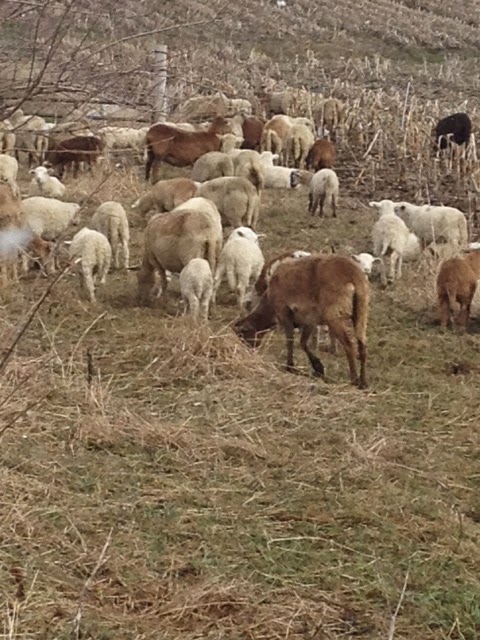
Jim and Ruth have a lot going on at the Graze-n-Grow. Ruth has a full blown greenhouse business selling flowers and vegetables, and she also raises chickens along with some geese and ducks. Jim has been raising Katahdin sheep for the past twelve years or so, having gone from wool sheep to this breed of hair sheep bred for their meat. Katahdin sounds ancient and from the Middle East doesn’t it? It’s not. As Jim Draper tells it a guy from Maine set out in the late 1950’s to develop a breed of sheep that had great meat characteristics with no need to bother with the wool. The market price for wool has been in the toilet for years, ever since Australia dumped its wool reserve, some twenty years of stockpiled wool pelts, on the international market. It’s never recovered. Jim recalled paying more to shear his wool sheep than the wool was worth. He wasn’t even breaking even by raising sheep. He wanted to keep raising them, sheep had been raised on that farm for years, but needed to find a new market, a new product, a new plan. After much research he sold his wool sheep and switched entirely to the new Katahdin breed.
Their name? Taken from the highest peak in Maine. Completely made up. Katahdin sheep are a cross of an African “hair sheep” which sheds its long fine wooly hair each spring, and several chunky wool breeds. After years of cross breeding they created a new stock of sheep that maintained the “hair” and bulked up on the “meat.” Hence Katahdin sheep, made to be eaten not shorn. Their coats are so fine you don’t even need to cut off their tails like wool sheep. They do not need shearing. And they’re rugged. Jim, and most Katahdin breeders, feed them on nothing but hay in the winter and green pasture grass as long as it lasts. No grain needed. Also unnecessary are vaccines or hormones. Jim pays very few veterinarian bills. His Katahdin sheep are ruminants eating grass as their body was designed. Purely grass fed, like all lamb used to be. My daughter calls that moving forward by going back.
Jim and Ruth’s challenge was finding a market for their new sheep. They found it rather quickly among the Muslim population in the Quad Cities. Jim realizes three fourths of his revenue from lamb sales around one Muslim holiday, Eid El Adha, the Festival of the Sacrifice at the end of the Hadj, or pilgrimage to Mecca. It’s an interesting observance, and one that revolves around families sacrificing an animal and distributing the meat. One third is to be eaten by the immediate family, another third given to extended family, acquaintances, and friends, and another third given to the poor. Millions of animals, goats and camels in addition to lambs and sheep, are sacrificed throughout the Muslim world on Eid El Adha. And Jim Draper and his Katahdin sheep found their way into it.
If you are Christian or Jewish you know the scripture on which this holiday is based. Jim and Ruth Draper knew it too. As we talked to them at their kitchen table I couldn’t help but notice a well worn Christian Bible next to the salt and pepper shakers. Eid El Adha is based on the Genesis story of Abraham, the humble servant of a God who tested his faith by commanding him to kill then burn his son Isaac on a pyre of sticks on a mountain. I’m quite sure our English language Bibles have lost much in the translation. If that were happening today the exchange between Abraham and God would go something like this, beginning with Abe hearing God’s command.
“You want me, an old man of 99, to kill my son Isaac, born to my wife Sarah miraculously at age 90, our only son whom we love.” His other child, Isaac’s older half brother, was born to Abe and Sarah’s Egyptian household servant Hagar. It was Sarah, then unable to bear children, who came up with the idea to create an heir to Abraham by having her husband Abe sleep with the servant. That child was named Ishmael. But back to God, Abraham, and Isaac.
“That’s right Abraham. I want you to sacrifice Isaac.”
“You have got to be kidding.”
“I‘m not.”
Abraham, as we learn, is a faithful God fearing guy. And so he takes Isaac up the mountain. Isaac is confused. He asks his Dad, “We have fire, and wood, but where is the lamb for a burnt offering?”
“God will provide it,” his Dad answers.
When they came to the sacrificial site they built an altar with the wood, but then, presto change, Abe ties Isaac up and lays him on the pile of wood. He raises his knife to kill him as God commanded. The Bible version I’m reading doesn’t note Isaac’s words or reaction to his Dad getting ready to kill him but surely he would have said something and if he did it would have no doubt recorded this:
“Jesus Christ, Dad. What is wrong with you?” No, wait. He wouldn’t have said Jesus Christ. Jesus doesn’t show up for another thousand years. But he might have said.
“Good God, have you gone crazy?”
Now that’s a valid question. Luckily, before Abe’s arm, attached to the hand that holds the knife that is about to kill his son, descends downward in a fatal blow God speaks to Abe. Imagine a big voice booming down from the sky. God wouldn’t have a small voice would he?
“Don’t lay a hand on the lad. For now I know you fear me, because you didn’t withhold your son from me.”
Abe stops, the knife in mid air. Just then he looks up and sees a ram whose horns are caught in a bush. He unties Isaac and they sacrifice the ram, much to Isaac’s relief I’m sure. I’m not ambitious enough to read on and find out what happened to Isaac, but it is hard for me to believe he ever felt the same about God, or his Dad, after that experience. But you know the Bible, anything can happen.
And so that story, told orally for years before it was written down, became part of the Jewish Torah, the Christian Old testament, and also the Koran, sacred scripture of the Islamic world. I learned that basic fact from traveling in North Africa in the seventies. All three faiths share the Old testament as scripture. As my Moroccan friend Najib once explained over tea in a busy Rabat street café, the stories that make up each religion’s earliest writings are not that different.
“We got Moise, you call him Moses. We got Noah and Ibrahim, you call him Abraham. We even have Jonah, the man who lived inside the big fish.”
Can’t you almost see those ancient people, somewhere in the desert in a tent, sitting around a fire listening to an old man tell the story of a faithful man about to sacrifice his son? It’s a compelling story, a good one with all the elements; suspense, violence, and in the end redemption. Like all good stories you don’t want them to go to waste. Everybody apparently used that story and wrote it down when writing became common. The Muslims though put a twist on their version of the story.
In the Koran it’s not Isaac being sacrificed but Ishmael. Ishmael is an important figure in Islam. He is regarded as a prophet and an ancestor to Muhammad. Ishmael is credited with later designing and the Kabba in Mecca, Islam’s most holy site. I didn’t learn this from researching the Koran. Jim Draper told me. He has learned it from his customers seeking sacrificial lambs.
“Yep, their story is just about the same as ours, excepting for the change in characters there, from Isaac to Ishmael. They put their important person in their story. We got our version and they got theirs. And must be that their book, the Koran, talks in more detail about the ram, because they come here in the fall wanting a ram without blemish. And they like them with horns. I can charge more if they have horns. Except if a horn is broken, or the animal is scarred in some way, they don’t want them. And they don’t want them castrated. I used to castrate the bucks, because they gain weight better, but they want them intact. So I don’t do anything to those lambs at all. And I’m telling you, with that holiday being in the fall, and the lambs just coming off summer pasture, that’s the perfect time to harvest my lambs. They’re heavy, their meat is still tender, and they are as natural as natural can be.”
“The other thing I do is let them practice their customs. Your really good Muslims, the devout ones, they are dead set on killing their own lamb themselves according to Halal. That’s like Kosher to the Jewish people. See when you sell a live animal to someone, they’re free to do with it what they want, and some people just load the live lamb up in their car or van or whatever and take it home to slaughter. But there’s been problems with that. Americans in cities don’t go much for families bleeding out a lamb and butchering it on the driveway or even the back yard for that matter. So I let them butcher here if they want. That’s important to them. They appreciate me for letting them carry out their religious traditions.”
“So where this, uh, killing done?”
“I let them use the back of the barn there. I got to say, it’s a very humane way to kill a sheep. In the small processing plants around here they just shoot them you know, a .22 to the head. In the larger plants they use an electric bolt, knocks them out, and then they hang them up and bleed them. But this Halal butchering, they call it zabihah, is slick. They pray before each animal is killed, making sure to use their God's name, Allah, during the slaughter. They use a very sharp knife, slitting the throat with a long cut that opens all the arteries, so the sheep bleeds out quick. The animal can’t be unconscious, but they make sure the lamb is quiet. They bleed so fast that they simply fade out from blood loss peaceful like. After they make the cut they hang them and let them bleed out completely. They don’t save the blood for nothing. And they make sure a religious person does the slaughter. Usually the husband does it, but some of them are queasy about it and let their wives. But I have to say it’s done tastefully. I kind of like the way they pray and give thanks. We do that when we eat, they do it long before they even cook as well.”
My son Dean was interested in Jim’s story. He has traveled to Morocco also and remembers the sheep and goat heads hanging in the souks or markets, used mainly for soup. He was both surprised and pleased to find a Midwestern farmer was so knowledgeable of another culture.
“I bet you never knew anyone that was Muslim growing up here,” Dean said.
“Heck no,” Jim said. “I’ve lived here all my life. We got Lutherans and Methodists, Catholics and Baptists, some other groups. But Muslims? Wasn’t till I started selling these meat sheep I ever met one.”
“So how you getting along with your Muslim customers?” Dean asked.
“You know, they’re like everyone else. Some of them are nice as can be, and some are hard to deal with. I used to have problems with them wanting to barter. Must be a custom in their countries. I have a set price and don’t like to dicker. Most of my advertising now is word of mouth between families and friends, and they like the taste of my lambs. They’re pretty much selling themselves. I got lots of repeat customers and for the most part they don’t argue about the cost anymore.”
“I like the Moroccans best. They’re more the working class regular people. There’s this Indian guy, maybe Pakistani, he’s got more money than most I think. He’s into the medical field somehow. Now he’s dang hard to deal with. But you know, they’re good people. They’re trying to keep up their traditions and do right like they were taught. I respect that.”
“You should go to Morocco,” my son said. “You’d love it.”
“That’s what they tell me. They offer to put me and Ruth up with their relatives over there. But Ruth and I, we’re pretty busy here. The sheep need looking after. It’s pretty much full time and year round.”
I liked Jim a lot. Not only because he wore Dickie’s bib overalls with patches on the knees but also because he was the kind of farmer I grew up with; smart, inquisitive, always trying to make his farm better, looking for new ways to make a honest living. If we can repurpose the small farms around here to filling a need or desire for good food raised in a sustainable way I’m all for it.
Jim asked Dean and I about our experiences travelling. We must have talked for an hour. He gave us a tour of Ruth’s well ordered greenhouses. She was meticulously taking tiny sprouts from the smallest of trays and pushing them into bigger flats where they could grown to be plants ready for sale. Their big day is Mother’s day. Though it was a cold and windy morning, with snow on the ground, it was hot inside the plastic hoop house. Grass fed lambs and plants grown from seed. There’s something nice about that combination.
As we went to our car Jim asked us to let him know how the people at my church liked his lamb. I promised to tell him. There are lots worse things you can do on a Tuesday morning than pay a visit to a local farm. It’s good to know there are people in the world changing themselves and their surroundings for the better and learning to accept people different than them.
So whatever your traditions, whatever stories you’ve been told to believe as if they were true, enjoy this Easter weekend. There’s something about it that makes the world new.
My daughter, a food scientist who continues to teach me new things about what I eat, sent me a link to an article about spring lamb that suggested we North Americans choose another meat for Easter as local spring lambs are just not big enough for slaughter and consumption during the spring holiday. It stated that if you purchase fresh spring lamb it will no doubt be a fully grown fall lamb from New Zealand or Australia shipped in for the American Easter lamb market. That made sense to me. We raised sheep on our dairy farm and those lambs born in the cold of January would just be getting to twenty pounds or so by March or April. We raised sheep, and shipped them to the sale barn for slaughter, but never ate a mouthful of their meat. I once asked my Dad why we didn’t eat the sheep like we did the cows and chickens.
“City people eat lamb and mutton,” he said. “We don’t.” And that was that.
I didn’t eat mutton, the meat of an adult sheep, or lamb till I traveled through North Africa where lamb and goat were the primary meat. I liked it then and have been eating it at every opportunity since. Having been recently educated by my daughter on the whole movement of farm to table going on in the hip restaurants she and my son take their Mom and Dad to, in order to both spend time with their parents and pick up the check, I was on the lookout for a local grass fed animal, and remembered some years back driving past a pasture on Route 80 somewhere between Princeton and Geneseo that had a hand painted sign on an old farm wagon that said “Easter Lamb” with a phone number. That’s all I started with. I began Googling lamb+(the names of towns along that stretch of Route 80). I got lucky with lamb+Sheffield. I was directed to Graze-n-Grow Farm, just East of Sheffield, where I met Jim and Ruth Draper.
Jim and Ruth have a lot going on at the Graze-n-Grow. Ruth has a full blown greenhouse business selling flowers and vegetables, and she also raises chickens along with some geese and ducks. Jim has been raising Katahdin sheep for the past twelve years or so, having gone from wool sheep to this breed of hair sheep bred for their meat. Katahdin sounds ancient and from the Middle East doesn’t it? It’s not. As Jim Draper tells it a guy from Maine set out in the late 1950’s to develop a breed of sheep that had great meat characteristics with no need to bother with the wool. The market price for wool has been in the toilet for years, ever since Australia dumped its wool reserve, some twenty years of stockpiled wool pelts, on the international market. It’s never recovered. Jim recalled paying more to shear his wool sheep than the wool was worth. He wasn’t even breaking even by raising sheep. He wanted to keep raising them, sheep had been raised on that farm for years, but needed to find a new market, a new product, a new plan. After much research he sold his wool sheep and switched entirely to the new Katahdin breed.
Their name? Taken from the highest peak in Maine. Completely made up. Katahdin sheep are a cross of an African “hair sheep” which sheds its long fine wooly hair each spring, and several chunky wool breeds. After years of cross breeding they created a new stock of sheep that maintained the “hair” and bulked up on the “meat.” Hence Katahdin sheep, made to be eaten not shorn. Their coats are so fine you don’t even need to cut off their tails like wool sheep. They do not need shearing. And they’re rugged. Jim, and most Katahdin breeders, feed them on nothing but hay in the winter and green pasture grass as long as it lasts. No grain needed. Also unnecessary are vaccines or hormones. Jim pays very few veterinarian bills. His Katahdin sheep are ruminants eating grass as their body was designed. Purely grass fed, like all lamb used to be. My daughter calls that moving forward by going back.
Jim and Ruth’s challenge was finding a market for their new sheep. They found it rather quickly among the Muslim population in the Quad Cities. Jim realizes three fourths of his revenue from lamb sales around one Muslim holiday, Eid El Adha, the Festival of the Sacrifice at the end of the Hadj, or pilgrimage to Mecca. It’s an interesting observance, and one that revolves around families sacrificing an animal and distributing the meat. One third is to be eaten by the immediate family, another third given to extended family, acquaintances, and friends, and another third given to the poor. Millions of animals, goats and camels in addition to lambs and sheep, are sacrificed throughout the Muslim world on Eid El Adha. And Jim Draper and his Katahdin sheep found their way into it.
If you are Christian or Jewish you know the scripture on which this holiday is based. Jim and Ruth Draper knew it too. As we talked to them at their kitchen table I couldn’t help but notice a well worn Christian Bible next to the salt and pepper shakers. Eid El Adha is based on the Genesis story of Abraham, the humble servant of a God who tested his faith by commanding him to kill then burn his son Isaac on a pyre of sticks on a mountain. I’m quite sure our English language Bibles have lost much in the translation. If that were happening today the exchange between Abraham and God would go something like this, beginning with Abe hearing God’s command.
“You want me, an old man of 99, to kill my son Isaac, born to my wife Sarah miraculously at age 90, our only son whom we love.” His other child, Isaac’s older half brother, was born to Abe and Sarah’s Egyptian household servant Hagar. It was Sarah, then unable to bear children, who came up with the idea to create an heir to Abraham by having her husband Abe sleep with the servant. That child was named Ishmael. But back to God, Abraham, and Isaac.
“That’s right Abraham. I want you to sacrifice Isaac.”
“You have got to be kidding.”
“I‘m not.”
Abraham, as we learn, is a faithful God fearing guy. And so he takes Isaac up the mountain. Isaac is confused. He asks his Dad, “We have fire, and wood, but where is the lamb for a burnt offering?”
“God will provide it,” his Dad answers.
When they came to the sacrificial site they built an altar with the wood, but then, presto change, Abe ties Isaac up and lays him on the pile of wood. He raises his knife to kill him as God commanded. The Bible version I’m reading doesn’t note Isaac’s words or reaction to his Dad getting ready to kill him but surely he would have said something and if he did it would have no doubt recorded this:
“Jesus Christ, Dad. What is wrong with you?” No, wait. He wouldn’t have said Jesus Christ. Jesus doesn’t show up for another thousand years. But he might have said.
“Good God, have you gone crazy?”
Now that’s a valid question. Luckily, before Abe’s arm, attached to the hand that holds the knife that is about to kill his son, descends downward in a fatal blow God speaks to Abe. Imagine a big voice booming down from the sky. God wouldn’t have a small voice would he?
“Don’t lay a hand on the lad. For now I know you fear me, because you didn’t withhold your son from me.”
Abe stops, the knife in mid air. Just then he looks up and sees a ram whose horns are caught in a bush. He unties Isaac and they sacrifice the ram, much to Isaac’s relief I’m sure. I’m not ambitious enough to read on and find out what happened to Isaac, but it is hard for me to believe he ever felt the same about God, or his Dad, after that experience. But you know the Bible, anything can happen.
And so that story, told orally for years before it was written down, became part of the Jewish Torah, the Christian Old testament, and also the Koran, sacred scripture of the Islamic world. I learned that basic fact from traveling in North Africa in the seventies. All three faiths share the Old testament as scripture. As my Moroccan friend Najib once explained over tea in a busy Rabat street café, the stories that make up each religion’s earliest writings are not that different.
“We got Moise, you call him Moses. We got Noah and Ibrahim, you call him Abraham. We even have Jonah, the man who lived inside the big fish.”
Can’t you almost see those ancient people, somewhere in the desert in a tent, sitting around a fire listening to an old man tell the story of a faithful man about to sacrifice his son? It’s a compelling story, a good one with all the elements; suspense, violence, and in the end redemption. Like all good stories you don’t want them to go to waste. Everybody apparently used that story and wrote it down when writing became common. The Muslims though put a twist on their version of the story.
In the Koran it’s not Isaac being sacrificed but Ishmael. Ishmael is an important figure in Islam. He is regarded as a prophet and an ancestor to Muhammad. Ishmael is credited with later designing and the Kabba in Mecca, Islam’s most holy site. I didn’t learn this from researching the Koran. Jim Draper told me. He has learned it from his customers seeking sacrificial lambs.
“Yep, their story is just about the same as ours, excepting for the change in characters there, from Isaac to Ishmael. They put their important person in their story. We got our version and they got theirs. And must be that their book, the Koran, talks in more detail about the ram, because they come here in the fall wanting a ram without blemish. And they like them with horns. I can charge more if they have horns. Except if a horn is broken, or the animal is scarred in some way, they don’t want them. And they don’t want them castrated. I used to castrate the bucks, because they gain weight better, but they want them intact. So I don’t do anything to those lambs at all. And I’m telling you, with that holiday being in the fall, and the lambs just coming off summer pasture, that’s the perfect time to harvest my lambs. They’re heavy, their meat is still tender, and they are as natural as natural can be.”
“The other thing I do is let them practice their customs. Your really good Muslims, the devout ones, they are dead set on killing their own lamb themselves according to Halal. That’s like Kosher to the Jewish people. See when you sell a live animal to someone, they’re free to do with it what they want, and some people just load the live lamb up in their car or van or whatever and take it home to slaughter. But there’s been problems with that. Americans in cities don’t go much for families bleeding out a lamb and butchering it on the driveway or even the back yard for that matter. So I let them butcher here if they want. That’s important to them. They appreciate me for letting them carry out their religious traditions.”
“So where this, uh, killing done?”
“I let them use the back of the barn there. I got to say, it’s a very humane way to kill a sheep. In the small processing plants around here they just shoot them you know, a .22 to the head. In the larger plants they use an electric bolt, knocks them out, and then they hang them up and bleed them. But this Halal butchering, they call it zabihah, is slick. They pray before each animal is killed, making sure to use their God's name, Allah, during the slaughter. They use a very sharp knife, slitting the throat with a long cut that opens all the arteries, so the sheep bleeds out quick. The animal can’t be unconscious, but they make sure the lamb is quiet. They bleed so fast that they simply fade out from blood loss peaceful like. After they make the cut they hang them and let them bleed out completely. They don’t save the blood for nothing. And they make sure a religious person does the slaughter. Usually the husband does it, but some of them are queasy about it and let their wives. But I have to say it’s done tastefully. I kind of like the way they pray and give thanks. We do that when we eat, they do it long before they even cook as well.”
My son Dean was interested in Jim’s story. He has traveled to Morocco also and remembers the sheep and goat heads hanging in the souks or markets, used mainly for soup. He was both surprised and pleased to find a Midwestern farmer was so knowledgeable of another culture.
“I bet you never knew anyone that was Muslim growing up here,” Dean said.
“Heck no,” Jim said. “I’ve lived here all my life. We got Lutherans and Methodists, Catholics and Baptists, some other groups. But Muslims? Wasn’t till I started selling these meat sheep I ever met one.”
“So how you getting along with your Muslim customers?” Dean asked.
“You know, they’re like everyone else. Some of them are nice as can be, and some are hard to deal with. I used to have problems with them wanting to barter. Must be a custom in their countries. I have a set price and don’t like to dicker. Most of my advertising now is word of mouth between families and friends, and they like the taste of my lambs. They’re pretty much selling themselves. I got lots of repeat customers and for the most part they don’t argue about the cost anymore.”
“I like the Moroccans best. They’re more the working class regular people. There’s this Indian guy, maybe Pakistani, he’s got more money than most I think. He’s into the medical field somehow. Now he’s dang hard to deal with. But you know, they’re good people. They’re trying to keep up their traditions and do right like they were taught. I respect that.”
“You should go to Morocco,” my son said. “You’d love it.”
“That’s what they tell me. They offer to put me and Ruth up with their relatives over there. But Ruth and I, we’re pretty busy here. The sheep need looking after. It’s pretty much full time and year round.”
I liked Jim a lot. Not only because he wore Dickie’s bib overalls with patches on the knees but also because he was the kind of farmer I grew up with; smart, inquisitive, always trying to make his farm better, looking for new ways to make a honest living. If we can repurpose the small farms around here to filling a need or desire for good food raised in a sustainable way I’m all for it.
Jim asked Dean and I about our experiences travelling. We must have talked for an hour. He gave us a tour of Ruth’s well ordered greenhouses. She was meticulously taking tiny sprouts from the smallest of trays and pushing them into bigger flats where they could grown to be plants ready for sale. Their big day is Mother’s day. Though it was a cold and windy morning, with snow on the ground, it was hot inside the plastic hoop house. Grass fed lambs and plants grown from seed. There’s something nice about that combination.
As we went to our car Jim asked us to let him know how the people at my church liked his lamb. I promised to tell him. There are lots worse things you can do on a Tuesday morning than pay a visit to a local farm. It’s good to know there are people in the world changing themselves and their surroundings for the better and learning to accept people different than them.
So whatever your traditions, whatever stories you’ve been told to believe as if they were true, enjoy this Easter weekend. There’s something about it that makes the world new.
Thursday, April 10, 2014
Independent Living
There is a Trailways bus that takes off from Burlington, Iowa every morning of the week heading east. It stops in towns along Interstate 80 before arriving at the bus station in downtown Chicago. You can get on the bus in Ottawa at the Dunkin Donuts in front of the North side Kroger at 4:30 a.m.. Dunkin Donuts is open twenty four hours a day so you can wait inside, with or without a donut, if it’s cold or rainy.
You pretty much have to buy bus tickets on line these days with a credit card and print them out. Of course, by getting on this bus you can travel on past Chicago. From there you can go anywhere. Remember my young friend, the one I bailed out of jail on a cold night around the new year and helped get a social security card and State ID? He got on that bus Saturday morning. With any luck he arrived in a good town near the West coast Monday afternoon. For him it’s a fresh start. A clean slate. My young friend got on the bus with little but a paid ticket and an old friend to stay with at the other end of the line. Some may call that ill prepared but from where he started it’s not bad.
I think there is nothing sweeter in life than a fresh start. Some say it’s a God send. I think all of us need a clean slate at least once as we make our way through the years. Maybe more than once. But we can’t expect too many. It was the immortal and astute Muddy Waters, I believe, who once said:
Every dog has its day.
If you’re a real good dog you might get two days.
Given the pain of completely leaving a community, a group of friends, perhaps family; walking away from those we love or who once loved us, to say nothing of abandoning habits and routines we rely on, know so well, and are so comforted by, it’s amazing anyone deliberately makes major life changes. But we do. We do amazing things-cross borders, brave deserts, sail oceans, risking everything to strike out on our own to escape our lives as they are. My young friend’s break was less dramatic. He simply set out across the country to find a job, keep a roof over his head, stay out of jail, and experience life as an adult not dependent on anyone else. All he had to do, on the surface anyway, was get on a bus. The hard part would come soon enough.
He talked about leaving with anticipation over and over this winter. I helped him put together a plan that included steps needed to make it happen. He followed those steps. When we talked calmly, at breakfast usually, he knew he had to go. He knew it was the best thing. He isn’t dumb, and he can see his personal reality clearly at times. Yet like all of us he has to balance reason with emotion. And for him, emotion wins much of the time. At the very end he broke down. He left during a crisis. He was beaten up and beaten down. But he managed to leave in spite of all his fears.
“I’ve taken long bus trips,” I told him, “and there’s nothing better than looking out a big window at the countryside going by for two days or so. Gives you a chance to sort out where you’ve been and figure out where you’re going. Hopefully somewhere in Colorado, which is about halfway, you’ll turn the page on Ottawa and start looking ahead to that new town out west.”
Traveling alone gives us a chance to look at our life closely. No one knows you out there. There is no one to remind you of past faults and weaknesses. At those times, short moments really in the scope of a whole life, we escape our past. Over the winter he slowly shared some of that past with me, though I’m sure not all of it. We shouldn’t require that of each other anyway; absolute full disclosure of regrets and fears, weaknesses and mistakes. Well perhaps to one other human being. I didn’t want to be that human being for my friend. I just wanted to help him get through this time in his life. No matter who ends up really knowing us, if anyone, it is more important I think to see ourselves for who we are, to look at ourselves honestly, in order to both celebrate the beauty and face the ugliness we discover in there.
I tried to help my young friend by talking to him. I made observations, thought about what he said, tried to explain simply how his life looked to me, and how he might expect to be seen by others. I hope some of that helped. In the end though, I could only make arrangements.
I gave him rides, encouraged him, reassured him, and bought him food. As so often happens, it was his family that put the money together to finance his trip. He’s lived through more than his share of pain and brought pain to others in arguable proportion. He has plenty of critics. What is in short supply are people who support him. Not that it matters much now. His past can’t be changed. It’s the future that’s matters. It is the choices he makes next, and not forgetting that life is long and anything is possible.
On the short drive to Dunkin Donuts at 4:15 in the morning we joked about the secret of life. I told him my version and he laughed, which made me laugh back. I would tell it to you here but it’s a secret, which is why they call it the secret of life. If we run into each other you ask I’ll tell it to you, but then you have to keep it to yourself as well.
He was tired but in good spirits; weepy but optimistic, if those things go together. I think they can. Under the bus, in the luggage compartment, was a single suitcase worn out from too many trips of mine. In a shopping bag he had five sandwiches, three big cookies, two pops, two bottles of water, and a book. In his pocket was cash and with it a cheap cell phone loaded with one month’s worth of minutes. That was everything he owned. As departure time neared the bus driver looked at his ticket and asked to see a picture ID. My young friend promptly pulled it from his wallet and showed it to the driver. I chuckled to myself. Few know how hard it was to accomplish that simple step of establishing his identity, something most of us so take for granted.
It was time to go. He gave me a big hug and I hugged him back. Yeah, he’s officially somebody now, with papers to prove it. He just has to figure who that’s going to be.
You pretty much have to buy bus tickets on line these days with a credit card and print them out. Of course, by getting on this bus you can travel on past Chicago. From there you can go anywhere. Remember my young friend, the one I bailed out of jail on a cold night around the new year and helped get a social security card and State ID? He got on that bus Saturday morning. With any luck he arrived in a good town near the West coast Monday afternoon. For him it’s a fresh start. A clean slate. My young friend got on the bus with little but a paid ticket and an old friend to stay with at the other end of the line. Some may call that ill prepared but from where he started it’s not bad.
I think there is nothing sweeter in life than a fresh start. Some say it’s a God send. I think all of us need a clean slate at least once as we make our way through the years. Maybe more than once. But we can’t expect too many. It was the immortal and astute Muddy Waters, I believe, who once said:
Every dog has its day.
If you’re a real good dog you might get two days.
Given the pain of completely leaving a community, a group of friends, perhaps family; walking away from those we love or who once loved us, to say nothing of abandoning habits and routines we rely on, know so well, and are so comforted by, it’s amazing anyone deliberately makes major life changes. But we do. We do amazing things-cross borders, brave deserts, sail oceans, risking everything to strike out on our own to escape our lives as they are. My young friend’s break was less dramatic. He simply set out across the country to find a job, keep a roof over his head, stay out of jail, and experience life as an adult not dependent on anyone else. All he had to do, on the surface anyway, was get on a bus. The hard part would come soon enough.
He talked about leaving with anticipation over and over this winter. I helped him put together a plan that included steps needed to make it happen. He followed those steps. When we talked calmly, at breakfast usually, he knew he had to go. He knew it was the best thing. He isn’t dumb, and he can see his personal reality clearly at times. Yet like all of us he has to balance reason with emotion. And for him, emotion wins much of the time. At the very end he broke down. He left during a crisis. He was beaten up and beaten down. But he managed to leave in spite of all his fears.
“I’ve taken long bus trips,” I told him, “and there’s nothing better than looking out a big window at the countryside going by for two days or so. Gives you a chance to sort out where you’ve been and figure out where you’re going. Hopefully somewhere in Colorado, which is about halfway, you’ll turn the page on Ottawa and start looking ahead to that new town out west.”
Traveling alone gives us a chance to look at our life closely. No one knows you out there. There is no one to remind you of past faults and weaknesses. At those times, short moments really in the scope of a whole life, we escape our past. Over the winter he slowly shared some of that past with me, though I’m sure not all of it. We shouldn’t require that of each other anyway; absolute full disclosure of regrets and fears, weaknesses and mistakes. Well perhaps to one other human being. I didn’t want to be that human being for my friend. I just wanted to help him get through this time in his life. No matter who ends up really knowing us, if anyone, it is more important I think to see ourselves for who we are, to look at ourselves honestly, in order to both celebrate the beauty and face the ugliness we discover in there.
I tried to help my young friend by talking to him. I made observations, thought about what he said, tried to explain simply how his life looked to me, and how he might expect to be seen by others. I hope some of that helped. In the end though, I could only make arrangements.
I gave him rides, encouraged him, reassured him, and bought him food. As so often happens, it was his family that put the money together to finance his trip. He’s lived through more than his share of pain and brought pain to others in arguable proportion. He has plenty of critics. What is in short supply are people who support him. Not that it matters much now. His past can’t be changed. It’s the future that’s matters. It is the choices he makes next, and not forgetting that life is long and anything is possible.
On the short drive to Dunkin Donuts at 4:15 in the morning we joked about the secret of life. I told him my version and he laughed, which made me laugh back. I would tell it to you here but it’s a secret, which is why they call it the secret of life. If we run into each other you ask I’ll tell it to you, but then you have to keep it to yourself as well.
He was tired but in good spirits; weepy but optimistic, if those things go together. I think they can. Under the bus, in the luggage compartment, was a single suitcase worn out from too many trips of mine. In a shopping bag he had five sandwiches, three big cookies, two pops, two bottles of water, and a book. In his pocket was cash and with it a cheap cell phone loaded with one month’s worth of minutes. That was everything he owned. As departure time neared the bus driver looked at his ticket and asked to see a picture ID. My young friend promptly pulled it from his wallet and showed it to the driver. I chuckled to myself. Few know how hard it was to accomplish that simple step of establishing his identity, something most of us so take for granted.
It was time to go. He gave me a big hug and I hugged him back. Yeah, he’s officially somebody now, with papers to prove it. He just has to figure who that’s going to be.
Subscribe to:
Posts (Atom)