Thursday, February 13, 2020

Hot Toddy 2020


I was reminded of this old post by a reader today and updated it.  Some posts, and recipes, are timeless.

Last Monday my nose started to run.  It became annoying.  As the day went on, I started sneezing.  I used more and more Kleenex, and my nose got red and raw.  Could be allergies I thought.

That night I didn’t sleep well, and Tuesday  I woke with the start of a sore throat.  By afternoon that sore throat was beyond just starting.  It hurt.  I started to cough. 

Wednesday my head cold had migrated to my chest.  I felt wheezy.  I knew then I officially had the crud.  I get it every winter it seems.  I get cocky sometimes and think I’ve beaten it, but I never do.  If its only one cold a year,that’s a triumph.  It’s to be expected, but I never expect it.  I feel victimized, singled out, unfortunate.  Some might say I get whiny, someone close to me.  I don’t think that’s the case.  I get sick is what I get, and nothing is more important than getting over it.

There are theories about the crud.  Some say our mild winter, which has so far lacked a hard and prolonged freeze, failed to kill these bugs that attack us.  I for one think nothing kills these bugs, they live among us and attack us in winter when we are most vulnerable.  We miss the sun, we’re halfway between Christmas and St. Patrick’s Day, stuck somewhere between red and green, and life sucks.  February, aside from Valentine’s day, sucks.  We’re sick of winter, life sucks, we get colds.  It’s the human condition for those of us who insist on living in Illinois throughout the winter.

But I for one refuse to despair because I have the cure for these damned colds.  Before there was Mucinex, before Nyquil and Dayquil, before Theraflu, and yes even before Vicks VapoRub, was the hot toddy.  And I have the recipe.  The Hot Toddy is not only ingredients and preparation, its attitude.  Colds suck, but hot toddies help us fight back.  Ironically when your spirits are down, the spirit(s) found in  the hot toddy will pick you up. 

Hot toddies are the tried and true treatment of colds and maladies of all kinds.  Before there was shrink wrap, TV advertising, and a reliance on pills and drugs to cure all our ills, hot toddies were relieving symptoms of cold and flu all across America.  Ingredients for this amazing remedy were commonly found in all households, save for those of tea totallers who helped America careen off the rails and into Prohibition in the 1930’s.  Here’s all it takes to be on the road to recovery via hot toddy, in this order.

Water-not much.  A quarter inch, and certainly less than a half an inch, in the bottom of a small saucepan is plenty.  A small saucepan mind you.  Maybe that little one you cook your oatmeal in.

Lemon-whatever you have, but preferably the juice of half a fresh lemon. Don’t worry about the seeds, and when you’re done squeezing toss the peel in the pan.

Honey-plenty. If your honey comes packed inside a plastic squeezable bear give yourself the amount of honey between his eyes and his mouth.  If it’s in a jar start with two tablespoons.

Cinnamon-if you have cinnamon sticks, little rolled up pieces of bark, throw in two.  If not, put in less than a teaspoon of ground.  Try to incorporate it into the honey so it doesn’t float on top.

Whiskey, or one of its brown cousins-this is the heart and soul of the hot toddy and deserves special attention.  After much experimentation I find a Kentucky bourbon of fairly high proof works best.  I’ve used both scotch and rye, and Bushmill’s Irish which comes in a close second, but for my palate it’s hard to beat the  Midwest America good stuff.  You don’t need to use your best sippin’ bourbon for this drink.  A bottle of good all-purpose inexpensive hard stuff works just fine. I’m partial to Old Grand Dad 100 proof.

Whatever you choose, or whatever you have, keep it on the counter, readily available, for the duration of your cold.  You might consider keeping a bottle on hand dedicated just for this medicinal purpose.  You never know when a cold may strike.  I plan to replace the bottle of Old Grand Dad that helped me beat my cold, perhaps adding one more to be safe, on my very next trip to Herman’s Liquor Store.

The brown cousins, brandy, cognac, and dark rum, though inferior in my opinion, are suitable replacements.  White rum, which you might consider appropriate, ruins the presentation.  It’s not right.  Hot toddies are brown.  That’s the way it goes.

Prepare as follows-Add enough whiskey or other brown spirits to the mixture in your saucepan to fill it half to three quarters full.  If it’s over ¾ full, that’s OK.  Light the burner, adjust the flame to somewhere between full on and half lit, and stir your toddy.  Get those cinnamon sticks twirling around on the bottom, swish the honey with the lemon, let the whiskey mix with the water, and watch as bubbles begin to form around the edge of the pan.

Get your nose close to the toddy.  This is part of the cure.  Get that nice boozy smell way up in your head.  It will help clear you up.  Under no circumstances allow your toddy mix to boil.  Boiling reduces the alcohol content, and that won’t do. Now taste.

·       If the lemon tastes too sour, add more whiskey.

·       If it seems a little watery, add more whiskey.

·       If you find the honey has made it too sweet, add more whiskey.

Come to think of it, any hot toddy problem is best solved by adding more whiskey.  Do this as you heat the toddy, as adding cold whiskey at the end reduces the temperature of your toddy which will result in a tepid toddy, rather than a hot one. 

Before it boils, but after it steams, turn the heat under your toddy mix off and ladle a generous portion of your newly created home remedy into a porcelain coffee cup rather than a glass.  The cup will keep your toddy hot, and not using a glass will prevent your spouse or other family members from visually monitoring your toddy consumption as the day goes on.  Don’t be surprised if it alarms them.  If confronted the proper response to expressions of concern, from a spouse or other loved one regarding the amount of hot toddy you are consuming is this:

“Who has this cold? You or me?” 

I suggest keeping the saucepan on the stove and adding various ingredients as needed so that you maintain a continuous supply of hot toddy at all times during the day.  If there was a dosage recommendation for hot toddy like those that come with manufactured products it would be “take liberally, as needed, until desired results are achieved.”

I began the hot toddy treatment Tuesday afternoon, continued it throughout the day on Wednesday, and by Thursday felt 100% better.  Taking a hot shower and getting dressed Thursday added to my recovery.  Sometimes you have to just soldier on. 

And there you go.  Stay warm. Winter will soon be over.  But if a cold strikes know that there is a home remedy at your disposal that promises to relieve your symptoms in a most enjoyable way.  Try the hot toddy.  You’ll like it.     

Wednesday, February 5, 2020

Dave's Still Here

I haven’t put out a blog in a month.  Not so.

For a very long time, I’ve sat on a book of farm stories.   Some of them were written a long time ago, when I was travelling.  I digitized them, brought them together in one Microsoft folder, and eventually put them into a single file.  Going out on a creative limb, I named the file Farm Stories, whole thing.  I’ve never found a title.  I managed a table of contents though.


Ten years ago, I sent a few farm stories to people close to me, mostly family and a few close friends.  One was “Shelling Corn.”  Another was “Christmas on the Farm.”  To a very few I sent a story called “Trust.”  They urged me to write more stories like them.  My nephew said something that sparked my interest.

“When I read your stories,” he said, “I can hear your voice.”

 I wasn’t sure what that meant but it seemed positive. 

I added stories, rewrote some, put them in some vague order.  Three years ago, I sent them out to a wider audience, maybe a dozen Alpha readers, which included both friends and acquaintances.  Some were people from my childhood I’d found on Face Book and not talked to in many years.  In addition to them I shared the stories with people that had no connection to farming or my early days in Central Illinois.

I found my former English teacher, who accepted the assignment gladly and made individual comments on each story.  I felt a little like she was grading my paper.  One of the Alpha readers tried to categorize them into farm stories and family stories.  They read my stories and gave them real thought.  I was amazed in a way.

I have always had feedback on my blog, most of it immediate, but this was different.  They read over 90,000 of my words and communicated in a thoughtful and helpful way.  That’s a wonderful thing to do for a writer.  It helped me a lot.

But still I concentrated mainly on my blog.  The book was put on the digital shelf.  But as an old psalmist once wrote, “who knows from whence cometh our help?”  Sometimes assistance bubbles up from unexpected sources.

I made a friend at church who was new to town.  He lived most of his life in or near diverse and vital cities before relocating here.  To adapt to small town life, he tries to recreate some of the things he experienced in cities and misses.

He had been part of a group on the West Coast who met regularly and listened to each other’s poetry read aloud, either original or admired.  He pitched the idea to our church, Open Table in Ottawa, and they agreed to let it happen monthly in their space. 

From that monthly group of poetry enthusiasts a group of regulars formed.  The regulars, which included me, became so comfortable talking and listening to each other, that this conversation occurred.

“I enjoyed your last blog.”

“I’m glad you did.  What was it about?”

“You were talking to the Republican guy in the BBQ joint in Alabama.”

“Yeah.  That was a fun one to write.  I was afraid it was too long.  Too political.”

“No, it was good.  The dialogue worked well.”

“Thanks.”  

“How many blogs do you think you’ve written?”

“A lot.  I started writing them years before I retired, but those were about the agency.  I first sent the blog to board members, then donors, and later staff and referral sources.  It grew.  Started in the early 2000’s I’d say.  Used to do it weekly without fail.  In fact, that’s one of the reasons I retired.  The blog was all I wanted to do.”

“So more than ten years?”

“Oh yeah.  Probably.”

“That’s too bad.”

“Why do you say that?”

“When there is a lot of stuff to go through, a lot of material to consider, it bogs people down. Overwhelms them.  Rereading and grouping old pieces together is not like working on the same book draft every day.  Your thoughts jump around, unless you confine yourself to a narrow topic.  Do you have a fairly narrow focus to your blog?”

“No.  Not at all.  When people ask me what my blog is about I say, “Whatever I want.”

“But you might think about publishing anyway.  I think your voice is strong.”

“What do you mean "voice"?  I’ve heard that before and I don’t exactly know what it means. “

“Hard to explain, but its something like authenticity.  Believability.  Think of reading Mike Royko.  Were you around for Royko?”

“Sure I was.”

“You didn’t even have to look at the byline to know you were reading Royko.  It was the way he used words.  Made sentences.  It was like putting his handwritten signature on the page even though it was a standard commercial font.  It made you comfortable, like a pleasant voice does.”

“I see.”

There was a pause.

“I’ve never pulled out blog posts and tried to group them together in a coherent way, but I do have a collection of old farm stories.”

“Why farm stories?”

“I grew up on a farm.  Dairy farm.  On Route 9 between Bloomington and Pekin.  Went to a tiny school in a small town.  The first story is an early memory at age four and the last is me leaving the farm for college and not looking back.”

“Boyhood story then.  Takes place on a farm.”

“Yeah, I guess, if you put it that away.  But a collection of stories.  Not a book.”

“Would you share it with me?”

“It’s long.  Somewhere over 90,000 words”

“That’s all right.  I don’t care.”

“Sure.  I’ll send it.”

That’s how stuff happens.  You talk to someone. Listen.  Make a connection.  Offer an idea.  It’s simple really.

The person who agreed to read my stories was first accepted by a publisher in 2006.  Several books of poetry and two novels later, she knows what it takes to get published. 

I don’t.  I’ve been silently trying to plot some course toward that goal ever since the first day I retired.  Silently is the key word in that sentence.  I read articles on writing and publishing.  Signed up for digital discussion groups with emerging authors.  It got me nowhere.  Why do we think we can do things on our own without real and tangible help from other people?  How often does that happen?

Read the dedication pages of books.  Honest authors thank a whole list of people.  It takes a village to raise a child and that same village is required, I think, to get one of its member’s written thoughts distributed to a wider public.  I’ve barely admitted publishing was a goal and talked to very few people about it.  It was like a hope I dared not mention lest it break into a thousand pieces.  Who knows why we think the way we do?

She told me she thought what I sent her was good.  She not only read it she began to edit it.  Together we rearranged the stories.  We cut stuff.  We thought some threads needed to be expanded, and some themes better developed.  We asked and answered questions of each other over email.

One of my  questions to her was this.  “Instead of a book of stories, do you think these might be chapters in a book?”

She responded right away. “I’ve been hoping you’d see them as chapters.  If you think that way, you will change your approach.  To me, your book is a memoir, a coming of age story of a boy who experiences the world through the people and animals on his family’s small farm, and the community around it.  Each chapter advances his learning, gets him closer to maturity, and prepares him for the day he leaves.  If you concentrate on it as a book, each chapter will advance that theme.”

I’m on my fifth draft.  Each draft requires less changes.  I’ve drafted an author blurb and a blurb about the book.  We’re getting closer.  The next big step is submission to publishers.

So that’s what I’ve been doing instead of blogging.  I’ll try to talk to you more often.

Tuesday, January 7, 2020

Fooling Around


I woke up early December 10th to a dark twelve-degree morning.  Before my thoughts turned to the present, I remembered how bright the moon was during the night and recalled, ever so briefly, the tail end of a vivid, colorful dream.

Sadly, mundane thoughts of the new day chased my dream away and it is now lost forever.  What was more important than my dream?  My regret at not cutting firewood the day before when it was warm.

Cold dominated my thoughts.  I thought of where to find my chopper mittens, my cold weather hat (a Stormy Kromer), and a warmer scarf.  At the same time, I imagined keeping the cold chill of the shack off my coffee.   It’s one small room heated by a small wood stove.  Sunrise is a treat in the shack because it has an east facing glass wall overlooking a deep ravine.  I didn’t want to miss the show, but it was going to be damned cold during the first twenty minutes of my arrival. 

I put bread in the toaster, got apple butter from the fridge, and poured myself a glass of milk.    

I ground dark roast coffee beans, filled the basket of a small stovetop Bialetti coffee maker, put it on a burner, and lit the gas.  Espresso would soon begin brewing in that odd upside-down machine.  I looked for my thermos, but it was nowhere to be found.  Then I remembered.  I could see it plain as day sitting in the shack on my desk where I’d left it the day before.  I hate it when that happens.  It creates a rough spot in an otherwise smooth morning.

I found my coat and warm weather hat where I had left them and headed out the back door.  It’s a quick trip to the shack and back.  The stainless-steel thermos, right where I thought it would be, was freezing.  So was my hand holding it as I carried it back to the house.

The espresso would be piping hot.  Putting it in an ice-cold thermos would defeat the purpose, so I microwaved a big tumbler of water (hot water takes forever to make the trip from the basement water heater to our kitchen faucet). 

As the microwave whirred and did its mysterious thing to the water, the Bialetti began to burble. So that it would not boil and make the fresh brew bitter, I turned the burner off.  Next, I poured the now hot water from the tumbler into the thermos to warm it so it wouldn’t draw heat from the espresso.

I waited.  While I did, I had breakfast and worked on the Chicago Tribune crossword puzzle. 

Sometime after the answer to the clue for 50 across “The Good Earth mother” leapt magically into my brain (Olan), it dawned on me (pun intended) that I was playing a zero-sum game.  As my thermos was warming up, my espresso was cooling down.  Success sometimes seems impossible.

What was the optimum time to end those opposite dynamics of cooling and warming for the hottest possible coffee?  I wasn’t going to know with any certainty, and I damned well wasn’t going to waste more time thinking about it.

I found my Stormy Kromer hat on the opposite end of a shelf where my chopper mittens were hiding.  I found the wool scarf I pictured on a hanger in the closet where it I thought it would be.  I went back to the kitchen.  There I dumped the hot water from the thermos, poured in the espresso, and added two sugar cubes.  After putting on my newly assembled cold weather gear, I headed back through the cold, hot coffee in hand, to the shack and the coming dawn.


It was time to put an end to those mundane thoughts and get on with my day.  There’s only so much fooling around you should do before beginning to write.

Monday, December 23, 2019

Santa at the Lodi


I dropped into the Lodi Tap House in Utica on Saturday, the winter solstice, and grabbed a stool at the bar.  It was crowded.  Lodi’s used to be Duffy’s, a revered Irish bar and an institution among Illinois Valley drinkers and St. Paddy’s day revelers.  I’d gone to Duffy’s for 45 years, back when the standard order at the bar was a shot of Kesslers and Miller High Life.

When it was sold, and the new owners revealed plans to scrap the Irish deal and create a modern style brew pub ala Chicago, I thought I’d never again enjoy spending time in that old odd shaped building.  But Lodi brought in an unbelievably large selection of beer and ales on tap, 24 that night, and 90 more draft beers in cans and bottles.  The choices are dizzying.  That doesn’t even count the liquor and cocktails.  On top of that are award winning burgers.  It’s a whole new deal for downtown Utica.  I got used to it, though grudgingly.     

There were only two stools open and one had a shot and a beer sitting in front of it and some money.  That’s a local custom, leave your money on the bar and let the bartender take it as you drink.

There was a guy making his way down the bar, talking to everyone it seemed, before he eventually sat down next to me.   He looked familiar.

Under a flat wool tweed cap, he had white hair and a big beard to match.  He was wearing blue jeans, a green flannel shirt, and a black vest.  He stared forward, the way guys in bars do, looking at himself in the wide bar length mirror, scanning the bottles, and the blackboard that explained the day’s line up of draft beer and ale.  He wasn’t paying much attention to me, but something about him nagged me.  I know I’d seen him before.

“Sorry to bother you but you look familiar.”

He spoke without turning his head.

“Do you think you can keep your voice down McClure?  Not draw attention to us?  It’s Santa Claus.  I’m out of uniform and taking a break.”

“Santa Claus!”  I tried to whisper but admit I was still a bit loud.  “What are you doing?  Undercover Santa?"  

“You’re doing exactly what I don’t want you to do.  Don’t call me Santa.  Just look ahead and be cool.  I don’t want to draw attention. Let me buy you a shot.  What’ll you have?”

“Bushmill’s Irish whiskey.  Black Bush if they have it.”

“Good choice.”

He ordered us both one.  I toned down my voice, looked at him in the mirror, where he was looking back at me and raised my glass.

“Merry Christmas Nick.”

He winked at me.

“I can call you Nick, right?”

“That works just fine.  Merry Christmas to you too Dave.”

And so, in the hubbub of Christmas week on the shortest day of the year in an old bar made new in a small town along the Illinois River, Nick and I had a quiet conversation.

“It seems like we run into each other every year, but this time I thought I was going to miss you. What brings you back here Nick?  You must get requests for personal appearances from all over the world.  You end up in Utica.”

“I get lots of requests.  And I try to spread them around.  But I’m kind of hooked into this country around Starved Rock.  I like it.  Seems authentic somehow.”

“Even when we take nice old Irish bars and make them into sparkly clean brew pubs?”

“You asking if I’m upset with the change?  McClure, every year it seems like you forget how old I am.  You act like you’re talking to someone your own age.  I was invented you know, a long time ago.  An idea made flesh, infused with magical power, and immortalized.  At least it appears so.  I mean you never know how long ideas are going to live, or the people that hold those ideas for that matter.  Still I’m in for a long run I think.”

“So now you’re going to tell me about the old days?”

Yes, I am.  I think you could stand a little perspective.”

He took a sip of his double IPA, a Pipeworks Ninja vs. Unicorn in a flashy can. 

“A damn nice ale this one.  Hoppy but not overdone.  Nice finish.”

“You were about to go back in time Nick.”

“So I was.  You forget that I was flying over here when there were still indigenous people camped along the river, the Illini and the Kickapoo tribes.  I hadn’t been coming to America for more than, I don’t know, 175 years when Illinois was the frontier.”

I delivered toys here to Irishmen’s kids living in shanties when they were digging the Illinois Michigan canal that’s a stone’s throw outside the door.  Those boys were making their own whiskey back then, and let me tell you, I wasn’t sneaking into their joints for a taste of it, not when you could get perfectly fine whiskey on the north shore of Ireland.  Bushmills began distilling whiskey in 1608 for god’s sake.

After the canal was dug coal miners showed up, first for the easy pickings, shallow veins of coal just below the surface, then coal companies began dropping shafts and sending miners underground in Streator, Cherry, Ladd, Toluca.  Italians, Frenchmen, people from all over Europe came here.”

“Do you have a point here Nick?”  

“The shanty towns became proper towns and they built sturdy old buildings like this one.  And you’re moaning because a bar changes its name?  Gets rid of the mannequin dressed up as an Irishman in a coffin by the front door?  Adopts a new menu?  Come on McClure.  Get a grip.”

Santa Claus has a way of giving you the long view.

“OK, I admit it.  I forget how much we’ve changed, and how steady that change must seem if you’re…how old are you again?”

“My beginnings have always been somewhat disputed, and record keeping being what it was back then it’s hard to be accurate, but everyone’s best guess is I’m 1,749 years old.  When you get that old it a year or ten more or less doesn’t matter much.”

“Yeah.  I have a disadvantage talking the past with you being only 68. But what about the present?  And even more important what about the future?”

“The future has been hard to deal with because it always seemed beyond our control.  But we’re developing facts, and models to put them in that predict things we don’t like.  I live at the North Pole.  I’m terribly worried about the environment.  You can’t believe the ice we’re losing up there or the changes that are happening.  And damned if we aren’t going backwards in doing what it will take to slow that down and stop it.  It’s terribly discouraging.”

“I’m with you there, Nick.  Facts don’t seem to matter.  It’s all about the money.”

“It’s been about the money for a long time McClure.  As I recall your generation was going to change that.  If I was 68, knowing most of my life was behind me, I’d feel I was running out of time to make a difference.  When you were young there was much more hope, I think.  In fact, I had real hope for you kids of the 60’s.  You gave us the promise of change.

But for all that good energy you’re snookered now.  It’s as if the world takes one step forward and two steps back, never really advancing, stuck in its old ways.  I know people your age tried hard.  But you’re not the first generation to fall short of expectations.  Try not to take it personally. 

“Wow Santa, that’s not exactly a song of good cheer.  Can I buy you another Bushmills?”        

“I thought you’d never ask.” 

The shots came. Filled to the brim with clear amber goodness, they bore good tidings of the season.  We clicked our glasses and knocked them back.

“So, this secret Santa bit, like Undercover Boss, is that new?” 

“I’ve been doing it for quite a while.  At least a thousand years.  I feel the need to talk to adults.

I exist largely in a world of kids who steadfastly believe in me.  If you could only look into their eyes as they look into Santa’s eyes, you’d feel their trust and belief.   I tell you, it’s a moment.  If everyone could experience that they might appreciate how people depend on each other to make the future bright.  We’re obligated to be very careful with that future.

But, kids become adults and their ideals fade with age.  They come to see Santa as little more than a prop for a picture.  They forget that ideas beyond themselves help create a world where people are free to live and love and flourish.  And when they do the world becomes simply about them, and they never seem to achieve real happiness. 

“Nick, give us a little more credit, will you?  The game not’s over till it’s over.” 

“Who do you think you are?  Yogi Berra?  People get lazy and fall back on stereotypes.  Tell me McClure, what are the three words most associated with my identity?”

“HO HO HO?”

“You got it.  HO HO freakin’ HO.  Always jolly.  Big belly, happy a lark, everything goodness and light.  Everyone thinks they know exactly who I am, what I think, as if I’m not allowed to change.  I get sick of it.”

He went on.

“Don’t get me wrong McClure, and for god sakes don’t be spreading this around.  I mean it is good for mythical characters to have a clear understandable message.  And the branding has certainly worked.  But if we don’t keep thinking about how we get better, uncover the flaws in our beliefs, we’re in trouble.  We can improve the world a lot, but we don’t seem to be.  I still have a big job to do.  I have things to say.”

“And what is that exactly, Nick?”

“Well, what prompted this side trip today was an encounter I had with a four-year old yesterday. I do a question and answer deal for kids I visit to satisfy their curiosity about Christmas.  Invite them to ask about where I live, the reindeer, the elves, Christmas eve, whatever.  You never know what they’ll ask.

So, this little four-year old girl puts her hand up and says;

‘My mom says you’re not real.’”

“Wow Nick.  How did you respond?”

“I put my hands on my chest and said ‘Gee, I feel real.  I took hold of my nose and said, ‘My nose feels real.’  I pulled my beard and said, ‘It hurts when I pull my beard.’  I didn’t want to contradict her mother, but at the same time I couldn’t just let the idea of Santa die right there in that classroom in front of everybody.

So, I decided to get out and talk to adults, the kids I used to have on my lap years ago, to see what is on their mind.”

“What are you seeing?”

“I see people losing hope.  Busy people, worn down, looking at the future like it’s a black hole.  But then again, I run on to others, like you, who seem to be doing okay.  You and people like you need to be positive.  Young people still look to older ones among them, even boomers, to show them how to enjoy life and make things better for those around them.”

“Well, it helps talking to you Nick.  You’re a pretty hopeful guy.”

“Yeah, well if it was just the kids, I’d be fine.  But the adults…”

Nick shook his head.

“Can I tell you something confidentially?  We’ve known each other for a while.  You can keep a secret right?”

I didn’t say yes but I didn’t say no. Nick kept talking.

“Adults are pissing me off.  Politicians are lying and covering up the truth.  People are so at odds they can’t even talk to one another.  Intelligent people, so self-centered and caught up in what’s only good for them they can’t see how clinging to the past is bad for others and horrible for the planet.”

“Nick come on.”

“I know.  You’ve talked me out of these funks before.  I will admit I’m more hopeful this year after visiting families in their homes.  I believe in the power of families to show kids the way towards a good future.  Families, if they just will, can teach young people kindness and compassion, and to think of others instead of themselves.  But it is still hard to ignore the problems.”

Why is it so hard to come together around truth?  It’s as if we’ve lost the ability to recognize what’s right.  And you Americans are, sadly in the lead on that.  As a country, you’re not looking good Dave.”

“How’s that?”

“You’re so divided.  Polarized, which is something I know about from where I live.   You are letting politics blind you to each other as people.  I feel sorry for Americans.  I used to celebrate people coming together at Christmas, around their family tables, in their churches on Christmas eve.  I even believed I might have had some hand in that.  But now I hear of people dreading those gatherings because they loathe encountering people who oppose their views.  You’ve nearly stopped talking.”

He went on.

“The world looked up to your country for so long.  Your country is a big player, but other countries see you now as just another government out for itself.  Turning its back on the world.  I really wish you Americans would get it together.”

The sun was getting lower in the sky and the light was fading in the Lodi Tap Room. 

“How is it I keep running into you Nick?  Surely you can’t come to the Illinois Valley every year.”

“Well, you go where you’re invited you know?  I have no choice but to leave it to the surrogates mainly, but I get disgusted with them.  So many of them have the wrong values.  Do it for the money, charge for the pictures, that kind of thing.  But I have no control. 

The way I started coming here, not long ago, was a guy called me, also disgusted with the amateurs.  He said he’d been reaching out to the usual suspects with red suits in his community and finding guys with body odor, bad breath.  He even had one come to an event drunk.  He damn near pleaded with me to make a personal appearance.  I started with a group in Streator if I remember right.”

“Nick, you’re scaring me pal.  That was ME!  I was the director of the YSB, and we kept getting crappy stand in Santas.  I wrote you myself, soon after we had email and I found your address.  You don’t remember?  You know there is testing for those kind of memory lapses these days.”

“Don’t give me any crap about my memory McClure.  You’d be in worse shape than me if you had to run an international organization that staged an annual world-wide event operating out of a headquarters in the wilderness with one man, a sleigh, nine flying reindeer and a bunch of elves to staff the whole outfit.”

He chuckled.

“So, it was you huh?  Well, I’m glad you brought me here all those years ago.  I sort of distrust any area where you can go days and days without seeing anyone wearing bib overalls or having dirt on their hands.  That’s what I mean by being authentic.  You have a big mix of people here.  Could be more diverse you know, but a good bunch all the same.  I’m not sure about that woman telling her little girl Santa wasn’t real, but I like the area.

“I sure hope I see you again Nick.”

“I have a feeling you will.  If you take care of yourself that is.  You won’t live forever you know.” 

He put his finger beside his nose, hopped off his bar stool, gave me a big smile and said

“But I will.”

His Ho Ho Ho boomed across the room.  After laying down a nice tip for the bartender, he was out the door.

I followed Santa out the door, watched him get into an old green Buick, and head south out of town.  I waited to see if he could get that Lucerne with the big six-cylinder engine to fly, but he didn’t. I watched his tail-lights turn left onto Dee Bennett Road.

I’ll close as Nick likes to.

“Merry Christmas to all, and to all a good night.”


Tuesday, December 10, 2019

Entrepreneurs


On Black Friday I worked with a small business owner who was closed for the day.  While we worked, I also interviewed her.

She was gearing up for Small Business Saturday after being closed both Thanksgiving and the day after.  She and her business partner wanted to give their employees those days off, plus they needed the day to prepare for increased internet sales.  Their physical location in the West Loop was closed, but on the internet the door is always open.  Black Friday is one of the few days in the year they offer products at sale prices.

The woman I interviewed has a smart phone app that shows online orders in real time.  The sale started at midnight.  At 12:01 product began virtually flying off the shelves.  She showed me the graphic.  During the short time I looked at her screen sales increased.  She was smiling.

"There are some whopping big orders in there.  I think some customers are doing all their Christmas shopping at once."

She put her phone down.  There was other work to do.

“What are we doing here?” I asked.

We were seated beside a plastic tub of granular looking white stuff with purple running through it. Beside it was a  box of jars with lids.

“We’re going to fill these jars with a sugar scrub, label and pack them.  I was a little short on a wholesale order from a nearby  business, Flowers for Dreams.  They create and deliver flower arrangements, and are are launching a program that offers add on products to their floral orders by incorporating products from other businesses like them.

They wanted something unique from us that related to their services.  So, I custom made a scrub that uses lavender buds along with essential oils and sugar.  We simply call it Flowers for Dreams Scrub. They need a couple dozen more jars.”

She began sifting the material through her fingers, blending it together, fluffing it up.

“What’s in it?”

“Well, sugar of course.  Pure plain white sugar is the base.  Then ground lavender buds, sunflower oil, apricot kernel oil, and natural vitamin e.  I finish it off with essential oils; lavender, jasmine, neroli and ylang ylang.”

Lavender and Jasmine I understood.  I decided not to ask about neroli and ylang ylang.

“The ground lavender can clump up a little in the sugar.  As we’re jarring this up if you see clumps just  break them up between your fingers.”

She was using a cylindrical measuring cup that was sized perfectly for the jar.  She gave me a big spoon.

“If I had another of these cups, I’d give it to you.  I pack them very tightly because they can settle when they’re shipped.  Hate to have customers open jars that aren’t full.  Press down hard with that spoon please.”

We were in one room on the third floor of Feather Loft LLC, an old repurposed building in Chicago in the West Loop by the Metra tracks.  It used to be a feather warehouse.

Now it is rented out by the room.  Her simple 12 x 15 space; high ceiling, original brick exterior walls and hardwood floors, is a storehouse for raw materials, a workshop where skin care products are made, and a lab to develop and test new products.  Other loft units are used by artists and musicians.  The possibilities are endless.  Each has good light, big windows, and they are affordable.

“So, you make all your products by hand like this?  Nothing purchased and passed on from somewhere else?”

“Everything that has our label on it is made right here in this room.  I mean we sell jade rollers, small brushes for masks, and accessory items.  But every product of ours: the lip balm, the butters, the deodorant, the soaps, soaks, scrubs, oils- everything with our logo on it, is put together just like this.  Sometimes I have helpers like you, but I make it all.”

The space I visited is pretty much a one-woman operation, and the woman I interviewed likes it that way.  Around her are five-gallon buckets of oil, sacks of dry goods, jars of things I couldn’t recognize.  And by the window is her work space; scales and simple tools, a single industrial hot plate, beakers and containers, books that hold recipes, a laptop computer, and lots of raw material.  That's where her real work gets done.
“We began in 2011 by making soap in my business partner’s apartment.  We went to high school together.  From the start we wanted to make all natural, environmentally sound products totally out of food grade ingredients that were good for people.  It was a challenge.  We mixed ingredients in giant pitchers and poured them into waxed orange juice cartons.

One of our first bars was Lemon Poppy.  It was scrubby.  We asked friends to try it and they liked it.  We started selling on Etsy but soon my partner put up a basic web site and internet orders increased.”

The woman I interviewed graduated with a food science degree from University of Illinois in 2006.  She worked in a lab for a company that managed private discount labels, testing contents to make sure they met standards and were labeled correctly.  Later she was one of the first lab and quality control technicians at the new Lagunitas Brewery by Douglas Park on Chicago’s west side.  Soap was a sideline.  But profitable.

“We made a Buddy Bar soap for pets named after my business partner’s beagle.  We continued to put food products in soaps for texture and collaborated with a local coffee roaster called Dark Matter coffee to make a nice bar.  After making all kinds of soaps, we began making oils and solid products we called butters.  The orders kept growing. Then we added salt soaks and sugar scrubs, and they slowly gained sales.  My boyfriend made me better reusable soap molds.  I liked it.

But then my business partner talked me into renting retail space.  It scared me to death.  I didn’t know why we would want to spend the money when we had so little overhead and were selling product anyway.  She convinced me we would never get to the next level if we didn’t take risk.  So, I closed my eyes and said yes.

We moved into a tiny street level space in Roscoe Village near the corner of Damen and Addison.  I started making product in the basement.  It was such a relief not to carry ingredients up into a second-floor apartment.  My Uncle Denny made us benches for a waiting area that doubled as storage boxes.  A friend made us inside signage that mirrored what was on our label.  We installed an awning with our logo on it.  For the first time our brand was visible on a Chicago street.  We had walk in traffic and regular customers.
 
We also bought three chairs and started giving facials and foot soaks using our products.  We hired some help very part time.  It was a new day for the business.  I was anxious but after a time it all began to click.  And all the while internet sales were increasing.”

As we talked, we were filling jars with Flower for Dreams scrub.

“How do you get all this sugar up here?”

“I carry it on my shoulder.  50-pound bags.”

“That’s three floors up.  I thought I saw a freight elevator out there.”

“It’s sort of a theoretical freight elevator.  You’re supposed to make an appointment with the building manager.  He unlocks it and runs the elevator.  But I can never seem to find a time that works for both of us.  So, I do it myself.  The next space I rent will be bigger.  Ground floor with an overhead door that can accept pallets.”

She’s learned to plan ahead.

“Bang that jar on the edge of the tub so it settles.  You have a little void in that one.  And when you start putting put the lids on make sure there are no grains of sugar in the threads of those jars.  It keeps the cap from sealing well.  Here.  Wipe them off with this towel.”

She was particular about every detail of the work.  When I had all the lids on, I thought we were done.

“Now for the labels.”

She walked to a giant peg board holding  spools of adhesive white labels with black letters displaying the company’s brand and meticulously detailing product ingredients.  From the board she took two spools to the work counter and spread them out a thick black towel.  She laid one of the jars filled with Flowers for Dreams scrub on its side on the towel.

“OK feel the side of these jars.  You’re going to notice two little ridges.  You may not see them, but you’ll feel them when you run a fingernail over them.  They mark the exact halves of the jar.  We want one label on one side between those ridges and another opposite it on the back side.  No labels on the ridges.  They don’t stick as well.  Put them on the jar equal distance from the space below the lid and the bottom.  Make sure they’re straight.”

She showed me how.  She was fast but careful.  I would have slapped them on.  That was clearly not her style.

“Where do you get these labels?”

The story on the labels says something about this small company’s values.

“We made our own labels on a home printer using peel off Avery labels for years, but we knew at some point we would need to outsource that.  They weren’t waterproof.  They didn’t look professional.

We asked around and found this guy Juan on Western Avenue who had a small business making big signs and window decals.  He had never made labels but figured out how to modify his process.  The stickers came out on huge wide sheets like Christmas wrapping.”

“Not at all like these,” I said, picking up a roll of stickers, perfectly sized for the width of the label, easily stored on the pegboard.

“Nope.  These are from StickerMule, a new on-line company catering to small businesses.  They have great online tools and good customer service.  But we still like to buy local from other small businesses whenever we can.”

I was putting on my third label.

“That one’s a little crooked.  Here, let me fix that.  I can get them off easier than you.”

“You really are particular about these labels.”

“Yeah, I am.  The people we sell to want to know exactly what they put on their skin.  We need to list every ingredient accurately, in descending order of amount, in plain language, and make it easy to read.  We’re proud of our ingredients.  We take a lot of time to make sure they work well together and get people the results they’re looking for.  They’re not inexpensive, because we choose ingredients based on quality not cost. That approach is working.”

We finished the labels on the scrub jars and moved on to our second task; filling, capping, labeling and packing 8 ounce bottles of Tea Tree Cleansing Oil.

“This product is one of our biggest sellers.  It’s selling so well we’ve gone to larger bottles.  We sold it in only 2 and 4 ounce bottles and noticed people ordering multiple bottles.  Like a 2 ounce and a 4, or a couple of 4 ouncers.  So, we offered it in 8 ounce bottles for less and now that’s our most popular size.”

“What does 8 ounces cost?”

“$30.”

“Wow.  I just buy Bag Balm at Farm and Fleet.”

“That’s petroleum based you know.  Has some lanolin, and a touch of Hydroxyquinoline sulfate, but mostly it’s petroleum jelly.”

“So, how is Tea Tree Cleansing Oil used?”

“It’s a deep facial cleanser, great for removing make up.  You spread the oil all over your face, steam your face with a hot cloth, and wipe everything off.  It’s a healthy alternative to soap for your face.”

“So, what’s in this oil that makes it work?”

“I experimented with this mix for a long time.  The ingredient that does the most work is castor oil.  That oil is super thick and great at dissolving skin sebum, our natural face oil.  But you can’t use straight castor oil because it’s too strong and by itself would dry out the skin.  So, I use sunflower oil as the base, and blend it with jojoba to improve the texture.

Then I add Tea Tree oil to give it a nice fresh scent, and also acts as an anti-bacterial.  Finally, I add meadow foam seed oil, a premium oil that prevents oxidation and ensures shelf life naturally.  After lots of trial and error I think I arrived at a really good blend.”

 “OK.  So how did you get from Roscoe Village to the West Loop?”

“Our place in Roscoe village was too small, and people were coming from other places in the city to get to us.  We weren’t necessarily serving Roscoe people.  We needed to move.  And if we were going to move, we wanted to get to an area that had a lot of foot traffic, drew a lot of people to the neighborhood to work, and was a desirable destination.”

“So, you found that in the West Loop, but you had to move several times, right?”

“Yes.  We tried a spot in Fulton Market for about a year, but wanted to get closer to the action in the West Loop.  We hired a lawyer and worked with a real estate broker through a series of pop ups while negotiating a deal on our current space in a historic building that needed a lot of work. At some point during that time I quit my job and worked the business full time.  In October we opened a space that carries a ten-year lease.  We designed it ourselves with an architect.

We learned a lot.  And we’re pleased with the neighborhood.  It has great restaurants, new hotels, and lots of consumers who are drawn to our brand.”

“What is your brand?”

“We’re a food grade skin care and wellness company.  We make a full line of natural skin care products by hand, offer wellness programming in our space, a ten-seat mask bar which is a facial class led by an instructor.  The mask bar, used by both individuals or groups, is designed so people can make and apply their own mask using products we sell.

We offer varied wellness programming from yoga to meditation to calligraphy, dance and more.  We maintain flexible event space people rent for celebrations, parties, corporate events, often with catered food.  They sometimes pair up an event with seats at the mask bar.  And, as always, there are in store and online sales of products.  We want to create an inclusive wellness community.”

“You have a lot going on.”

“Yep.  It’s not just soap in orange juice cartons anymore.”

“How many staff?”

“Eight, in addition to my business partner and I, and volunteers oddly enough.  People are drawn to our space, offer to help in various ways, and we let them.”

“So, 2020 is the start of your tenth year in business.”

“It is?  Yeah, I guess it is.  Wow.  We’ve been too busy to count.”

“Congratulations.”

“Thanks.  And thanks for the interview.  You asked questions I hadn’t thought of.”

“Well, I have a real interest in both you and your future.  I like watching you grow.”

I labeled my last bottle of oil, put it in a carton, and closed it up.

“Can I help you carry this stuff down to your car?”

“You don’t have to, but if you  want to, I’ll let you.”

Full Disclosure: The woman I interviewed is my daughter Maureen McClure.

She and her business partner, Elizabeth Leipold, both formerly from Ottawa, Illinois, own and operate 

You can visit their store in Chicago at 847 West Randolph or visit them at their very cool website by clicking here: Scratch Goods.  If you do, tell them Moe’s Dad sent you.

Wednesday, December 4, 2019

Learning from Mistakes

After being in Chicago for three days over Thanksgiving, and lazing around in the house for two more, I returned to the shack Monday morning and built a fire in the stove.  I do that nearly every winter morning when I’m home and in my routine.

It’s a tiny stove, made in the San Juan Islands at a place called Navigator Stove Works.  I bought their “Sardine” model, smallest in a line that includes “Cod” and “Halibut” stoves as well.  The stoves were designed and marketed to heat small spaces below deck on sailboats.  Turns out they also work great in a small space like the shack.
    
Half a brown paper  grocery bag, pinecones, thin pine sticks, a single heavy chunk of wood and my little stove is full.   It’s a formula for fire.  I leave a piece of bag sticking up near the top.  Before I light a wooden match, I check the air intake on the side of the stove, open it wide if its throttled back, strike the match, let the flame grow a moment or two outside the stove, then reach in and light the paper.  I put the lid back on the stove, turn to the computer, and go on with my day.


When I hear the pine crackling inside the stove beside me, or feel warmth on my shoulder, I know it is burning as it should and I add wood.  Monday, I heard or felt nothing.  I pulled off the lid to reveal unburnt fuel and wisps of smoke.  That rarely happens.  When it does the paper burns and my kindling doesn’t catch.  When I lit a second match and applied it directly to a pinecone, I realized the paper was still there.  What the heck?

I relit the paper, making sure this time it caught and was burning well, and replaced the lid.  My computer was booted up to Outlook and I began to check e mail.  After a time, I realized I still had no heat.

I removed the stove lid to the same scenario.  Smoke and unused fuel.  How could that be?  I sat back in my chair.  My formula for fire had failed me.  I had good dry fuel, the fuel had access to air, and I started it with a strong flame.  It had to burn.  It always did.

And then I remembered.

Before I left for the holiday, we had high winds.  Leaves were racing past the shack and piling up on the saplings at the edge of the ravine.  Trees were swaying side to side outside the shack and wind whistled across the top of the stovepipe that carries smoke up from the stove and lets it pass through the roof.

I closed the flue.  Something I rarely if ever do.  Somehow, I thought it wise to keep that air from blowing down into a cold stove and the shack while I was gone.  I’m not sure why.

The damper that closes the flue is just a circle of tin inside the round 4” stove pipe.  It is fastened to a rod that extends outside the pipe on both sides above the stove.  On the rod is a handle.  Turn the handle horizontally and the tin circle inside the stovepipe is flat, shutting off air from entering or escaping the stove.  Turn it vertically and the tin circle is straight up and down presenting no obstacle to escaping air and smoke.  Simple little deal.

I thought I knew exactly what the fire in my stove required, but I left out a critical fact.  Fire requires air to burn, but not simply an air supply.  Fire can’t exist without air flow. Intake means nothing without exhaust.   While I checked the air intake on the side of the stove, I ignored the other side of the equation, a way for that air and smoke to escape and allow more air in.

I opened the flue, applied a third match inside my stove, and in less than a minute a fire was roaring, and smoke was floating away through the trees outside the shack.  I smiled.  

Forgetting the flue and not recognizing the need for air flow in my stove was a small thing, but it reminded me how I can and do at times ignore facts.  In this case it was a law of physics, a basic component needed for combustion.  In other situations, or at other times, we may overlook or fail to acknowledge basic needs.  Perhaps our own.  More likely those of others.

I was reminded to think clearly, and not ignore what I know as fact. 

Thursday, November 14, 2019

The Road to Belfast


Tooling around Ireland is not like traveling in the States.  Distance is abbreviated.   You can drive from coast to coast, from way south Cork to way north Ballycastle, in 5 hours and 10 minutes.  We could have driven straight east from Donegal to Belfast, west coast to east, in just over two hours.  Instead, we looped up north.  We found we had plenty of time.  Besides, we had places to go and things to see. 

When it comes to Americans driving in Ireland right is right and left is just plain wrong.  It took my friend Ken and I quite a while driving north from Donegal to turn that little switch in our brains that allowed us to feel comfortable going down the road.  The roundabouts were a challenge.  It felt for all the world that bearing left would throw us head long into a collision that would kill us all. While old habits, in this case 50 plus years of driving in the right lane, die hard-I’m glad to report they do finally die.  Happily, they expired before we did.


From Ardara in Donegal we took the road to a large city on the border of the Republic of Ireland and the island’s northern six counties.  The name of that large city on the border of Donegal County and its neighboring county to the east, one of the six counties that make up Northern Ireland, is disputed.  If you are a loyalist, which refers to loyalty to the Queen of England, and usually synonymous with being Protestant, you call that city, and its county, Londonderry.  If you do not recognize or accept the partition of your island into two parts, you are most likely Catholic.  In that case you ditch the London prefix and call it Derry.  Politics, religion, and use of language intertwine.  Let’s call it Derry.  If nothing else its shorter. 

I don’t pretend to understand the passion behind the semantics, but then I didn’t experience “the troubles” nor am I steeped in an Irish history created by centuries of oppression, strife, rebellion and violence.  I don’t feel what those living on that beautiful island feel, or what family lore was left to Irish children for generations.  I just try to be sensitive to everyone and learn.


We drove a rented BMW SUV on the wrong side of the road to Derry, where we promptly got lost.    It’s a city of 85,000.  At the first glimpse of a possible exit, we headed straight out of town.  People tell us it was a mistake skipping Derry, and if I go back, I’ll try to rectify that.  But you can’t see everything.


As we drove from the Republic of Ireland into what is called by some Northern Ireland we tried to determine when and where we crossed the line that separates the two government authorities, which use different currency, and all the things that borders do to divide both land and people.  We never found it.  It was invisible.  At some point while lost in Derry we went into a gas station/convenient store and they didn’t take Euros, instead accepting our credit card and pointing out where we might find an ATM to get some pounds.  Also, the road signs changed from kilometers to miles.


Our transition from one human engineered geographical construct to the other was completely seamless.  We couldn’t even tell where checkpoints used to be.  The peace accord of 1998 accomplished that.  The prospect of re-establishing a hard border to establish customs and trade control, instead of the one we so effortlessly crossed, between the Republic of Ireland which will remain in the European Union and the Norther six counties which will ostensibly leave with England, is one of the main Brexit worries and a key political obstacle.  For good reason I’d say.  It would be a step back for all of Ireland, and I found no appetite for that among any of the people with whom I talked, no matter where they lived or went to church.


The closer we got to the sea, the more beautiful the Irish countryside became.  We headed straight to the town of Bushmills.  It was a pilgrimage of sorts.  We were headed to a whiskey distillery that is dear to my heart, and most likely my liver.  It was the Bushmills Distillery, which lays claim as the oldest distillery in the world, granted license by King James I of England in 1608.  My guess is plenty of whiskey was made in stills all over Ireland and the neighboring British isles prior to that but someone produced an old official license for Bushmills and the marketing spin took over from there.


We took the tour, our second of the week, having done the same at the site of the former Jameson whiskey distillery on Bow Street in Dublin.   Jameson moved its distillery in 1975 to Midleton in County Cork where every drop of that nice liquor in the green bottles is now made.  It maintains the Dublin facility as a warehouse and a first-rate tasting room and tour site.  The Bow Street experience features an historic old building and a fancy tour with slide show, dramatic music, dimmed lights.  Besides the tasting at the end, we learned things.  Here’s what makes whiskey from Ireland distinctly Irish.
  
The Irish don’t use peat in their distilling process, unlike the Scots.  Scotch Whisky (notice the spelling, no e in the last syllable) gets it distinctive taste from peat used as fuel to toast barley.  Barley is wet down and allowed to germinate slightly, then toasted to stop germination.  Irish whiskey uses malted barley too but omits the peat. 


Irish whiskey is distilled three times, at least the leading brands-Jameson and Bushmills, whereas scotch and bourbon rarely are.  Jameson differs slightly in its grain mix.  At one time in Ireland malted barley was taxed.  In order to keep costs down Jameson began using unmalted barley and corn.  Then they liked the taste and continued.  Jameson also blends pot still whiskey with that made using a column still.  That’s a little technical but they think it makes a difference.


Most all makers of whiskey use charred oak barrels, usually from Kentucky, sometimes from France, and for the fancier smoother stuff they switch the maturing whiskey to used barrels that once held a sweeter liquor like sherry, port wine, or rum. Years of aging and the type of cask whiskey is stored in makes the biggest difference in a whiskey’s taste.


Bushmills whiskey, my favorite, comes from Antrim County where the McClures came from, or at least lived for a while.  The walk through the Bushmills distillery was more of a working tour, going from building to building as workers were present and the distilling process was taking place in its various stages.


The finishing room where the whiskey casks are aged is my favorite. Annual temperature variation, in climates with cold winters and hot summers, pushes the liquid into the wood when it is hot, contracts when it is cold, and in so doing picks up flavor from the barrel and the char. You can’t beat the smell in the finishing room.  As whiskey ages it loses volume through evaporation.  The whiskey that is lost when the wood barrels breathe is called the angel’s share.  That’s what you smell in the finishing room.  Heavenly.


I asked the guide which came first, the town or the distillery.  Bushmills the town was first.  Long before whiskey was made there, mills which ground grain were powered by the river Bush.  Hence the name.


Only 100% malted barley is used to make Bushmills whiskey.  The barley is grown near Cork, where the soil makes the grain sweeter.  Every drop of Bushmills whiskey ever made was, and continues to be, produced in that one original distillery on the north coast of the island known as Ireland.  Here is the original building, or so they say.


It was my fourth distillery tour, so I had a pretty good idea of the process.  But on this tour, I had a question I was itching to ask.  I waited till the tour was finishing and asked if of my tour guide privately.
  
“Some of my Catholic friends back in Illinois don’t like to drink Bushmills because they say its Protestant whiskey, whereas Jameson is Catholic.  One friend claims you have never hired a Catholic here at your distillery.  Any truth to that?”


He turned his head and grimaced.  I hoped I hadn’t offended him.  But he turned back with a collected sort of look.  He began calmly. 

“You can go home and tell your friends that’s BULLSHIT.  Oh, make no mistake at one time it was true.  Absolutely. The still was Protestant owned and that’s where the jobs went.  But that all ended in the 1960’s.  We’re a modern country with equal hiring practices.  For example, I’m Catholic.  So is our master distiller, the man with the top job here.  Our workforce reflects the diversity of our country in that regard, and Bushmills is proud of that.  But we can’t seem to live the rumour down.  That damned story has lived on in the States way too long.  Help me spread the word that it’s false, would you?”


“I’ll see what I can do.”


In the gift shop I bought a 16-year old single malt Bushmills that is finished in a Spanish Oloroso sherry cask.   A very thoughtful person bought me a bottle for my retirement, and as stingy as I was with it, that bottle was long ago emptied.  I haven’t found it since.  Colleen took my picture in the tasting room having a glass of it.  It felt like coming home.  Over the years I’ve bought enough Bushmills I feel like I own a piece of the place.


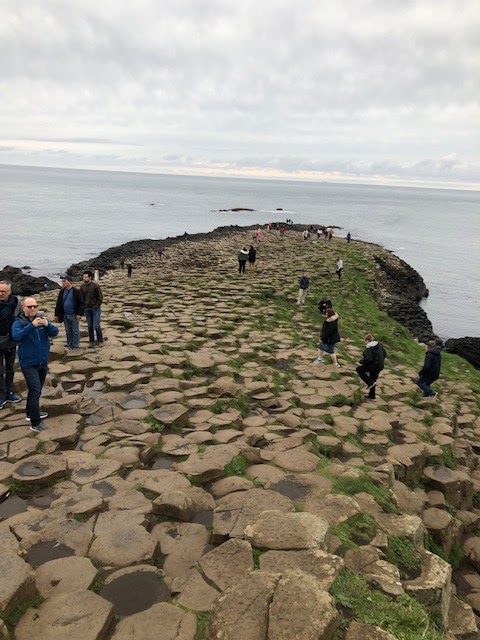
From Bushmills we drove up and along the coast, a short three miles away, to the Giant’s Causeway, a distinctive geological area and UNESCO world heritage site caused by volcanic activity.   There at the edge of Antrim County molten basalt pushed through chalk beds to form an extensive lava plateau.  As the lava cooled, it contracted like mud does when it dries.  The lava fractured vertically into pillars and horizontally into hexagonal and octagonal stone biscuits, often joined by ball and socket joints.  The tallest pillars are 39 feet tall, and the lava in the cliffs is 92 feet thick in places.  The tops of the columns form what look like stepping stones, symmetrical cobblestones if you will, leading from the cliffs into the sea to disappear under the water.


This volcanic activity happened way before Irish whiskey, Guinness, potatoes, flat wool caps, corned beef and cabbage, horse racing, the Irish sweepstakes, smiling eyes, leprechauns, religion of any stripe, songs or even tunes.  It took place before language or people to speak it.  Homo Sapiens showed up in Europe 45,000 years ago.  The Giant’s Causeway was formed during the Paleocene era, 50-60 million years ago.  And I thought the Bushmills distillery was old. 

With it being Ireland, the people who eventually lived there created a legend around the Giant’s Causeway.  Here’s the story.

In Gaelic mythology the Irish giant Fionn macCumhaill (English translation Finn MacCool) was challenged to a fight by the Scottish giant Benandonner.  Finn accepted the challenge and built the causeway across the North Channel to Scotland so the two giants could meet.  In one version of the tale (Irish legends are famous for having more than one ending) Finn defeats Benandonner handily.  In another Finn hides from the Scottish giant after realizing Benandonner is much bigger than he.  Finn’s wife disguises Finn as a baby and tucks him in a large cradle.  When Benandonner see the size of the “baby”, he reckons the father, Finn, must be a giant among giants and flees back to Scotland in fright, destroying the causeway behind him so that Finn could not chase him down.
  
Across a sea channel not far away are identical basalt columns, part of the same lava flow, at Fingal’s Cave on the Scottish isle of Staffa.  They lend credence to both stories. You can count on the Irish for always having a story, sometimes two. 

We stayed till late afternoon at the seashore with tourists from all over the world, drawn by the unique and unusual geology of the Giant’s Causeway.  Sometimes the most fascinating attractions are the natural ones.

Before the sun set, we made our way to Belfast.  It had been a long but very good day.