Monday, April 21, 2014


Thursday, April 17, 2014
A Story for Spring
Tonight, for the potluck following my church’s Seder dinner, I’m cooking lamb. My church, an open and affirming UCC church here in Ottawa, has been having Seder dinners for quite a while. Until I attended one I was unfamiliar with the tradition of a Seder, believing it to be a Jewish tradition. And it is. It is a meal served to commemorate the beginning of Passover in the Jewish faith. So why is my protestant Christian church having a Seder meal? Because Jesus was a Jew, as were all the early Christians, and in that sense the Seder is part of our common faith. The meal, and the ritual within the meal, tells the story of the Jewish exodus from Egypt. But I’m not writing about the Seder. I’m writing about the lamb.
My daughter, a food scientist who continues to teach me new things about what I eat, sent me a link to an article about spring lamb that suggested we North Americans choose another meat for Easter as local spring lambs are just not big enough for slaughter and consumption during the spring holiday. It stated that if you purchase fresh spring lamb it will no doubt be a fully grown fall lamb from New Zealand or Australia shipped in for the American Easter lamb market. That made sense to me. We raised sheep on our dairy farm and those lambs born in the cold of January would just be getting to twenty pounds or so by March or April. We raised sheep, and shipped them to the sale barn for slaughter, but never ate a mouthful of their meat. I once asked my Dad why we didn’t eat the sheep like we did the cows and chickens.
“City people eat lamb and mutton,” he said. “We don’t.” And that was that.
I didn’t eat mutton, the meat of an adult sheep, or lamb till I traveled through North Africa where lamb and goat were the primary meat. I liked it then and have been eating it at every opportunity since. Having been recently educated by my daughter on the whole movement of farm to table going on in the hip restaurants she and my son take their Mom and Dad to, in order to both spend time with their parents and pick up the check, I was on the lookout for a local grass fed animal, and remembered some years back driving past a pasture on Route 80 somewhere between Princeton and Geneseo that had a hand painted sign on an old farm wagon that said “Easter Lamb” with a phone number. That’s all I started with. I began Googling lamb+(the names of towns along that stretch of Route 80). I got lucky with lamb+Sheffield. I was directed to Graze-n-Grow Farm, just East of Sheffield, where I met Jim and Ruth Draper.
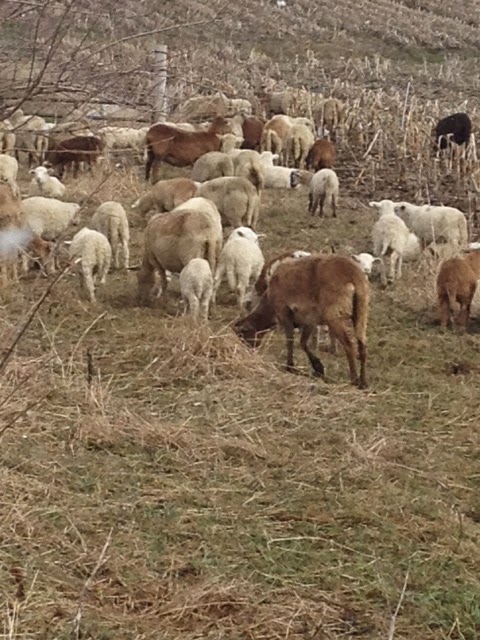
Jim and Ruth have a lot going on at the Graze-n-Grow. Ruth has a full blown greenhouse business selling flowers and vegetables, and she also raises chickens along with some geese and ducks. Jim has been raising Katahdin sheep for the past twelve years or so, having gone from wool sheep to this breed of hair sheep bred for their meat. Katahdin sounds ancient and from the Middle East doesn’t it? It’s not. As Jim Draper tells it a guy from Maine set out in the late 1950’s to develop a breed of sheep that had great meat characteristics with no need to bother with the wool. The market price for wool has been in the toilet for years, ever since Australia dumped its wool reserve, some twenty years of stockpiled wool pelts, on the international market. It’s never recovered. Jim recalled paying more to shear his wool sheep than the wool was worth. He wasn’t even breaking even by raising sheep. He wanted to keep raising them, sheep had been raised on that farm for years, but needed to find a new market, a new product, a new plan. After much research he sold his wool sheep and switched entirely to the new Katahdin breed.
Their name? Taken from the highest peak in Maine. Completely made up. Katahdin sheep are a cross of an African “hair sheep” which sheds its long fine wooly hair each spring, and several chunky wool breeds. After years of cross breeding they created a new stock of sheep that maintained the “hair” and bulked up on the “meat.” Hence Katahdin sheep, made to be eaten not shorn. Their coats are so fine you don’t even need to cut off their tails like wool sheep. They do not need shearing. And they’re rugged. Jim, and most Katahdin breeders, feed them on nothing but hay in the winter and green pasture grass as long as it lasts. No grain needed. Also unnecessary are vaccines or hormones. Jim pays very few veterinarian bills. His Katahdin sheep are ruminants eating grass as their body was designed. Purely grass fed, like all lamb used to be. My daughter calls that moving forward by going back.
Jim and Ruth’s challenge was finding a market for their new sheep. They found it rather quickly among the Muslim population in the Quad Cities. Jim realizes three fourths of his revenue from lamb sales around one Muslim holiday, Eid El Adha, the Festival of the Sacrifice at the end of the Hadj, or pilgrimage to Mecca. It’s an interesting observance, and one that revolves around families sacrificing an animal and distributing the meat. One third is to be eaten by the immediate family, another third given to extended family, acquaintances, and friends, and another third given to the poor. Millions of animals, goats and camels in addition to lambs and sheep, are sacrificed throughout the Muslim world on Eid El Adha. And Jim Draper and his Katahdin sheep found their way into it.
If you are Christian or Jewish you know the scripture on which this holiday is based. Jim and Ruth Draper knew it too. As we talked to them at their kitchen table I couldn’t help but notice a well worn Christian Bible next to the salt and pepper shakers. Eid El Adha is based on the Genesis story of Abraham, the humble servant of a God who tested his faith by commanding him to kill then burn his son Isaac on a pyre of sticks on a mountain. I’m quite sure our English language Bibles have lost much in the translation. If that were happening today the exchange between Abraham and God would go something like this, beginning with Abe hearing God’s command.
“You want me, an old man of 99, to kill my son Isaac, born to my wife Sarah miraculously at age 90, our only son whom we love.” His other child, Isaac’s older half brother, was born to Abe and Sarah’s Egyptian household servant Hagar. It was Sarah, then unable to bear children, who came up with the idea to create an heir to Abraham by having her husband Abe sleep with the servant. That child was named Ishmael. But back to God, Abraham, and Isaac.
“That’s right Abraham. I want you to sacrifice Isaac.”
“You have got to be kidding.”
“I‘m not.”
Abraham, as we learn, is a faithful God fearing guy. And so he takes Isaac up the mountain. Isaac is confused. He asks his Dad, “We have fire, and wood, but where is the lamb for a burnt offering?”
“God will provide it,” his Dad answers.
When they came to the sacrificial site they built an altar with the wood, but then, presto change, Abe ties Isaac up and lays him on the pile of wood. He raises his knife to kill him as God commanded. The Bible version I’m reading doesn’t note Isaac’s words or reaction to his Dad getting ready to kill him but surely he would have said something and if he did it would have no doubt recorded this:
“Jesus Christ, Dad. What is wrong with you?” No, wait. He wouldn’t have said Jesus Christ. Jesus doesn’t show up for another thousand years. But he might have said.
“Good God, have you gone crazy?”
Now that’s a valid question. Luckily, before Abe’s arm, attached to the hand that holds the knife that is about to kill his son, descends downward in a fatal blow God speaks to Abe. Imagine a big voice booming down from the sky. God wouldn’t have a small voice would he?
“Don’t lay a hand on the lad. For now I know you fear me, because you didn’t withhold your son from me.”
Abe stops, the knife in mid air. Just then he looks up and sees a ram whose horns are caught in a bush. He unties Isaac and they sacrifice the ram, much to Isaac’s relief I’m sure. I’m not ambitious enough to read on and find out what happened to Isaac, but it is hard for me to believe he ever felt the same about God, or his Dad, after that experience. But you know the Bible, anything can happen.
And so that story, told orally for years before it was written down, became part of the Jewish Torah, the Christian Old testament, and also the Koran, sacred scripture of the Islamic world. I learned that basic fact from traveling in North Africa in the seventies. All three faiths share the Old testament as scripture. As my Moroccan friend Najib once explained over tea in a busy Rabat street café, the stories that make up each religion’s earliest writings are not that different.
“We got Moise, you call him Moses. We got Noah and Ibrahim, you call him Abraham. We even have Jonah, the man who lived inside the big fish.”
Can’t you almost see those ancient people, somewhere in the desert in a tent, sitting around a fire listening to an old man tell the story of a faithful man about to sacrifice his son? It’s a compelling story, a good one with all the elements; suspense, violence, and in the end redemption. Like all good stories you don’t want them to go to waste. Everybody apparently used that story and wrote it down when writing became common. The Muslims though put a twist on their version of the story.
In the Koran it’s not Isaac being sacrificed but Ishmael. Ishmael is an important figure in Islam. He is regarded as a prophet and an ancestor to Muhammad. Ishmael is credited with later designing and the Kabba in Mecca, Islam’s most holy site. I didn’t learn this from researching the Koran. Jim Draper told me. He has learned it from his customers seeking sacrificial lambs.
“Yep, their story is just about the same as ours, excepting for the change in characters there, from Isaac to Ishmael. They put their important person in their story. We got our version and they got theirs. And must be that their book, the Koran, talks in more detail about the ram, because they come here in the fall wanting a ram without blemish. And they like them with horns. I can charge more if they have horns. Except if a horn is broken, or the animal is scarred in some way, they don’t want them. And they don’t want them castrated. I used to castrate the bucks, because they gain weight better, but they want them intact. So I don’t do anything to those lambs at all. And I’m telling you, with that holiday being in the fall, and the lambs just coming off summer pasture, that’s the perfect time to harvest my lambs. They’re heavy, their meat is still tender, and they are as natural as natural can be.”
“The other thing I do is let them practice their customs. Your really good Muslims, the devout ones, they are dead set on killing their own lamb themselves according to Halal. That’s like Kosher to the Jewish people. See when you sell a live animal to someone, they’re free to do with it what they want, and some people just load the live lamb up in their car or van or whatever and take it home to slaughter. But there’s been problems with that. Americans in cities don’t go much for families bleeding out a lamb and butchering it on the driveway or even the back yard for that matter. So I let them butcher here if they want. That’s important to them. They appreciate me for letting them carry out their religious traditions.”
“So where this, uh, killing done?”
“I let them use the back of the barn there. I got to say, it’s a very humane way to kill a sheep. In the small processing plants around here they just shoot them you know, a .22 to the head. In the larger plants they use an electric bolt, knocks them out, and then they hang them up and bleed them. But this Halal butchering, they call it zabihah, is slick. They pray before each animal is killed, making sure to use their God's name, Allah, during the slaughter. They use a very sharp knife, slitting the throat with a long cut that opens all the arteries, so the sheep bleeds out quick. The animal can’t be unconscious, but they make sure the lamb is quiet. They bleed so fast that they simply fade out from blood loss peaceful like. After they make the cut they hang them and let them bleed out completely. They don’t save the blood for nothing. And they make sure a religious person does the slaughter. Usually the husband does it, but some of them are queasy about it and let their wives. But I have to say it’s done tastefully. I kind of like the way they pray and give thanks. We do that when we eat, they do it long before they even cook as well.”
My son Dean was interested in Jim’s story. He has traveled to Morocco also and remembers the sheep and goat heads hanging in the souks or markets, used mainly for soup. He was both surprised and pleased to find a Midwestern farmer was so knowledgeable of another culture.
“I bet you never knew anyone that was Muslim growing up here,” Dean said.
“Heck no,” Jim said. “I’ve lived here all my life. We got Lutherans and Methodists, Catholics and Baptists, some other groups. But Muslims? Wasn’t till I started selling these meat sheep I ever met one.”
“So how you getting along with your Muslim customers?” Dean asked.
“You know, they’re like everyone else. Some of them are nice as can be, and some are hard to deal with. I used to have problems with them wanting to barter. Must be a custom in their countries. I have a set price and don’t like to dicker. Most of my advertising now is word of mouth between families and friends, and they like the taste of my lambs. They’re pretty much selling themselves. I got lots of repeat customers and for the most part they don’t argue about the cost anymore.”
“I like the Moroccans best. They’re more the working class regular people. There’s this Indian guy, maybe Pakistani, he’s got more money than most I think. He’s into the medical field somehow. Now he’s dang hard to deal with. But you know, they’re good people. They’re trying to keep up their traditions and do right like they were taught. I respect that.”
“You should go to Morocco,” my son said. “You’d love it.”
“That’s what they tell me. They offer to put me and Ruth up with their relatives over there. But Ruth and I, we’re pretty busy here. The sheep need looking after. It’s pretty much full time and year round.”
I liked Jim a lot. Not only because he wore Dickie’s bib overalls with patches on the knees but also because he was the kind of farmer I grew up with; smart, inquisitive, always trying to make his farm better, looking for new ways to make a honest living. If we can repurpose the small farms around here to filling a need or desire for good food raised in a sustainable way I’m all for it.
Jim asked Dean and I about our experiences travelling. We must have talked for an hour. He gave us a tour of Ruth’s well ordered greenhouses. She was meticulously taking tiny sprouts from the smallest of trays and pushing them into bigger flats where they could grown to be plants ready for sale. Their big day is Mother’s day. Though it was a cold and windy morning, with snow on the ground, it was hot inside the plastic hoop house. Grass fed lambs and plants grown from seed. There’s something nice about that combination.
As we went to our car Jim asked us to let him know how the people at my church liked his lamb. I promised to tell him. There are lots worse things you can do on a Tuesday morning than pay a visit to a local farm. It’s good to know there are people in the world changing themselves and their surroundings for the better and learning to accept people different than them.
So whatever your traditions, whatever stories you’ve been told to believe as if they were true, enjoy this Easter weekend. There’s something about it that makes the world new.
My daughter, a food scientist who continues to teach me new things about what I eat, sent me a link to an article about spring lamb that suggested we North Americans choose another meat for Easter as local spring lambs are just not big enough for slaughter and consumption during the spring holiday. It stated that if you purchase fresh spring lamb it will no doubt be a fully grown fall lamb from New Zealand or Australia shipped in for the American Easter lamb market. That made sense to me. We raised sheep on our dairy farm and those lambs born in the cold of January would just be getting to twenty pounds or so by March or April. We raised sheep, and shipped them to the sale barn for slaughter, but never ate a mouthful of their meat. I once asked my Dad why we didn’t eat the sheep like we did the cows and chickens.
“City people eat lamb and mutton,” he said. “We don’t.” And that was that.
I didn’t eat mutton, the meat of an adult sheep, or lamb till I traveled through North Africa where lamb and goat were the primary meat. I liked it then and have been eating it at every opportunity since. Having been recently educated by my daughter on the whole movement of farm to table going on in the hip restaurants she and my son take their Mom and Dad to, in order to both spend time with their parents and pick up the check, I was on the lookout for a local grass fed animal, and remembered some years back driving past a pasture on Route 80 somewhere between Princeton and Geneseo that had a hand painted sign on an old farm wagon that said “Easter Lamb” with a phone number. That’s all I started with. I began Googling lamb+(the names of towns along that stretch of Route 80). I got lucky with lamb+Sheffield. I was directed to Graze-n-Grow Farm, just East of Sheffield, where I met Jim and Ruth Draper.
Jim and Ruth have a lot going on at the Graze-n-Grow. Ruth has a full blown greenhouse business selling flowers and vegetables, and she also raises chickens along with some geese and ducks. Jim has been raising Katahdin sheep for the past twelve years or so, having gone from wool sheep to this breed of hair sheep bred for their meat. Katahdin sounds ancient and from the Middle East doesn’t it? It’s not. As Jim Draper tells it a guy from Maine set out in the late 1950’s to develop a breed of sheep that had great meat characteristics with no need to bother with the wool. The market price for wool has been in the toilet for years, ever since Australia dumped its wool reserve, some twenty years of stockpiled wool pelts, on the international market. It’s never recovered. Jim recalled paying more to shear his wool sheep than the wool was worth. He wasn’t even breaking even by raising sheep. He wanted to keep raising them, sheep had been raised on that farm for years, but needed to find a new market, a new product, a new plan. After much research he sold his wool sheep and switched entirely to the new Katahdin breed.
Their name? Taken from the highest peak in Maine. Completely made up. Katahdin sheep are a cross of an African “hair sheep” which sheds its long fine wooly hair each spring, and several chunky wool breeds. After years of cross breeding they created a new stock of sheep that maintained the “hair” and bulked up on the “meat.” Hence Katahdin sheep, made to be eaten not shorn. Their coats are so fine you don’t even need to cut off their tails like wool sheep. They do not need shearing. And they’re rugged. Jim, and most Katahdin breeders, feed them on nothing but hay in the winter and green pasture grass as long as it lasts. No grain needed. Also unnecessary are vaccines or hormones. Jim pays very few veterinarian bills. His Katahdin sheep are ruminants eating grass as their body was designed. Purely grass fed, like all lamb used to be. My daughter calls that moving forward by going back.
Jim and Ruth’s challenge was finding a market for their new sheep. They found it rather quickly among the Muslim population in the Quad Cities. Jim realizes three fourths of his revenue from lamb sales around one Muslim holiday, Eid El Adha, the Festival of the Sacrifice at the end of the Hadj, or pilgrimage to Mecca. It’s an interesting observance, and one that revolves around families sacrificing an animal and distributing the meat. One third is to be eaten by the immediate family, another third given to extended family, acquaintances, and friends, and another third given to the poor. Millions of animals, goats and camels in addition to lambs and sheep, are sacrificed throughout the Muslim world on Eid El Adha. And Jim Draper and his Katahdin sheep found their way into it.
If you are Christian or Jewish you know the scripture on which this holiday is based. Jim and Ruth Draper knew it too. As we talked to them at their kitchen table I couldn’t help but notice a well worn Christian Bible next to the salt and pepper shakers. Eid El Adha is based on the Genesis story of Abraham, the humble servant of a God who tested his faith by commanding him to kill then burn his son Isaac on a pyre of sticks on a mountain. I’m quite sure our English language Bibles have lost much in the translation. If that were happening today the exchange between Abraham and God would go something like this, beginning with Abe hearing God’s command.
“You want me, an old man of 99, to kill my son Isaac, born to my wife Sarah miraculously at age 90, our only son whom we love.” His other child, Isaac’s older half brother, was born to Abe and Sarah’s Egyptian household servant Hagar. It was Sarah, then unable to bear children, who came up with the idea to create an heir to Abraham by having her husband Abe sleep with the servant. That child was named Ishmael. But back to God, Abraham, and Isaac.
“That’s right Abraham. I want you to sacrifice Isaac.”
“You have got to be kidding.”
“I‘m not.”
Abraham, as we learn, is a faithful God fearing guy. And so he takes Isaac up the mountain. Isaac is confused. He asks his Dad, “We have fire, and wood, but where is the lamb for a burnt offering?”
“God will provide it,” his Dad answers.
When they came to the sacrificial site they built an altar with the wood, but then, presto change, Abe ties Isaac up and lays him on the pile of wood. He raises his knife to kill him as God commanded. The Bible version I’m reading doesn’t note Isaac’s words or reaction to his Dad getting ready to kill him but surely he would have said something and if he did it would have no doubt recorded this:
“Jesus Christ, Dad. What is wrong with you?” No, wait. He wouldn’t have said Jesus Christ. Jesus doesn’t show up for another thousand years. But he might have said.
“Good God, have you gone crazy?”
Now that’s a valid question. Luckily, before Abe’s arm, attached to the hand that holds the knife that is about to kill his son, descends downward in a fatal blow God speaks to Abe. Imagine a big voice booming down from the sky. God wouldn’t have a small voice would he?
“Don’t lay a hand on the lad. For now I know you fear me, because you didn’t withhold your son from me.”
Abe stops, the knife in mid air. Just then he looks up and sees a ram whose horns are caught in a bush. He unties Isaac and they sacrifice the ram, much to Isaac’s relief I’m sure. I’m not ambitious enough to read on and find out what happened to Isaac, but it is hard for me to believe he ever felt the same about God, or his Dad, after that experience. But you know the Bible, anything can happen.
And so that story, told orally for years before it was written down, became part of the Jewish Torah, the Christian Old testament, and also the Koran, sacred scripture of the Islamic world. I learned that basic fact from traveling in North Africa in the seventies. All three faiths share the Old testament as scripture. As my Moroccan friend Najib once explained over tea in a busy Rabat street café, the stories that make up each religion’s earliest writings are not that different.
“We got Moise, you call him Moses. We got Noah and Ibrahim, you call him Abraham. We even have Jonah, the man who lived inside the big fish.”
Can’t you almost see those ancient people, somewhere in the desert in a tent, sitting around a fire listening to an old man tell the story of a faithful man about to sacrifice his son? It’s a compelling story, a good one with all the elements; suspense, violence, and in the end redemption. Like all good stories you don’t want them to go to waste. Everybody apparently used that story and wrote it down when writing became common. The Muslims though put a twist on their version of the story.
In the Koran it’s not Isaac being sacrificed but Ishmael. Ishmael is an important figure in Islam. He is regarded as a prophet and an ancestor to Muhammad. Ishmael is credited with later designing and the Kabba in Mecca, Islam’s most holy site. I didn’t learn this from researching the Koran. Jim Draper told me. He has learned it from his customers seeking sacrificial lambs.
“Yep, their story is just about the same as ours, excepting for the change in characters there, from Isaac to Ishmael. They put their important person in their story. We got our version and they got theirs. And must be that their book, the Koran, talks in more detail about the ram, because they come here in the fall wanting a ram without blemish. And they like them with horns. I can charge more if they have horns. Except if a horn is broken, or the animal is scarred in some way, they don’t want them. And they don’t want them castrated. I used to castrate the bucks, because they gain weight better, but they want them intact. So I don’t do anything to those lambs at all. And I’m telling you, with that holiday being in the fall, and the lambs just coming off summer pasture, that’s the perfect time to harvest my lambs. They’re heavy, their meat is still tender, and they are as natural as natural can be.”
“The other thing I do is let them practice their customs. Your really good Muslims, the devout ones, they are dead set on killing their own lamb themselves according to Halal. That’s like Kosher to the Jewish people. See when you sell a live animal to someone, they’re free to do with it what they want, and some people just load the live lamb up in their car or van or whatever and take it home to slaughter. But there’s been problems with that. Americans in cities don’t go much for families bleeding out a lamb and butchering it on the driveway or even the back yard for that matter. So I let them butcher here if they want. That’s important to them. They appreciate me for letting them carry out their religious traditions.”
“So where this, uh, killing done?”
“I let them use the back of the barn there. I got to say, it’s a very humane way to kill a sheep. In the small processing plants around here they just shoot them you know, a .22 to the head. In the larger plants they use an electric bolt, knocks them out, and then they hang them up and bleed them. But this Halal butchering, they call it zabihah, is slick. They pray before each animal is killed, making sure to use their God's name, Allah, during the slaughter. They use a very sharp knife, slitting the throat with a long cut that opens all the arteries, so the sheep bleeds out quick. The animal can’t be unconscious, but they make sure the lamb is quiet. They bleed so fast that they simply fade out from blood loss peaceful like. After they make the cut they hang them and let them bleed out completely. They don’t save the blood for nothing. And they make sure a religious person does the slaughter. Usually the husband does it, but some of them are queasy about it and let their wives. But I have to say it’s done tastefully. I kind of like the way they pray and give thanks. We do that when we eat, they do it long before they even cook as well.”
My son Dean was interested in Jim’s story. He has traveled to Morocco also and remembers the sheep and goat heads hanging in the souks or markets, used mainly for soup. He was both surprised and pleased to find a Midwestern farmer was so knowledgeable of another culture.
“I bet you never knew anyone that was Muslim growing up here,” Dean said.
“Heck no,” Jim said. “I’ve lived here all my life. We got Lutherans and Methodists, Catholics and Baptists, some other groups. But Muslims? Wasn’t till I started selling these meat sheep I ever met one.”
“So how you getting along with your Muslim customers?” Dean asked.
“You know, they’re like everyone else. Some of them are nice as can be, and some are hard to deal with. I used to have problems with them wanting to barter. Must be a custom in their countries. I have a set price and don’t like to dicker. Most of my advertising now is word of mouth between families and friends, and they like the taste of my lambs. They’re pretty much selling themselves. I got lots of repeat customers and for the most part they don’t argue about the cost anymore.”
“I like the Moroccans best. They’re more the working class regular people. There’s this Indian guy, maybe Pakistani, he’s got more money than most I think. He’s into the medical field somehow. Now he’s dang hard to deal with. But you know, they’re good people. They’re trying to keep up their traditions and do right like they were taught. I respect that.”
“You should go to Morocco,” my son said. “You’d love it.”
“That’s what they tell me. They offer to put me and Ruth up with their relatives over there. But Ruth and I, we’re pretty busy here. The sheep need looking after. It’s pretty much full time and year round.”
I liked Jim a lot. Not only because he wore Dickie’s bib overalls with patches on the knees but also because he was the kind of farmer I grew up with; smart, inquisitive, always trying to make his farm better, looking for new ways to make a honest living. If we can repurpose the small farms around here to filling a need or desire for good food raised in a sustainable way I’m all for it.
Jim asked Dean and I about our experiences travelling. We must have talked for an hour. He gave us a tour of Ruth’s well ordered greenhouses. She was meticulously taking tiny sprouts from the smallest of trays and pushing them into bigger flats where they could grown to be plants ready for sale. Their big day is Mother’s day. Though it was a cold and windy morning, with snow on the ground, it was hot inside the plastic hoop house. Grass fed lambs and plants grown from seed. There’s something nice about that combination.
As we went to our car Jim asked us to let him know how the people at my church liked his lamb. I promised to tell him. There are lots worse things you can do on a Tuesday morning than pay a visit to a local farm. It’s good to know there are people in the world changing themselves and their surroundings for the better and learning to accept people different than them.
So whatever your traditions, whatever stories you’ve been told to believe as if they were true, enjoy this Easter weekend. There’s something about it that makes the world new.
Thursday, April 10, 2014
Independent Living
There is a Trailways bus that takes off from Burlington, Iowa every morning of the week heading east. It stops in towns along Interstate 80 before arriving at the bus station in downtown Chicago. You can get on the bus in Ottawa at the Dunkin Donuts in front of the North side Kroger at 4:30 a.m.. Dunkin Donuts is open twenty four hours a day so you can wait inside, with or without a donut, if it’s cold or rainy.
You pretty much have to buy bus tickets on line these days with a credit card and print them out. Of course, by getting on this bus you can travel on past Chicago. From there you can go anywhere. Remember my young friend, the one I bailed out of jail on a cold night around the new year and helped get a social security card and State ID? He got on that bus Saturday morning. With any luck he arrived in a good town near the West coast Monday afternoon. For him it’s a fresh start. A clean slate. My young friend got on the bus with little but a paid ticket and an old friend to stay with at the other end of the line. Some may call that ill prepared but from where he started it’s not bad.
I think there is nothing sweeter in life than a fresh start. Some say it’s a God send. I think all of us need a clean slate at least once as we make our way through the years. Maybe more than once. But we can’t expect too many. It was the immortal and astute Muddy Waters, I believe, who once said:
Every dog has its day.
If you’re a real good dog you might get two days.
Given the pain of completely leaving a community, a group of friends, perhaps family; walking away from those we love or who once loved us, to say nothing of abandoning habits and routines we rely on, know so well, and are so comforted by, it’s amazing anyone deliberately makes major life changes. But we do. We do amazing things-cross borders, brave deserts, sail oceans, risking everything to strike out on our own to escape our lives as they are. My young friend’s break was less dramatic. He simply set out across the country to find a job, keep a roof over his head, stay out of jail, and experience life as an adult not dependent on anyone else. All he had to do, on the surface anyway, was get on a bus. The hard part would come soon enough.
He talked about leaving with anticipation over and over this winter. I helped him put together a plan that included steps needed to make it happen. He followed those steps. When we talked calmly, at breakfast usually, he knew he had to go. He knew it was the best thing. He isn’t dumb, and he can see his personal reality clearly at times. Yet like all of us he has to balance reason with emotion. And for him, emotion wins much of the time. At the very end he broke down. He left during a crisis. He was beaten up and beaten down. But he managed to leave in spite of all his fears.
“I’ve taken long bus trips,” I told him, “and there’s nothing better than looking out a big window at the countryside going by for two days or so. Gives you a chance to sort out where you’ve been and figure out where you’re going. Hopefully somewhere in Colorado, which is about halfway, you’ll turn the page on Ottawa and start looking ahead to that new town out west.”
Traveling alone gives us a chance to look at our life closely. No one knows you out there. There is no one to remind you of past faults and weaknesses. At those times, short moments really in the scope of a whole life, we escape our past. Over the winter he slowly shared some of that past with me, though I’m sure not all of it. We shouldn’t require that of each other anyway; absolute full disclosure of regrets and fears, weaknesses and mistakes. Well perhaps to one other human being. I didn’t want to be that human being for my friend. I just wanted to help him get through this time in his life. No matter who ends up really knowing us, if anyone, it is more important I think to see ourselves for who we are, to look at ourselves honestly, in order to both celebrate the beauty and face the ugliness we discover in there.
I tried to help my young friend by talking to him. I made observations, thought about what he said, tried to explain simply how his life looked to me, and how he might expect to be seen by others. I hope some of that helped. In the end though, I could only make arrangements.
I gave him rides, encouraged him, reassured him, and bought him food. As so often happens, it was his family that put the money together to finance his trip. He’s lived through more than his share of pain and brought pain to others in arguable proportion. He has plenty of critics. What is in short supply are people who support him. Not that it matters much now. His past can’t be changed. It’s the future that’s matters. It is the choices he makes next, and not forgetting that life is long and anything is possible.
On the short drive to Dunkin Donuts at 4:15 in the morning we joked about the secret of life. I told him my version and he laughed, which made me laugh back. I would tell it to you here but it’s a secret, which is why they call it the secret of life. If we run into each other you ask I’ll tell it to you, but then you have to keep it to yourself as well.
He was tired but in good spirits; weepy but optimistic, if those things go together. I think they can. Under the bus, in the luggage compartment, was a single suitcase worn out from too many trips of mine. In a shopping bag he had five sandwiches, three big cookies, two pops, two bottles of water, and a book. In his pocket was cash and with it a cheap cell phone loaded with one month’s worth of minutes. That was everything he owned. As departure time neared the bus driver looked at his ticket and asked to see a picture ID. My young friend promptly pulled it from his wallet and showed it to the driver. I chuckled to myself. Few know how hard it was to accomplish that simple step of establishing his identity, something most of us so take for granted.
It was time to go. He gave me a big hug and I hugged him back. Yeah, he’s officially somebody now, with papers to prove it. He just has to figure who that’s going to be.
You pretty much have to buy bus tickets on line these days with a credit card and print them out. Of course, by getting on this bus you can travel on past Chicago. From there you can go anywhere. Remember my young friend, the one I bailed out of jail on a cold night around the new year and helped get a social security card and State ID? He got on that bus Saturday morning. With any luck he arrived in a good town near the West coast Monday afternoon. For him it’s a fresh start. A clean slate. My young friend got on the bus with little but a paid ticket and an old friend to stay with at the other end of the line. Some may call that ill prepared but from where he started it’s not bad.
I think there is nothing sweeter in life than a fresh start. Some say it’s a God send. I think all of us need a clean slate at least once as we make our way through the years. Maybe more than once. But we can’t expect too many. It was the immortal and astute Muddy Waters, I believe, who once said:
Every dog has its day.
If you’re a real good dog you might get two days.
Given the pain of completely leaving a community, a group of friends, perhaps family; walking away from those we love or who once loved us, to say nothing of abandoning habits and routines we rely on, know so well, and are so comforted by, it’s amazing anyone deliberately makes major life changes. But we do. We do amazing things-cross borders, brave deserts, sail oceans, risking everything to strike out on our own to escape our lives as they are. My young friend’s break was less dramatic. He simply set out across the country to find a job, keep a roof over his head, stay out of jail, and experience life as an adult not dependent on anyone else. All he had to do, on the surface anyway, was get on a bus. The hard part would come soon enough.
He talked about leaving with anticipation over and over this winter. I helped him put together a plan that included steps needed to make it happen. He followed those steps. When we talked calmly, at breakfast usually, he knew he had to go. He knew it was the best thing. He isn’t dumb, and he can see his personal reality clearly at times. Yet like all of us he has to balance reason with emotion. And for him, emotion wins much of the time. At the very end he broke down. He left during a crisis. He was beaten up and beaten down. But he managed to leave in spite of all his fears.
“I’ve taken long bus trips,” I told him, “and there’s nothing better than looking out a big window at the countryside going by for two days or so. Gives you a chance to sort out where you’ve been and figure out where you’re going. Hopefully somewhere in Colorado, which is about halfway, you’ll turn the page on Ottawa and start looking ahead to that new town out west.”
Traveling alone gives us a chance to look at our life closely. No one knows you out there. There is no one to remind you of past faults and weaknesses. At those times, short moments really in the scope of a whole life, we escape our past. Over the winter he slowly shared some of that past with me, though I’m sure not all of it. We shouldn’t require that of each other anyway; absolute full disclosure of regrets and fears, weaknesses and mistakes. Well perhaps to one other human being. I didn’t want to be that human being for my friend. I just wanted to help him get through this time in his life. No matter who ends up really knowing us, if anyone, it is more important I think to see ourselves for who we are, to look at ourselves honestly, in order to both celebrate the beauty and face the ugliness we discover in there.
I tried to help my young friend by talking to him. I made observations, thought about what he said, tried to explain simply how his life looked to me, and how he might expect to be seen by others. I hope some of that helped. In the end though, I could only make arrangements.
I gave him rides, encouraged him, reassured him, and bought him food. As so often happens, it was his family that put the money together to finance his trip. He’s lived through more than his share of pain and brought pain to others in arguable proportion. He has plenty of critics. What is in short supply are people who support him. Not that it matters much now. His past can’t be changed. It’s the future that’s matters. It is the choices he makes next, and not forgetting that life is long and anything is possible.
On the short drive to Dunkin Donuts at 4:15 in the morning we joked about the secret of life. I told him my version and he laughed, which made me laugh back. I would tell it to you here but it’s a secret, which is why they call it the secret of life. If we run into each other you ask I’ll tell it to you, but then you have to keep it to yourself as well.
He was tired but in good spirits; weepy but optimistic, if those things go together. I think they can. Under the bus, in the luggage compartment, was a single suitcase worn out from too many trips of mine. In a shopping bag he had five sandwiches, three big cookies, two pops, two bottles of water, and a book. In his pocket was cash and with it a cheap cell phone loaded with one month’s worth of minutes. That was everything he owned. As departure time neared the bus driver looked at his ticket and asked to see a picture ID. My young friend promptly pulled it from his wallet and showed it to the driver. I chuckled to myself. Few know how hard it was to accomplish that simple step of establishing his identity, something most of us so take for granted.
It was time to go. He gave me a big hug and I hugged him back. Yeah, he’s officially somebody now, with papers to prove it. He just has to figure who that’s going to be.
Friday, April 4, 2014
Raising Chickens
On our farm, a 190 acre dairy farm with timber, pasture, and good tillable McLean county soil for crops, Dad was master of the dairy barn and the sheep lot and my Mom the absolute ruler of the hen house. She bought baby chicks, nurtured them, fed them generously, took their eggs, killed them, butchered them, cooked their flesh in various ways, ate them, and started the cycle over the next spring with more baby chicks. To the chickens, had they been able to think like humans, she would have been God-mother, sustainer of life, their executioner and destiny. She filled her roles in the life cycle of those chickens with ease and grace. It was something to behold.
Our farm was how we made our living. Raising animals was not a hobby. The check from Prairie Farms dairy in Carlinville and the egg money kept our family afloat. It was serious business, and death was part of the equation.
As her youngest child I bore special witness to her dominion over the chickens. As the youngest child by far and at eight the only kid living on the farm I was her helper and companion, observant and complicit in all things having to do with the chickens. I fed them when she couldn’t, gathered eggs, helped with the baby chicks at the beginning of their life and at the end when she butchered them. To be honest, the days we butchered chickens were much like any other on the farm. It was a task that had to be done and we were the ones who did it. We thought little of it.
Death and farming went hand in hand. Each year Dad bred one of the bigger more beefy Jersey milk cows with Angus or Hereford semen to produce a calf we all knew would be butchered at about fifteen months of age and kept in the deep freeze in the basement to feed us through the year. Our farm was at the crossroads of a gravel road and a state highway. Careless dogs, running loose like farm dogs did then were sometimes hit and killed by cars and trucks on the road. Lambs born on January nights and neglected by their mothers froze to death. Jersey calves were occasionally still born or died from scours. But no animal on the farm matched the death rate of the chickens.
Each spring we bought fluffy baby chicks in cardboard boxes from the hatchery in Bloomington. My time on the farm extended past those days my parents talked about when they let their hens sit on a clutch of eggs and hatch chicks themselves.
“Why not let hens hatch their own eggs Mom?”
“This works better,” she said. “We can keep eating and selling eggs year round, and buying chicks from the hatchery means lots less roosters.”
Hatchery chicks were sexed to guarantee females. We only kept one rooster. In fact, being male was nearly fatal on our farm. We kept and raised heifer calves to become milk cows but sold the little bulls within days of their birth to a man down the road that raised them for veal. We had one buck sheep and each year we shipped all the male lambs while keeping the best of the ewes. We had but one Jersey bull, then when we switched to artificial insemination, no bull at all.
Soon after we sold Joe, the last bull on the farm, my Dad shared this astute observation with me. “Of all the things alive on this place, the only ones with balls are the buck sheep, the rooster (though you couldn’t see them) you, and me. It’s good to be human, don’t you think?” I had to agree.
Mom and I would drive to the hatchery in Bloomington about this time of year and fill the station wagon with flat cardboard boxes full of chicks. You could hear them peeping and scratching inside. Because there were no seat belts then I turned around in the back seat and lifedt the lids on the boxes, sometimes bringing a chick out and cupping it in my hands, a ball of soft yellow with a beak, beady eyes, and fragile legs underneath.
We put the chicks in the brooder house, a small one room chicken house with electricity and South facing windows. We put them in flimsy circular pens made of corrugated cardboard a foot high. It didn't take much to corral baby chicks. Over the circles hung heat lamps. Keeping them warm meant keeping them alive.
“Why circles Mom? Why not a square pens?”
“Because chicks have tiny brains and they’re not very smart. They pile up in corners and smother each other, suffocate. Take away the corners and more live. That means we get more eggs and more chicken on the table.” Mom was a practical thinker.
As it was, not all the chicks made it through the first week. Each day it seemed we threw a few of their tiny carcasses into the manure spreader outside the milk barn. But after they started sprouting real feathers they became hardier. They grew at an amazing rate. Before you knew it we added them in with the mature hens in the big chicken house with the fenced in yard. They had transformed themselves from chicks to pullets. As they began producing eggs, and throughout the year, we thinned out the flock by butchering the older hens. My Mom’s belief was that the older a hen the tougher the meat. Young chickens were better for frying. She stewed the old ones, often with dumplings. A chicken butchering day was sometimes announced by my Mom at breakfast.
“After I get the breakfast dishes done I want you to help me do up some chickens.”
Do up meant butcher. It started with catching them. Just inside the hen house door, hanging on nails, Mom kept two long wire chicken catchers with wooden handles on one end and twisted wire hooks on the other. The hen house floor was cluttered with feeders, a shallow water tank, and a short broad open pail with cracked oyster shell for their craws. In one corner were elevated racks for roosting, and in another long boxes filled with straw where hens nested and laid their eggs. Armed with the wire catchers Mom and I would herd the hens into an open corner of the chicken house, where they piled up much as chicks would I guess. We reached under them, trying to get the wire hook around one of their scaly yellow legs. When we got one we pulled it out, squawking and flapping its wings. Mom would look over the hens I caught with a critical eye.
“No, let that one go, she’s too young. Go after the older girls.” Mom was better at it than I was. I was afraid of hurting them, and she was not.
When she approved of the chicken I caught I would draw it to me and grab both of its legs with my hand. I hated that part. If you weren’t careful to keep the hen away from you it would slap you in the face with its wings. Sometimes I would let go out of fear. Mom chided me.
"David, that chicken is not going to hurt you. Hang onto it now and take it out.”
When we were successful in catching and holding a good candidate for butchering I would take it outside the house and tie it by the legs, upside down, to one of the lengths of baler twines hanging from a pine tree. That pine was great for climbing. Its limbs grew evenly spaced and parallel, like a ladder. From two of the lowest limbs six baler twines hung. When we had six chickens hanging there we were done with the first phase. It was a strange sight, and the hens looked perplexed, hanging upside down, three hens on one side of the trunk and three on the other, their wings spread. They hung there quietly, clucking softly, completely unaware of what was about to happen.
My Mom was the executioner. On the days we did up chickens Mom put a sharp butcher knife in her apron pocket. As the chickens waited innocently, upside down, she approached them and drew out her knife.
You might think that the actually killing of the chickens would be somewhat solemn. We were after all ending the life of a living breathing thing. I had learned somewhere that when plains Indians killed buffalo they said a little prayer of thanks. Later in my life while traveling in Morocco I learned that Muslim teaching requires families to buy their chickens alive and kill them in a manner prescribed by their religion, respecting its life. While you might have expected there would be some ceremony or at least a token of notice as to what was about to take place there on our farm, in fact the impending death of six chickens my Mom had raised from chicks and profited from during their lifetime, I have to report there was absolutely none. Not only did she acknowledge nothing, she often talked about something else entirely.
“What do you like best about Sunday school?” she once asked as her fingers encircled the neck of the first chicken, closing around it just below the beak and eyes and stretching its neck towards her, drawing it near. In addition to being ruler of the hen house she was the Sunday school superintendent at the First Presbyterian Church in Danvers.
“I like it when they let us rewrite the Bible stories in our own words.” I had recently written as a Sunday class assignment my version of Moses leading the Jews out of Egypt. In my version, Moses’ words to the Pharaoh came as he stuck a snub nosed .38 revolver into his ribs. “Let my people go… or else.”
“Yeah, that was a good lesson.” As those words were coming out of my Mom's mouth she cleanly sliced off the head of the first chicken, drawing her knife across its neck with a quick jerk and tossing the now separated head against the base of the tree. When she was done there would be a small pile of six chicken heads there. The cats would eat them later.
That head was immediately motionless and obviously altered there at the base of the pine tree, it’s eyes either shut or open but fixed. In contrast the rest of the chicken, its body, was jerking and flapping wildly at the end of the baler twine, causing the chicken, or most of it, to swing in an wide arc under the tree limb spraying blood which splattered on the ground in a scarlet line much like you might find in a Jackson Pollack painting. My Mom went quickly through the chickens, killing three on one side of the tree trunk, then three on the other. When she was finished it was mayhem, six headless chicken bodies swinging wildly, sometimes banging into each other, the twines suspending them at times twisting together. We would step back and watch. Occasionally drops of blood found its way onto our skin or clothes.
Our Aunt Lou and Uncle Ed used a different and more traditional method of killing chickens. They used a hatchet. After placing the chicken’s neck on a tree stump, they chopped it off with one thunk and let it flop around on the ground. Mom thought that was messy.
When I first helped do up chickens I was perplexed at why and how the body of the hen would react so violently to death while the head of the hen immediately went still. Mom explained it this way.
“I think bodies pretty much do what brains tell them to do. The last thing that chicken’s brain told its body, when it felt my knife on its neck, was ‘Get the heck out of here.’ All that wing flapping is the chicken trying to fly away from danger. But as you know, we put the chicken in such a dangerous position that it was too late. But its body did what it was told and tried to fly away anyway. That’s why they flap their wings.” I liked the way my Mom explained things.
When the chickens were still, hanging straight down and no longer moving, Mom and I would go to the milk house and fill two five gallon buckets with scalding hot water, bringing them back under the tree where we had a little bench to sit on. We would sit side by side, dunking the hens in the hot water and pulling off their feathers. Later I would collect and burn the feather in our burn barrel. Void of feathers, and much smaller in appearance, Mom would then slice open the chickens' abdomens and rake the guts into one of the buckets. I liked to see what was in their craw, some call it a gullet or gizzard. Mom let me cut that little skin pouch open with my pocketknife and inspect it. Inside was what they most recently ate. There was chicken feed in there, but also bugs from their outside yard, and kitchen scraps Mom would make me throw over the fence; bits of potato peel, beet tops, carrot ends. It was like a science project only I wasn’t in school.
We would continue to talk there on the bench about this and that as we worked; the Cubs, school, things I wondered about. When we were all done she put five dressed chickens in bags and sent me with them to the deep freeze in the basement. The sixth one she took to the kitchen for supper that night.
It might seem grisly and violent to you, but it was just another day’s work for us on that little farm. I have to say I enjoyed it. I wouldn’t mind doing it all again.
Our farm was how we made our living. Raising animals was not a hobby. The check from Prairie Farms dairy in Carlinville and the egg money kept our family afloat. It was serious business, and death was part of the equation.
As her youngest child I bore special witness to her dominion over the chickens. As the youngest child by far and at eight the only kid living on the farm I was her helper and companion, observant and complicit in all things having to do with the chickens. I fed them when she couldn’t, gathered eggs, helped with the baby chicks at the beginning of their life and at the end when she butchered them. To be honest, the days we butchered chickens were much like any other on the farm. It was a task that had to be done and we were the ones who did it. We thought little of it.
Death and farming went hand in hand. Each year Dad bred one of the bigger more beefy Jersey milk cows with Angus or Hereford semen to produce a calf we all knew would be butchered at about fifteen months of age and kept in the deep freeze in the basement to feed us through the year. Our farm was at the crossroads of a gravel road and a state highway. Careless dogs, running loose like farm dogs did then were sometimes hit and killed by cars and trucks on the road. Lambs born on January nights and neglected by their mothers froze to death. Jersey calves were occasionally still born or died from scours. But no animal on the farm matched the death rate of the chickens.
Each spring we bought fluffy baby chicks in cardboard boxes from the hatchery in Bloomington. My time on the farm extended past those days my parents talked about when they let their hens sit on a clutch of eggs and hatch chicks themselves.
“Why not let hens hatch their own eggs Mom?”
“This works better,” she said. “We can keep eating and selling eggs year round, and buying chicks from the hatchery means lots less roosters.”
Hatchery chicks were sexed to guarantee females. We only kept one rooster. In fact, being male was nearly fatal on our farm. We kept and raised heifer calves to become milk cows but sold the little bulls within days of their birth to a man down the road that raised them for veal. We had one buck sheep and each year we shipped all the male lambs while keeping the best of the ewes. We had but one Jersey bull, then when we switched to artificial insemination, no bull at all.
Soon after we sold Joe, the last bull on the farm, my Dad shared this astute observation with me. “Of all the things alive on this place, the only ones with balls are the buck sheep, the rooster (though you couldn’t see them) you, and me. It’s good to be human, don’t you think?” I had to agree.
Mom and I would drive to the hatchery in Bloomington about this time of year and fill the station wagon with flat cardboard boxes full of chicks. You could hear them peeping and scratching inside. Because there were no seat belts then I turned around in the back seat and lifedt the lids on the boxes, sometimes bringing a chick out and cupping it in my hands, a ball of soft yellow with a beak, beady eyes, and fragile legs underneath.
We put the chicks in the brooder house, a small one room chicken house with electricity and South facing windows. We put them in flimsy circular pens made of corrugated cardboard a foot high. It didn't take much to corral baby chicks. Over the circles hung heat lamps. Keeping them warm meant keeping them alive.
“Why circles Mom? Why not a square pens?”
“Because chicks have tiny brains and they’re not very smart. They pile up in corners and smother each other, suffocate. Take away the corners and more live. That means we get more eggs and more chicken on the table.” Mom was a practical thinker.
As it was, not all the chicks made it through the first week. Each day it seemed we threw a few of their tiny carcasses into the manure spreader outside the milk barn. But after they started sprouting real feathers they became hardier. They grew at an amazing rate. Before you knew it we added them in with the mature hens in the big chicken house with the fenced in yard. They had transformed themselves from chicks to pullets. As they began producing eggs, and throughout the year, we thinned out the flock by butchering the older hens. My Mom’s belief was that the older a hen the tougher the meat. Young chickens were better for frying. She stewed the old ones, often with dumplings. A chicken butchering day was sometimes announced by my Mom at breakfast.
“After I get the breakfast dishes done I want you to help me do up some chickens.”
Do up meant butcher. It started with catching them. Just inside the hen house door, hanging on nails, Mom kept two long wire chicken catchers with wooden handles on one end and twisted wire hooks on the other. The hen house floor was cluttered with feeders, a shallow water tank, and a short broad open pail with cracked oyster shell for their craws. In one corner were elevated racks for roosting, and in another long boxes filled with straw where hens nested and laid their eggs. Armed with the wire catchers Mom and I would herd the hens into an open corner of the chicken house, where they piled up much as chicks would I guess. We reached under them, trying to get the wire hook around one of their scaly yellow legs. When we got one we pulled it out, squawking and flapping its wings. Mom would look over the hens I caught with a critical eye.
“No, let that one go, she’s too young. Go after the older girls.” Mom was better at it than I was. I was afraid of hurting them, and she was not.
When she approved of the chicken I caught I would draw it to me and grab both of its legs with my hand. I hated that part. If you weren’t careful to keep the hen away from you it would slap you in the face with its wings. Sometimes I would let go out of fear. Mom chided me.
"David, that chicken is not going to hurt you. Hang onto it now and take it out.”
When we were successful in catching and holding a good candidate for butchering I would take it outside the house and tie it by the legs, upside down, to one of the lengths of baler twines hanging from a pine tree. That pine was great for climbing. Its limbs grew evenly spaced and parallel, like a ladder. From two of the lowest limbs six baler twines hung. When we had six chickens hanging there we were done with the first phase. It was a strange sight, and the hens looked perplexed, hanging upside down, three hens on one side of the trunk and three on the other, their wings spread. They hung there quietly, clucking softly, completely unaware of what was about to happen.
My Mom was the executioner. On the days we did up chickens Mom put a sharp butcher knife in her apron pocket. As the chickens waited innocently, upside down, she approached them and drew out her knife.
You might think that the actually killing of the chickens would be somewhat solemn. We were after all ending the life of a living breathing thing. I had learned somewhere that when plains Indians killed buffalo they said a little prayer of thanks. Later in my life while traveling in Morocco I learned that Muslim teaching requires families to buy their chickens alive and kill them in a manner prescribed by their religion, respecting its life. While you might have expected there would be some ceremony or at least a token of notice as to what was about to take place there on our farm, in fact the impending death of six chickens my Mom had raised from chicks and profited from during their lifetime, I have to report there was absolutely none. Not only did she acknowledge nothing, she often talked about something else entirely.
“What do you like best about Sunday school?” she once asked as her fingers encircled the neck of the first chicken, closing around it just below the beak and eyes and stretching its neck towards her, drawing it near. In addition to being ruler of the hen house she was the Sunday school superintendent at the First Presbyterian Church in Danvers.
“I like it when they let us rewrite the Bible stories in our own words.” I had recently written as a Sunday class assignment my version of Moses leading the Jews out of Egypt. In my version, Moses’ words to the Pharaoh came as he stuck a snub nosed .38 revolver into his ribs. “Let my people go… or else.”
“Yeah, that was a good lesson.” As those words were coming out of my Mom's mouth she cleanly sliced off the head of the first chicken, drawing her knife across its neck with a quick jerk and tossing the now separated head against the base of the tree. When she was done there would be a small pile of six chicken heads there. The cats would eat them later.
That head was immediately motionless and obviously altered there at the base of the pine tree, it’s eyes either shut or open but fixed. In contrast the rest of the chicken, its body, was jerking and flapping wildly at the end of the baler twine, causing the chicken, or most of it, to swing in an wide arc under the tree limb spraying blood which splattered on the ground in a scarlet line much like you might find in a Jackson Pollack painting. My Mom went quickly through the chickens, killing three on one side of the tree trunk, then three on the other. When she was finished it was mayhem, six headless chicken bodies swinging wildly, sometimes banging into each other, the twines suspending them at times twisting together. We would step back and watch. Occasionally drops of blood found its way onto our skin or clothes.
Our Aunt Lou and Uncle Ed used a different and more traditional method of killing chickens. They used a hatchet. After placing the chicken’s neck on a tree stump, they chopped it off with one thunk and let it flop around on the ground. Mom thought that was messy.
When I first helped do up chickens I was perplexed at why and how the body of the hen would react so violently to death while the head of the hen immediately went still. Mom explained it this way.
“I think bodies pretty much do what brains tell them to do. The last thing that chicken’s brain told its body, when it felt my knife on its neck, was ‘Get the heck out of here.’ All that wing flapping is the chicken trying to fly away from danger. But as you know, we put the chicken in such a dangerous position that it was too late. But its body did what it was told and tried to fly away anyway. That’s why they flap their wings.” I liked the way my Mom explained things.
When the chickens were still, hanging straight down and no longer moving, Mom and I would go to the milk house and fill two five gallon buckets with scalding hot water, bringing them back under the tree where we had a little bench to sit on. We would sit side by side, dunking the hens in the hot water and pulling off their feathers. Later I would collect and burn the feather in our burn barrel. Void of feathers, and much smaller in appearance, Mom would then slice open the chickens' abdomens and rake the guts into one of the buckets. I liked to see what was in their craw, some call it a gullet or gizzard. Mom let me cut that little skin pouch open with my pocketknife and inspect it. Inside was what they most recently ate. There was chicken feed in there, but also bugs from their outside yard, and kitchen scraps Mom would make me throw over the fence; bits of potato peel, beet tops, carrot ends. It was like a science project only I wasn’t in school.
We would continue to talk there on the bench about this and that as we worked; the Cubs, school, things I wondered about. When we were all done she put five dressed chickens in bags and sent me with them to the deep freeze in the basement. The sixth one she took to the kitchen for supper that night.
It might seem grisly and violent to you, but it was just another day’s work for us on that little farm. I have to say I enjoyed it. I wouldn’t mind doing it all again.
Friday, March 28, 2014
Death Hits Hard
Death hits hard, not only for the dying, but for those of us still alive. I’m pretty sure our understanding of death, our fear of it, changes the way we live.
For example, not long ago I was driving my car down an Ottawa street and pulled over, parking alongside a house on a residential street. I had received a text message from a relative and needed to return it. I sat motionless in the driver’s seat, my car idling, my head bowed looking at my smart phone, my thumbs working furiously. I was startled by a tapping on the passenger side window. It scared me. A man was crouched beside my car, smiling broadly. I rolled down the window.
‘SORRY,” he said very loudly. “I SAW YOU SITTING HER FROM MY KITCHEN WINDOWN AND HAD TO COME OUT AND CHECK ON YOU.”
“Thanks, I’m fine. Just texting. I thought I’d be safe for a change and pull over.”
“NO, HELL, DON’T APOLOGIZE. I COULDN’T HELP BUT CHECK ON YOU. SEE I USED TO LIVE OVER BY THE PARK. HAD A HOUSE OVER THERE, AND ONE DAY I WAS OUT IN MY YARD AND SAW AN OLD GUY SITTING IN HIS CAR REAL STILL , LIKE YOU, AND I JUST FIGURED, YOU KNOW, HE’S READING, OR WATCHING HIS GRAND KIDS PLAY ON THE SWINGS AND I DIDN’T THINK NOTHING OF IT.”
I wanted to finish my text but listened politely.
“AND THEN, LATER IN THE DAY, I REALIZED HE WAS STILL SITTING THERE! HADN’T MOVED! AND SO I WENT ON OVER THERE AND WOULDN’T YOU KNOW…”
“He was dead?”
“YOU GUESSED IT. DEADER THAN A FREAKIN DOORNAIL, RIGHT THERE ON THE STREET!!!” He said that even louder than capital letters can express.
“SHOOK ME UP I’LL TELL YOU. I DIDN’T HAVE A CELL PHONE, SO I TOLD THE KIDS IN THE PARK TO JUST KEEP PLAYING AND I WENT IN THE HOUSE AND CALLED THE POLICE. THEN I KEPT THE KIDS AWAY AS THEY GOT THE, YOU KNOW, AMBULANCE AND STUFF.”
“That must have been quite a shock.”
“YOU’RE NOT KIDDING IT WAS QUITE A SHOCK. I DON’T THINK I’VE BEEN THE SAME SINCE. AND YOU KNOW WHAT? I COULD TELL RIGHT AWAY HE WAS DEAD. I’D NEVER SEEN A DEAD PERSON, A REAL HUMAN BEING, BUT THERE WAS NO DOUBT I’M TELLING YOU. HE MUST HAVE BEEN DEAD ONLY A COUPLE HOURS OR MORE BUT I’M HERE TO TELL YOU HE WAS DEFINITELY GONE.”
“Well I’ll be gone in just a few minutes here myself, except I’m going to drive away. Sorry to bring up bad memories, but as you can see, I’m still breathing.”
The man at my car window laughed. He was a long good bye kind of a guy. He repeated parts of the same story just told, an abbreviated version, and laughed some more. He proved hard to get rid of. That’s an annoying habit, and one I hope I don’t fall into as time stretches out in the years to come. But finally he walked back to his house, I finished my text, and that was that. But it turned out to be an omen for things to come.
I’m sixty two. I’ll be sixty three in August. But it’s funny how our definition of old changes as we age. I’m learning about deaths in our community first now on Face Book. I don’t know what to think about that. It’s much the same as opening the newspaper to the obituary section and having the news of an old friend’s death slap you in the face, but there’s something creepy about seeing the news on your phone. Maybe I’ll get used to it. The Face Book post I first saw was from an old friend’s daughter, referring to missing her father. She was our first babysitter after our daughter was born. She’s now in her forties. And while I used to attend funeral services to console my friends who lost their parents, I’m now attending the funerals of friends. There’s a very big difference. My friends are like me.
The man whose funeral I attended died accidentally and alone in his home, his death discovered a short time later. He was sixty three. That’s so young. When I was moved up into the YSB office from a caseworker’s position, he took my place as the counselor in Ottawa. He had a great way with kids, and parents, and later used those same skills to work for the city enforcing building and other municipal codes. He was tactful. He spoke to people in a kind way. And he enjoyed life very much. Too much sometimes. He had a spark. And now he and that spark are gone.
Tuesday night I was in the shack listening to music and before I went into the house I checked my phone and found yet another fatal Face Book post. It was a post written by a young man, shared by his father, lamenting the loss of his grandmother. His grandmother was one of my first board presidents when I became director of YSB. I met her three years earlier when I first came to work at the agency. She was a single mother raising a family of four kids, which included twin junior high girls, and working very hard to make ends meet. No one would have blamed her if she said she didn’t have time to do charity work but she did it anyway. She served as a volunteer on this county’s first mental health board, was a charter member of YSB’s first board of directors, and went on to help United Way immensely. She was smart. She had drive and tenacity. She died suddenly, also alone in her home, of an acute condition still undetermined. She was seventy one. I now count that as very young also.
I am hungry for many more years of life. Just as I am anxious for this spring to arrive I am equally anticipating many more springs. I’d take twenty more or so, and more if I can retain enough brain cells to think and write. I’ll even live through winters like the last one to be alive for twenty more springs. In an attempt to avoid death I’ve finally heeded all the dire warnings and pulled over to text, just as I quit smoking thirty years ago and recently got serious about taking my cholesterol medication every day. I want to live a lot longer. I go so far as to expect to, as I’m sure my friends did. But in a flash they are gone.
It’s not that I saw these friends every day. I didn’t at all. Our lives took different paths. But we had a sort of bond because we worked together and knew each other in good ways. Whenever I saw either of my recently departed friends we would take time to talk, and catch up. We always talked about our families. I think we all cared deeply about our own kids, just as we cared about the kids YSB served. Couple of times a year we would run into each other and talk. When we last talked we didn’t know we would never talk again.
So it’s not that I’ll especially miss the contact with my recently departed, because it was so infrequent. It’s that the community seems now to be different without them. That may be a silly sentiment, and I don’t exactly know how to explain it, but I can’t shake it. They were here when I arrived. They were two of the people that made this town what it is. I know others step up to fill their shoes, but their lives had meaning, and they brought meaning to mine. I miss them already. I’m starting to lose my friends, and as I do I realize how much they mean to me. These deaths, and those sure yet to come, will not be easy by any means. It’s going to be painful. I didn’t see this coming.
For example, not long ago I was driving my car down an Ottawa street and pulled over, parking alongside a house on a residential street. I had received a text message from a relative and needed to return it. I sat motionless in the driver’s seat, my car idling, my head bowed looking at my smart phone, my thumbs working furiously. I was startled by a tapping on the passenger side window. It scared me. A man was crouched beside my car, smiling broadly. I rolled down the window.
‘SORRY,” he said very loudly. “I SAW YOU SITTING HER FROM MY KITCHEN WINDOWN AND HAD TO COME OUT AND CHECK ON YOU.”
“Thanks, I’m fine. Just texting. I thought I’d be safe for a change and pull over.”
“NO, HELL, DON’T APOLOGIZE. I COULDN’T HELP BUT CHECK ON YOU. SEE I USED TO LIVE OVER BY THE PARK. HAD A HOUSE OVER THERE, AND ONE DAY I WAS OUT IN MY YARD AND SAW AN OLD GUY SITTING IN HIS CAR REAL STILL , LIKE YOU, AND I JUST FIGURED, YOU KNOW, HE’S READING, OR WATCHING HIS GRAND KIDS PLAY ON THE SWINGS AND I DIDN’T THINK NOTHING OF IT.”
I wanted to finish my text but listened politely.
“AND THEN, LATER IN THE DAY, I REALIZED HE WAS STILL SITTING THERE! HADN’T MOVED! AND SO I WENT ON OVER THERE AND WOULDN’T YOU KNOW…”
“He was dead?”
“YOU GUESSED IT. DEADER THAN A FREAKIN DOORNAIL, RIGHT THERE ON THE STREET!!!” He said that even louder than capital letters can express.
“SHOOK ME UP I’LL TELL YOU. I DIDN’T HAVE A CELL PHONE, SO I TOLD THE KIDS IN THE PARK TO JUST KEEP PLAYING AND I WENT IN THE HOUSE AND CALLED THE POLICE. THEN I KEPT THE KIDS AWAY AS THEY GOT THE, YOU KNOW, AMBULANCE AND STUFF.”
“That must have been quite a shock.”
“YOU’RE NOT KIDDING IT WAS QUITE A SHOCK. I DON’T THINK I’VE BEEN THE SAME SINCE. AND YOU KNOW WHAT? I COULD TELL RIGHT AWAY HE WAS DEAD. I’D NEVER SEEN A DEAD PERSON, A REAL HUMAN BEING, BUT THERE WAS NO DOUBT I’M TELLING YOU. HE MUST HAVE BEEN DEAD ONLY A COUPLE HOURS OR MORE BUT I’M HERE TO TELL YOU HE WAS DEFINITELY GONE.”
“Well I’ll be gone in just a few minutes here myself, except I’m going to drive away. Sorry to bring up bad memories, but as you can see, I’m still breathing.”
The man at my car window laughed. He was a long good bye kind of a guy. He repeated parts of the same story just told, an abbreviated version, and laughed some more. He proved hard to get rid of. That’s an annoying habit, and one I hope I don’t fall into as time stretches out in the years to come. But finally he walked back to his house, I finished my text, and that was that. But it turned out to be an omen for things to come.
I’m sixty two. I’ll be sixty three in August. But it’s funny how our definition of old changes as we age. I’m learning about deaths in our community first now on Face Book. I don’t know what to think about that. It’s much the same as opening the newspaper to the obituary section and having the news of an old friend’s death slap you in the face, but there’s something creepy about seeing the news on your phone. Maybe I’ll get used to it. The Face Book post I first saw was from an old friend’s daughter, referring to missing her father. She was our first babysitter after our daughter was born. She’s now in her forties. And while I used to attend funeral services to console my friends who lost their parents, I’m now attending the funerals of friends. There’s a very big difference. My friends are like me.
The man whose funeral I attended died accidentally and alone in his home, his death discovered a short time later. He was sixty three. That’s so young. When I was moved up into the YSB office from a caseworker’s position, he took my place as the counselor in Ottawa. He had a great way with kids, and parents, and later used those same skills to work for the city enforcing building and other municipal codes. He was tactful. He spoke to people in a kind way. And he enjoyed life very much. Too much sometimes. He had a spark. And now he and that spark are gone.
Tuesday night I was in the shack listening to music and before I went into the house I checked my phone and found yet another fatal Face Book post. It was a post written by a young man, shared by his father, lamenting the loss of his grandmother. His grandmother was one of my first board presidents when I became director of YSB. I met her three years earlier when I first came to work at the agency. She was a single mother raising a family of four kids, which included twin junior high girls, and working very hard to make ends meet. No one would have blamed her if she said she didn’t have time to do charity work but she did it anyway. She served as a volunteer on this county’s first mental health board, was a charter member of YSB’s first board of directors, and went on to help United Way immensely. She was smart. She had drive and tenacity. She died suddenly, also alone in her home, of an acute condition still undetermined. She was seventy one. I now count that as very young also.
I am hungry for many more years of life. Just as I am anxious for this spring to arrive I am equally anticipating many more springs. I’d take twenty more or so, and more if I can retain enough brain cells to think and write. I’ll even live through winters like the last one to be alive for twenty more springs. In an attempt to avoid death I’ve finally heeded all the dire warnings and pulled over to text, just as I quit smoking thirty years ago and recently got serious about taking my cholesterol medication every day. I want to live a lot longer. I go so far as to expect to, as I’m sure my friends did. But in a flash they are gone.
It’s not that I saw these friends every day. I didn’t at all. Our lives took different paths. But we had a sort of bond because we worked together and knew each other in good ways. Whenever I saw either of my recently departed friends we would take time to talk, and catch up. We always talked about our families. I think we all cared deeply about our own kids, just as we cared about the kids YSB served. Couple of times a year we would run into each other and talk. When we last talked we didn’t know we would never talk again.
So it’s not that I’ll especially miss the contact with my recently departed, because it was so infrequent. It’s that the community seems now to be different without them. That may be a silly sentiment, and I don’t exactly know how to explain it, but I can’t shake it. They were here when I arrived. They were two of the people that made this town what it is. I know others step up to fill their shoes, but their lives had meaning, and they brought meaning to mine. I miss them already. I’m starting to lose my friends, and as I do I realize how much they mean to me. These deaths, and those sure yet to come, will not be easy by any means. It’s going to be painful. I didn’t see this coming.
Friday, March 21, 2014
We've Only Just Begun
In the category of coincidental and strange these two events both happened during this past week. On Wednesday night I was at church waiting in line for a bowl of soup at our Lenten service when I looked on the floor and saw a tiny slip of paper. I picked it up and found it was a fortune from a cookie. It read “All of us are ignorant, only on different subjects.” I put it in my pocket.
Thursday my wife brought home Chinese food from a local takeout joint and in it were two fortune cookies. I opened mine and found, for the first time ever, no fortune. It took me until today, when I found Wednesday’s fortune in my pocket, to put the two events together. I can only surmise that the message on the tiny paper I found the night before belonged in that empty cookie and was especially meant for me. We all know, or should, that we’re ignorant, but it’s good to be reminded.
And now to the week’s main event:-the primary election. I was an election judge for the first time. Why? That’s a good question. My Mom was an election judge. I grew up in a part of Illinois where there were so few Democrats it’s possible everyone with that affiliation worked the polls. I’d served as a poll watcher for a couple of elections, including Obama’s election six years ago, so I was familiar with what went on. I believe we all need to be involved in our political system, and this was a way to do so. So I applied to be a judge. I don’t think they turn many people down.
There must be a balance you know, in Illinois’ system, of a Democratic judge for every Republican judge. In the precinct I worked, not the one in which I vote, I served with two Republican judges, a middle aged couple who had been working elections for a very long time, and a seventeen year old from a local rural high school. I think it’s smart to involve young people. He was excited to have been selected as a judge, to have the day off school, and to enjoy 4G on his smart phone all day. He and I were lucky to be serving with veterans who were nice people that knew what they were doing and helped us learn.
Every judge attends a training every year and receives a handbook of rules that outline their duties and details every part of what happens at the polling places; when to allow provisional ballots, how to operate the ballot reading machine, how to care for the ballots, how far from the door of the polling place campaign materials may be displayed, how and to administer the oath and to whom. I had no idea. On paper it’s intimidating but in practice it went very smoothly. The training for judges was conducted by our County Clerk, whom we also elect. She knows her stuff and is a hands on county official. If we had a question her office was a phone call away and they answered immediately. In addition they sent people to the polling place to ask us how things were going. I was impressed.
There is no head judge but rather we make decisions as a group on a consensus model. Duties are segregated so that Democratic and Republican judges share them equally. The ballots and the system for counting them are closely monitored and controlled with lots of checks and balances. The count on the machine must agree with the number of ballots distributed and the number of ballot requests singed by registered voters on the spindle. There are lots of ways to make sure everything is in order. It works. The only feasible opportunity I can imagine for fraud in the system would be collusion among judges to stuff the box with ballots of people who did not vote. I worked in a large hall that served as the polling place for six West side Ottawa precincts. Looking at the people serving as judges in those precincts, many of whom I knew, there’s just no way that would occur. From observing who showed up at the training and at the precincts as judges I know good people are involved. I can’t speak for the rest of the state, but here in LaSalle County I’m confident we have the concept of free and orderly elections under control. I have a new respect for the process. Developing democracies should be so lucky.
Not that elections are cheap. Election judges are paid. I don’t know all the costs to running an election but if there are four judges at each precinct, the cost of judges being reimbursed for their efforts in the 119 precincts in LaSalle County alone is a little over $57,.000. That does not count printing costs of all the many ballots, the investment and maintenance involved in the voting machines, and other things of which I’m sure I’m not aware.
Very few of us voted in this primary. LaSalle County has a population of 112,973. Of those 66,775 are registered to vote. Between early voting and Tuesday’s showing 12,244 ballots were cast for an 18% turnout. In the precinct I worked 579 voters are registered and 74 of them voted, for just under 13%. That’s low by every standard. Republican ballots were taken by 45 voters, Democratic ballots by 29. That’s not to say there were Republicans or Democrats in those numbers, it only reflects the ballot they chose to take that day.
Of course in Illinois you must request either a Republican or Democratic ballot. I gather from Face Book that bothers people. I honestly don’t know the arguments for and against that practice. I do know that a lot of people crossed over, or took ballots of the opposite party in order to participate in another contest. In Tuesday’s election that would be primarily Democrats taking Republican ballots in order to vote for a particular candidate for Governor, which I’m guessing would be Dillard over Rauner. I’m just guessing because it’s a secret ballot, but I’m fairly sure about the crossing over because it’s a small community and I knew many of the people voting.
People I’ve been with in Springfield identifying with and participating in Democratic party politics took Republican ballots, sometimes sheepishly, in order to influence the Republican gubernatorial race. My Republican election judge counterpart was especially interested in our precinct results for that contest. When he saw our little precinct had, at the end of a slow and boring day, Rauner winning by five votes he let out a worried sigh, taking it as an ominously bad sign. He proved right. Of course it all depends on how you look at it. His primary interest is as a state employee. He has been involved in AFSCME as a local union leader and fears a Rauner administration would be “a mess” for state employees. I’m guessing he may be right on that count as well. But we’ll have to see.
There are people of both parties in all kinds of occupations, with divergent views on every issue, who have as many different takes on politics as you can imagine. When we begin to generalize about each other according to what party we say we belong to we’re just fooling ourselves. Nothing and nobody is that simple. You are reminded of that when you give your neighbors their ballots. I know many of them as individuals, not Republicans or Democrats. As real people we are much too complex to be thought of as a package of beliefs espoused by the party with which we identify. That’s worth remembering I think. It is so convenient to pigeonhole each other, to think we know what other people believe because of a political label. Doing so is ignorant of human nature. And it’s good to realize our ignorance every so often, as a wise author in a fortune cookie factory once wrote.
Elections are humbling experiences because all kind of people vote-rich and poor, young and old, working and retired, professional and non professional, white and otherwise, informed and without a clue. It’s truly the people, warts and all, choosing for whatever reasons they hold dear, based on whatever information or lack of information they’ve gathered, who will represent them. It’s the collective us choosing them. It may not be pretty but it is certainly democratic. We’re hurt however when so few of us participate. It allows politicians to be chosen by too few. In elections I’m pretty sure the more voters the better.
Not that voting is an especially invigorating experience, especially in the primary. On the Democratic ballot there were virtually no contests. It was either no candidate or one candidate save for County Treasurer and State Central Committeeman. And few if any present in the hall Tuesday knew what a State Central Committeeman actually does. Conventional wisdom among the election judges I talked to, twenty of them or so, was that they act as the precinct committeeman’s committeeman in Springfield. We do not believe they get paid. At least we hope not.
I was interested in the County Treasurer’s race because one of the candidates running was a bright young man, the same age as my son, with a MBA and a desire to get involved. That’s rare and should be encouraged. I think there must be so many ways we can modernize and bring efficiencies to local government using the ideas, especially around technology, of smart young people. He won by a thin margin over an older candidate with some political experience and a good local name. That’s positive I think.
Other than those races there were no referenda and little actually happening. Aside from the Governor’s race on the Republican side their ballot was equally dull. We’re still electing both a State Comptroller and Treasurer, rather than combining those offices, for no apparent reason. We’re electing a Regional Superintendent of Schools. No issues arise concerning those offices. Few of us understand their duties. In LaSalle County we’re filling a large portion of our 29 County board member seats. At least we were spared the township elections. I’ve been told that in Illinois we elect more public officials than in any other state. I believe it.
It’s not a well oiled operation, Illinois politics, it’s clunky and old and due for an overhaul. But I think you have to be part of it, pay attention to it, and be ready to vote for change when change is needed. It starts with the primary. I’ll be there working at the general election too. I’ve sort of signed on for a cycle here. The silly season of election year politics is just getting underway. I’ll report again in November, or maybe once or twice along the way. Who knows what happens next?
Thursday my wife brought home Chinese food from a local takeout joint and in it were two fortune cookies. I opened mine and found, for the first time ever, no fortune. It took me until today, when I found Wednesday’s fortune in my pocket, to put the two events together. I can only surmise that the message on the tiny paper I found the night before belonged in that empty cookie and was especially meant for me. We all know, or should, that we’re ignorant, but it’s good to be reminded.
And now to the week’s main event:-the primary election. I was an election judge for the first time. Why? That’s a good question. My Mom was an election judge. I grew up in a part of Illinois where there were so few Democrats it’s possible everyone with that affiliation worked the polls. I’d served as a poll watcher for a couple of elections, including Obama’s election six years ago, so I was familiar with what went on. I believe we all need to be involved in our political system, and this was a way to do so. So I applied to be a judge. I don’t think they turn many people down.
There must be a balance you know, in Illinois’ system, of a Democratic judge for every Republican judge. In the precinct I worked, not the one in which I vote, I served with two Republican judges, a middle aged couple who had been working elections for a very long time, and a seventeen year old from a local rural high school. I think it’s smart to involve young people. He was excited to have been selected as a judge, to have the day off school, and to enjoy 4G on his smart phone all day. He and I were lucky to be serving with veterans who were nice people that knew what they were doing and helped us learn.
Every judge attends a training every year and receives a handbook of rules that outline their duties and details every part of what happens at the polling places; when to allow provisional ballots, how to operate the ballot reading machine, how to care for the ballots, how far from the door of the polling place campaign materials may be displayed, how and to administer the oath and to whom. I had no idea. On paper it’s intimidating but in practice it went very smoothly. The training for judges was conducted by our County Clerk, whom we also elect. She knows her stuff and is a hands on county official. If we had a question her office was a phone call away and they answered immediately. In addition they sent people to the polling place to ask us how things were going. I was impressed.
There is no head judge but rather we make decisions as a group on a consensus model. Duties are segregated so that Democratic and Republican judges share them equally. The ballots and the system for counting them are closely monitored and controlled with lots of checks and balances. The count on the machine must agree with the number of ballots distributed and the number of ballot requests singed by registered voters on the spindle. There are lots of ways to make sure everything is in order. It works. The only feasible opportunity I can imagine for fraud in the system would be collusion among judges to stuff the box with ballots of people who did not vote. I worked in a large hall that served as the polling place for six West side Ottawa precincts. Looking at the people serving as judges in those precincts, many of whom I knew, there’s just no way that would occur. From observing who showed up at the training and at the precincts as judges I know good people are involved. I can’t speak for the rest of the state, but here in LaSalle County I’m confident we have the concept of free and orderly elections under control. I have a new respect for the process. Developing democracies should be so lucky.
Not that elections are cheap. Election judges are paid. I don’t know all the costs to running an election but if there are four judges at each precinct, the cost of judges being reimbursed for their efforts in the 119 precincts in LaSalle County alone is a little over $57,.000. That does not count printing costs of all the many ballots, the investment and maintenance involved in the voting machines, and other things of which I’m sure I’m not aware.
Very few of us voted in this primary. LaSalle County has a population of 112,973. Of those 66,775 are registered to vote. Between early voting and Tuesday’s showing 12,244 ballots were cast for an 18% turnout. In the precinct I worked 579 voters are registered and 74 of them voted, for just under 13%. That’s low by every standard. Republican ballots were taken by 45 voters, Democratic ballots by 29. That’s not to say there were Republicans or Democrats in those numbers, it only reflects the ballot they chose to take that day.
Of course in Illinois you must request either a Republican or Democratic ballot. I gather from Face Book that bothers people. I honestly don’t know the arguments for and against that practice. I do know that a lot of people crossed over, or took ballots of the opposite party in order to participate in another contest. In Tuesday’s election that would be primarily Democrats taking Republican ballots in order to vote for a particular candidate for Governor, which I’m guessing would be Dillard over Rauner. I’m just guessing because it’s a secret ballot, but I’m fairly sure about the crossing over because it’s a small community and I knew many of the people voting.
People I’ve been with in Springfield identifying with and participating in Democratic party politics took Republican ballots, sometimes sheepishly, in order to influence the Republican gubernatorial race. My Republican election judge counterpart was especially interested in our precinct results for that contest. When he saw our little precinct had, at the end of a slow and boring day, Rauner winning by five votes he let out a worried sigh, taking it as an ominously bad sign. He proved right. Of course it all depends on how you look at it. His primary interest is as a state employee. He has been involved in AFSCME as a local union leader and fears a Rauner administration would be “a mess” for state employees. I’m guessing he may be right on that count as well. But we’ll have to see.
There are people of both parties in all kinds of occupations, with divergent views on every issue, who have as many different takes on politics as you can imagine. When we begin to generalize about each other according to what party we say we belong to we’re just fooling ourselves. Nothing and nobody is that simple. You are reminded of that when you give your neighbors their ballots. I know many of them as individuals, not Republicans or Democrats. As real people we are much too complex to be thought of as a package of beliefs espoused by the party with which we identify. That’s worth remembering I think. It is so convenient to pigeonhole each other, to think we know what other people believe because of a political label. Doing so is ignorant of human nature. And it’s good to realize our ignorance every so often, as a wise author in a fortune cookie factory once wrote.
Elections are humbling experiences because all kind of people vote-rich and poor, young and old, working and retired, professional and non professional, white and otherwise, informed and without a clue. It’s truly the people, warts and all, choosing for whatever reasons they hold dear, based on whatever information or lack of information they’ve gathered, who will represent them. It’s the collective us choosing them. It may not be pretty but it is certainly democratic. We’re hurt however when so few of us participate. It allows politicians to be chosen by too few. In elections I’m pretty sure the more voters the better.
Not that voting is an especially invigorating experience, especially in the primary. On the Democratic ballot there were virtually no contests. It was either no candidate or one candidate save for County Treasurer and State Central Committeeman. And few if any present in the hall Tuesday knew what a State Central Committeeman actually does. Conventional wisdom among the election judges I talked to, twenty of them or so, was that they act as the precinct committeeman’s committeeman in Springfield. We do not believe they get paid. At least we hope not.
I was interested in the County Treasurer’s race because one of the candidates running was a bright young man, the same age as my son, with a MBA and a desire to get involved. That’s rare and should be encouraged. I think there must be so many ways we can modernize and bring efficiencies to local government using the ideas, especially around technology, of smart young people. He won by a thin margin over an older candidate with some political experience and a good local name. That’s positive I think.
Other than those races there were no referenda and little actually happening. Aside from the Governor’s race on the Republican side their ballot was equally dull. We’re still electing both a State Comptroller and Treasurer, rather than combining those offices, for no apparent reason. We’re electing a Regional Superintendent of Schools. No issues arise concerning those offices. Few of us understand their duties. In LaSalle County we’re filling a large portion of our 29 County board member seats. At least we were spared the township elections. I’ve been told that in Illinois we elect more public officials than in any other state. I believe it.
It’s not a well oiled operation, Illinois politics, it’s clunky and old and due for an overhaul. But I think you have to be part of it, pay attention to it, and be ready to vote for change when change is needed. It starts with the primary. I’ll be there working at the general election too. I’ve sort of signed on for a cycle here. The silly season of election year politics is just getting underway. I’ll report again in November, or maybe once or twice along the way. Who knows what happens next?
Thursday, March 13, 2014
Finding your Place
Remember that young man I bailed out of jail one of those many cold nights this winter? I’m still in touch with him, trying most lately get him proper identification. He has none, zippo, and finds without it he can do very little-buy a bus ticket, open a bank account, fill a prescription, get a job, and so on. How he came to be living without identification is, he says, a long story.
Actually, it’s not long at all. In the interest of personal safety, as in, I’m convinced, fearing for his life, he walked away from an apartment which had in it his driver’s license, birth certificate, social security card, high school transcript, a manila folder with the important papers we all have somewhere, usually entrusted to us when by our parents after reaching adulthood. In addition to those items he also walked away from everything he owned. Ran away is likely a more accurate verb to apply to what happened back then, far from here. How he found himself in that predicament probably is a long story, and I don’t want to hear it. But from what little I gather running away may well have been a good decision. But it left him nameless, paperless, cardless, without identify. Surprisingly he found an employer and a job that required none of that for a short while. But that was months and months ago. Now he’s unemployed and pretty much stranded.
I’ve always had all the documents I needed to prove myself a legitimate person with a traceable past. However I did get one of those jobs, like my young friend, that required nothing but a strong back and showing up. While traveling in Europe I found myself in Aberdeen, Scotland working some low level but real job in an urban lumber yard, having failed to get onto an oil rig in the North Sea as planned. In a bar I met three Irish kids new to town who had made their way up North hoping to work for a guy they knew from back home, County Cork I think, who was assembling a crew to do the dirty work of laying a natural gas pipeline North of Aberdeen by a town called Peterhead. They invited me to come along.
We ended up outside a tiny house late at night on a dark street in a bad part of Aberdeen, the light from inside the house blocked by a very big man in the doorway. I stood behind the Irishmen as they introduced themselves, referencing relatives of the man they knew from a community back home, whom he recognized. He shook their hands and told them the corner where they should meet the bus in the morning to take them to the job.
“And we met this Yankee,” the most talkative of the three said, “who looks like he could work. Grew up on a farm he tells us.”
He stepped aside so the man could see me better. He looked me over without smiling, not saying a word. When he did speak he spoke to them not me.
“Well he’s big enough. Bring him along.”
That ended the shortest job interview in my life. There was an oil boom in the North Sea, labor was in short supply, and the man hiring us that night was there to deliver able bodies to work. He had just included mine.
I worked that job till the weather, mostly rain and mud, shut it down. At noon each Friday while it lasted the man that hired me came out to the job in the Scottish lowland countryside in a tweed sport coat, its pockets bulging with cash. His assistant, a fast talking little man with a squeaky voice, called out our names and the foreman in the field, consulting a dirty list he kept in his shirt pocket, confirmed how many days we worked that week. The man then counted out an appropriate wad of paper notes, each man stepped forward to take his pay, and we went back to work. They never called my name. When it came my turn the man with the squeaky voice simply yelled
“Yankee!”
After which I walked up and got my money. It was a simple arrangement. I did think from time to time that if the Caterpillar tractors with side mounted booms, while swinging the big pipes up onto the timbers we stacked as a platform in the mud on which they were welded, had hit me in the head and killed me they would never know who I was. Maybe my Irish friends would alert the people at the hostel where I lived and they would find my passport. Hard telling what would have happened. Needless worry. As you can tell I made it through that experience just fine.
As did my young friend, who successfully negotiated a similar but safer experience in America on his own. As far as I can tell that stands as one of the few successes of his life. But he finds himself today in a different time and place. Without ID in this century he is less than invisible, he’s suspect. So I set out to help him become authentic, a real person once again, with papers. At times he’s skeptical, but cooperative. His demeanor is of a person beaten down. Hope barely flickers in his eyes when he talks about the future. I tell him making himself legitimate is his only chance to enjoy a decent life. I’m not sure he sees it.
He started with absolutely nothing that would identify him. Our first step was to go on line with the county in which he was born to order up a birth certificate. Not hard. He knew his birthday, his full name, his parent’s full names (including his Mom’s maiden name) and that was all it took, plus twenty dollars. Did it all on line with a credit card (not his).
Next we ordered a transcript from the high school he attended, a document which would contain his social security number. He didn’t graduate from that school mind you. He later got a GED from another school. That wasn’t what we were after. We were after a piece of paper from a legitimate place (schools have a solid sort of standing) that confirmed he was who he said he was and contained his social security number. We got that one fairly easily as well, after they received a personal check (not his either). The only complicated part was the confirmation process. They required a phone number in order to talk personally with the former student and confirm it was truly him requesting the document. Phone numbers are a mess for the poor these days.
He’s only been in town since last fall but I have in my phone at least five numbers for this kid. I’ve taken to entering the number, his name, and the month in which it’s active. He loses phones, runs out of minutes, gets old phones from people buying new ones, calls on the phones of friends. It’s a jumbled communication mess. His numbers are fluid, from month to month, or week to week. He texts me, because it’s cheaper, from an unrecognizable number and starts his message with
“Hey Dave, it’s me. Here’s my new number.”
I used to know the phone numbers of my friends and relatives by heart. They were land lines and the numbers never changed. They were in the phone book. I can still recall them. That’s over. We had to give his old school district a number so they could talk directly to him to verify his request. We did so and hoped the current connection lasted until they processed the application. It did. He texted me one day to say he’s just talked to someone at the school district office who “asked him a bunch of stuff” and predicted the transcript would arrive within five days. It did, in my mailbox.
Armed with that and the birth certificate, along with some bills indicating his address, we went to the Secretary of State’s office in Ottawa, took a number, and after a very short wait were called to the counter. This young man grew up in an urban area. “Back home you would wait hours to get called,” he said. Almost everyone realizes enjoys that advantage of small town life, or should. We take so much for granted.
His documents proved not enough to get a photo ID. We were given a list that designated acceptable proof of identity in each of four sections, and delineated what was not acceptable for each section. The residency section requires two documents, neither of which we had. Common to all the sections save for residency was a social security card. So we got in my car and headed to Peru to the relatively new Social Security office on Wenzel Road.
There were three people waiting including us, a security guard, and a couple of staff behind the counter. I have a new appreciation for the Social Security system since they began to deposit money in my bank account. I thought to myself that working for them must be a good job, Federal, with pensions. That being said the staff didn’t look all that happy.
The security guard showed us to a touch screen computer for a little machine interview. The first question was “Do you have an appointment?” to which my young friend answered no. Given the lack of folks waiting it didn’t appear that would be a problem. The security guard directed us to take a seat until we were called.
As we waited an older man, perhaps a little younger than me, with a very long beard, worn out boots, and a folder full of papers approached the counter after his name was called. He, like my young friend, was trying to establish his identify and get a new social security card. He presented his stuff with the pronouncement “this is all I have.” The woman behind the desk, who was curt, shuffled though the documents and told him it wasn’t good enough. She gave him a list similar, I guessed, to the one we were given at the Secretary of State’s office, and pointed out what he lacked.
“But I know my social security number,” he said. “And I’ve paid into social security.”
“Yes but how do I know that you are the person associated with that number, sir? You have not proven your identity.”
“But these papers are all I have.”
“You’ve said that several times but what you have is not sufficient.”
“Is there someone else I can talk to?”
“No one else will tell you any different. We have strict rules. Now please step away from the counter. We’ll be glad to help you when you produce the documents required on this list.”
There was a long pause finally broken by the woman behind the counter. “You can stare me down all you want sir, but we’re done here. I can call the security guard and you can be escorted out the door.”
He didn’t move. “Jack?” she announced loudly. “Will you please show this gentleman the door?”
The guy stayed at the desk. The security guard came over and talked to him about the list, pointing out that he would be best served by getting a birth certificate.
“But I was adopted,” he said.
“Then you‘ll need your adoption papers. What you need to do is to contact some of these places on the list who have your records, get them, and bring them here. We don’t look them up for you.”
The security guard was more helpful than the woman behind the counter. The bearded man turned and walked quickly out the door. He looked absolutely disgusted. Or was it defeated? Those looks can be a lot alike.
It was my young friend’s turn next. He breezed through. We had a newly issued birth certificate, a school transcript with his social security number on it, and that was all we needed. The woman behind the counter, much more pleasant than before, promised to mail a replacement card to my young friend’s current address. I cringed at that. He lives in an apartment with a relative and I’m not sure how secure the mailboxes are in that building. But mailing to that address might help establish residency for him. I warned him to find out when the mailman came and to check every day close to that time. Whether he will is anyone’s guess. But he seemed encouraged at the ease of the transaction.
“It’s going well because you’re getting your shit together,” I said, borrowing an old phrase from the sixties. “Once we get all your shit in one bag you’ll be ready to get on with a real life.”
As I watched that bearded old guy walk out of the social security office I realized that I didn’t want my young friend to be him. I didn’t want his life, thirty five years from now, to be one of what I imagined was constant struggle, and finding yourself entering the last part of your life with nothing to show for it. I shouldn’t judge. The old bearded man may have had a lifetime of rich experience and only recently fell on hard times. But I don’t think that’s the case. I think I saw the struggle in his eyes. I see that same despair sometimes in the face of my young friend, during this cold Illinois winter when nothing good has happened for him. I know how that feels.
I have never lost my passport or had a driver’s license get away from me. But I have had times in my life when I had no idea what I was going to do next. No hint of a plan, and no ambition to put one together. In that way I understand my young friend. He won’t even talk about the future unless I make him because it scares him. I don’t think he’s convinced he has one.
Even when I felt most uncertain of my future, like standing in the mud as a Yankee laborer in Scotland, I always felt I had assets. I had caring parents and stable family, an education, a work history, and some confidence. I got a good part of that confidence from being successful in jobs. I worked hard, they kept me on, and I was paid for my efforts. In addition to that I always felt I had skills.
What I want for my young friend, in addition to establishing his identity on paper, is to find an identity within himself. He needs to be successful at something, anything, so that he develops confidence in his ability to make his own way. He doesn’t start with my assets. His life has not followed the same path as mine, but then we all come from different places. I believe it is too late for no one. Keep your fingers crossed for this young man, and so many others like him. We all need for them to succeed.
Actually, it’s not long at all. In the interest of personal safety, as in, I’m convinced, fearing for his life, he walked away from an apartment which had in it his driver’s license, birth certificate, social security card, high school transcript, a manila folder with the important papers we all have somewhere, usually entrusted to us when by our parents after reaching adulthood. In addition to those items he also walked away from everything he owned. Ran away is likely a more accurate verb to apply to what happened back then, far from here. How he found himself in that predicament probably is a long story, and I don’t want to hear it. But from what little I gather running away may well have been a good decision. But it left him nameless, paperless, cardless, without identify. Surprisingly he found an employer and a job that required none of that for a short while. But that was months and months ago. Now he’s unemployed and pretty much stranded.
I’ve always had all the documents I needed to prove myself a legitimate person with a traceable past. However I did get one of those jobs, like my young friend, that required nothing but a strong back and showing up. While traveling in Europe I found myself in Aberdeen, Scotland working some low level but real job in an urban lumber yard, having failed to get onto an oil rig in the North Sea as planned. In a bar I met three Irish kids new to town who had made their way up North hoping to work for a guy they knew from back home, County Cork I think, who was assembling a crew to do the dirty work of laying a natural gas pipeline North of Aberdeen by a town called Peterhead. They invited me to come along.
We ended up outside a tiny house late at night on a dark street in a bad part of Aberdeen, the light from inside the house blocked by a very big man in the doorway. I stood behind the Irishmen as they introduced themselves, referencing relatives of the man they knew from a community back home, whom he recognized. He shook their hands and told them the corner where they should meet the bus in the morning to take them to the job.
“And we met this Yankee,” the most talkative of the three said, “who looks like he could work. Grew up on a farm he tells us.”
He stepped aside so the man could see me better. He looked me over without smiling, not saying a word. When he did speak he spoke to them not me.
“Well he’s big enough. Bring him along.”
That ended the shortest job interview in my life. There was an oil boom in the North Sea, labor was in short supply, and the man hiring us that night was there to deliver able bodies to work. He had just included mine.
I worked that job till the weather, mostly rain and mud, shut it down. At noon each Friday while it lasted the man that hired me came out to the job in the Scottish lowland countryside in a tweed sport coat, its pockets bulging with cash. His assistant, a fast talking little man with a squeaky voice, called out our names and the foreman in the field, consulting a dirty list he kept in his shirt pocket, confirmed how many days we worked that week. The man then counted out an appropriate wad of paper notes, each man stepped forward to take his pay, and we went back to work. They never called my name. When it came my turn the man with the squeaky voice simply yelled
“Yankee!”
After which I walked up and got my money. It was a simple arrangement. I did think from time to time that if the Caterpillar tractors with side mounted booms, while swinging the big pipes up onto the timbers we stacked as a platform in the mud on which they were welded, had hit me in the head and killed me they would never know who I was. Maybe my Irish friends would alert the people at the hostel where I lived and they would find my passport. Hard telling what would have happened. Needless worry. As you can tell I made it through that experience just fine.
As did my young friend, who successfully negotiated a similar but safer experience in America on his own. As far as I can tell that stands as one of the few successes of his life. But he finds himself today in a different time and place. Without ID in this century he is less than invisible, he’s suspect. So I set out to help him become authentic, a real person once again, with papers. At times he’s skeptical, but cooperative. His demeanor is of a person beaten down. Hope barely flickers in his eyes when he talks about the future. I tell him making himself legitimate is his only chance to enjoy a decent life. I’m not sure he sees it.
He started with absolutely nothing that would identify him. Our first step was to go on line with the county in which he was born to order up a birth certificate. Not hard. He knew his birthday, his full name, his parent’s full names (including his Mom’s maiden name) and that was all it took, plus twenty dollars. Did it all on line with a credit card (not his).
Next we ordered a transcript from the high school he attended, a document which would contain his social security number. He didn’t graduate from that school mind you. He later got a GED from another school. That wasn’t what we were after. We were after a piece of paper from a legitimate place (schools have a solid sort of standing) that confirmed he was who he said he was and contained his social security number. We got that one fairly easily as well, after they received a personal check (not his either). The only complicated part was the confirmation process. They required a phone number in order to talk personally with the former student and confirm it was truly him requesting the document. Phone numbers are a mess for the poor these days.
He’s only been in town since last fall but I have in my phone at least five numbers for this kid. I’ve taken to entering the number, his name, and the month in which it’s active. He loses phones, runs out of minutes, gets old phones from people buying new ones, calls on the phones of friends. It’s a jumbled communication mess. His numbers are fluid, from month to month, or week to week. He texts me, because it’s cheaper, from an unrecognizable number and starts his message with
“Hey Dave, it’s me. Here’s my new number.”
I used to know the phone numbers of my friends and relatives by heart. They were land lines and the numbers never changed. They were in the phone book. I can still recall them. That’s over. We had to give his old school district a number so they could talk directly to him to verify his request. We did so and hoped the current connection lasted until they processed the application. It did. He texted me one day to say he’s just talked to someone at the school district office who “asked him a bunch of stuff” and predicted the transcript would arrive within five days. It did, in my mailbox.
Armed with that and the birth certificate, along with some bills indicating his address, we went to the Secretary of State’s office in Ottawa, took a number, and after a very short wait were called to the counter. This young man grew up in an urban area. “Back home you would wait hours to get called,” he said. Almost everyone realizes enjoys that advantage of small town life, or should. We take so much for granted.
His documents proved not enough to get a photo ID. We were given a list that designated acceptable proof of identity in each of four sections, and delineated what was not acceptable for each section. The residency section requires two documents, neither of which we had. Common to all the sections save for residency was a social security card. So we got in my car and headed to Peru to the relatively new Social Security office on Wenzel Road.
There were three people waiting including us, a security guard, and a couple of staff behind the counter. I have a new appreciation for the Social Security system since they began to deposit money in my bank account. I thought to myself that working for them must be a good job, Federal, with pensions. That being said the staff didn’t look all that happy.
The security guard showed us to a touch screen computer for a little machine interview. The first question was “Do you have an appointment?” to which my young friend answered no. Given the lack of folks waiting it didn’t appear that would be a problem. The security guard directed us to take a seat until we were called.
As we waited an older man, perhaps a little younger than me, with a very long beard, worn out boots, and a folder full of papers approached the counter after his name was called. He, like my young friend, was trying to establish his identify and get a new social security card. He presented his stuff with the pronouncement “this is all I have.” The woman behind the desk, who was curt, shuffled though the documents and told him it wasn’t good enough. She gave him a list similar, I guessed, to the one we were given at the Secretary of State’s office, and pointed out what he lacked.
“But I know my social security number,” he said. “And I’ve paid into social security.”
“Yes but how do I know that you are the person associated with that number, sir? You have not proven your identity.”
“But these papers are all I have.”
“You’ve said that several times but what you have is not sufficient.”
“Is there someone else I can talk to?”
“No one else will tell you any different. We have strict rules. Now please step away from the counter. We’ll be glad to help you when you produce the documents required on this list.”
There was a long pause finally broken by the woman behind the counter. “You can stare me down all you want sir, but we’re done here. I can call the security guard and you can be escorted out the door.”
He didn’t move. “Jack?” she announced loudly. “Will you please show this gentleman the door?”
The guy stayed at the desk. The security guard came over and talked to him about the list, pointing out that he would be best served by getting a birth certificate.
“But I was adopted,” he said.
“Then you‘ll need your adoption papers. What you need to do is to contact some of these places on the list who have your records, get them, and bring them here. We don’t look them up for you.”
The security guard was more helpful than the woman behind the counter. The bearded man turned and walked quickly out the door. He looked absolutely disgusted. Or was it defeated? Those looks can be a lot alike.
It was my young friend’s turn next. He breezed through. We had a newly issued birth certificate, a school transcript with his social security number on it, and that was all we needed. The woman behind the counter, much more pleasant than before, promised to mail a replacement card to my young friend’s current address. I cringed at that. He lives in an apartment with a relative and I’m not sure how secure the mailboxes are in that building. But mailing to that address might help establish residency for him. I warned him to find out when the mailman came and to check every day close to that time. Whether he will is anyone’s guess. But he seemed encouraged at the ease of the transaction.
“It’s going well because you’re getting your shit together,” I said, borrowing an old phrase from the sixties. “Once we get all your shit in one bag you’ll be ready to get on with a real life.”
As I watched that bearded old guy walk out of the social security office I realized that I didn’t want my young friend to be him. I didn’t want his life, thirty five years from now, to be one of what I imagined was constant struggle, and finding yourself entering the last part of your life with nothing to show for it. I shouldn’t judge. The old bearded man may have had a lifetime of rich experience and only recently fell on hard times. But I don’t think that’s the case. I think I saw the struggle in his eyes. I see that same despair sometimes in the face of my young friend, during this cold Illinois winter when nothing good has happened for him. I know how that feels.
I have never lost my passport or had a driver’s license get away from me. But I have had times in my life when I had no idea what I was going to do next. No hint of a plan, and no ambition to put one together. In that way I understand my young friend. He won’t even talk about the future unless I make him because it scares him. I don’t think he’s convinced he has one.
Even when I felt most uncertain of my future, like standing in the mud as a Yankee laborer in Scotland, I always felt I had assets. I had caring parents and stable family, an education, a work history, and some confidence. I got a good part of that confidence from being successful in jobs. I worked hard, they kept me on, and I was paid for my efforts. In addition to that I always felt I had skills.
What I want for my young friend, in addition to establishing his identity on paper, is to find an identity within himself. He needs to be successful at something, anything, so that he develops confidence in his ability to make his own way. He doesn’t start with my assets. His life has not followed the same path as mine, but then we all come from different places. I believe it is too late for no one. Keep your fingers crossed for this young man, and so many others like him. We all need for them to succeed.
Subscribe to:
Posts (Atom)