Monday, January 25, 2016

Road Trip 2016 #4

Note to Readers:  My blog is time delayed.  I’m writing about events that took place last week.  I’m glad you feel like you’re with me in the car, identifying with my plight, but I’m sitting in a nice condo in Sarasota with the patio door open.  The locals think it’s chilly because it’s in the 60s.  Go figure.  I won’t start home till the roads are clear.  Thanks for the worry, but no need.  I’m with family and all is well.  Now, back to that snowstorm in West Virginia.

My decision to turn back from Route 250, made instantly at the feel of four skidding tires and the sight of a deep ditch on a downhill turn, choosing instead to follow Route 2 down the Ohio River Valley, had implications. It implied I was turning my back on the communities of Limestone, Pleasant Valley, Cameron, Littleton, Hundred, Glover Gap, Metz, Mannington, Pruntytown, Phillipi, and Belington plus all the twists, turns, dips, valleys, hills, and vistas in between.  Which was true.
 
On the other hand, choosing Route 2 implied I was opening myself up to the towns and the sights along flatter and more navigable roads running down the Ohio River Valley.  Equally true.  I’d been on neither route and had visited none of those towns.  Does it imply I’ll never make it down Route 250?  Probably.  But not necessarily.  These are implications and not facts.  Life is long (hopefully).  And in the immortal words of Fats Waller “one never really knows, do one?”

West Virginia, while seceding from Virginia at the start of the Civil War due to its opposition to slavery, is (or was) technically the North.  But it feels like the South.  And it sounds like the South when you talk to its citizens.  It made me hanker for old Southern music.  A CD in my fancy case, a torn short brown paper Handy Foods bag tied with twine from a ball in the shack, called to me; Genuine Negro Jig by the Carolina Chocolate Drops.  I was going to wait till I got to North Carolina but couldn’t.  I needed a distraction.  It was snowing heavier than ever.  But for the Carolina Chocolate Drops, life was good.  Or was it?

               Cornbread and butter beans and you across the table
               Eatin’ them beans and making love as long as I am able
               Hoein’ corn and cotton too until the day is over
   Ride the mule and cut the fool and love again all over

You can hear bones clacking, the sounds of kazoos, and washtubs thumping behind the banjos, fiddles, and nice harmonies of the Chocolate Drops.  It’s old-time foot-stomping music.  It made me want to set the cruise control and do a little car dancing.  But I couldn’t.  It was doing some serious driving.

The river was wide on my right, on its other side Ohio.  On my left were the steep West Virginia hills I declined to cross on Route 250.  Behind me was Moundsville.  Under me was a snow-covered four-lane road, only two lanes of which were being used.  Over me were close gray clouds. Before me were frantically flapping windshield wipers, driving snow, fog, and the rear lights of a big truck.  Around me was white mixed in with the snow and wet coming off the tires in front of me and the cars passing in the other lane.  I couldn’t see the sides of the road, instead following two tracks, more like ruts, cut by slow-moving southbound traffic.  I stayed in those ruts and followed the lights of that truck.

I made it through Kent, then Proctor.  Both were little towns, more like clusters of homes, with few businesses.  I couldn’t see them well.  I just kept moving south, at about 30 miles an hour.  I wasn’t about to pass that truck.

New Martinsville was a bigger town.  I pulled under a canopy covering the gas pumps of a Marathon station thinking I would get out of the snow.  I didn’t.  The wind blew it sideways.  The Buick was a mess, Brownish frozen slush covered the headlights and streaked down the side panels.  I kicked off big chunks of ice formed behind the tires.  As soon as I got out of this weather, I promised the Buick, I’ll take you to a car wash.  I filled the tank and filled the windshield washer reservoir with blue stuff.  It was almost empty.  I never had gone through it that fast.

Inside the station refugees from the storm were wandering the aisles envying the candy bars, ogling the beef jerky, and coveting the doughnuts.  I approached a guy at the coolers trying to decide which kind of water to buy (remember when water was just water?) to seek a recommendation on food.  He looked like he missed few if any meals.  Those guys are the best to ask.

“Is there was a good place to eat in town that isn’t a chain restaurant?”

“Hardly.  But there is a place back up the road called the Blue Sidecar that used to have good barbeque.  Mostly a drinkin’ place, but the food can be good, dependin on who’s cookin’ and how sober they are.”

“Blue Sidecar?   I musta missed it.”

“It’s on the river side of the road.  Just a cinder block place.  It’s blue.”

Made sense.  I headed back the way I came and couldn’t find it.  I pulled over.  As much as I hated to, I resorted to my phone.  Yelp.  It said the Blue Sidecar was 400 feet down the road.  There was a big sign down there but I couldn’t read it.  Too much snow.  I drove closer.  The sign said ‘Amy’s Candlelight Fine Dining and Sports Bar.’  Under the sign was a blue building, a concrete box.  I pulled in.

The place had a little foyer with doors on the right and left.  I tried the left door.  Inside were maybe a dozen folding banquet tables, each set for six, with burgundy table cloths.  On each table was a candle.  Three people were talking quietly at one table.  They looked up.  I smiled and tried the right door.

Inside was a long formica bar, three big screen TV’s, some booths, and the smell of stale beer.  It was empty.  Standing behind the bar was a smiling bartender with a lot of makeup and a ridiculously thick scarf roped around her neck.  She had plucked her eyebrows completely out, it appeared and replaced them with a brown arc of eyebrow pencil.  She was short and had a full face.
 
“Is this the Blue Sidecar?”

“It was till two weeks ago.  Now it’s Amy's Candlelight Fine Dining and Sports Bar.  You’re in the sports bar honey.”

“What happened to the Blue Sidecar?”

“The owner drank too much.”

“I see.  Are you Amy?”

“No.”

“You serving lunch?”

“Sure am.  Want a menu?”

“Yeah.”

“How about a drink.”

“You got any craft beer?”

“No.  But when I get you craft beer types in here I give them a draft Yuengling Dark.  You’ll like it.”

“OK.”

She smiled.  When she did her cheeks moved up and made her eyes smaller.  They had a twinkle though.  She had big teeth.

There was a single menu for both the fine dining and sports bar sides.  The dishes weren’t what I would describe as a fine dining type, but then again the sports bar had no candles. 

“What’s good here Amy?”

“I told ya I’m not Amy.”  She pointed to a badge pinned to that big scarf.  “I’m Katelyn.”

“Sorry.  I forgot.  So what’s good here Katelyn?”

“I wouldn’t have nothin’ but the brisket sandwich myself.”

“Why’s that?”

“It’s all made.  The cook can’t mess that up.”

“OK, I think I’ll have the brisket sandwich.”

“You want fries, sweet potato fries, onion rings, or slaw with that?”

“Slaw.  Can you give me extra?”

“I’ll take care of you, honey.”

I’d brought my road atlas in to figure out where I was going.  Another road, route 20, would take me over towards Fairmont and then Elkins.  That was my preferred destination if the weather would let me get there.

Another woman came in and sat on a barstool at the end of the bar.  She had a portable phone and a notebook in her hand.  She quickly punched in a number and began talking.  She was loud and all business.  I couldn’t help but overhear.
 
“I need to place a liquor order.  These are all handles, 1.75’s all right?  You ready?”

She paused, not looking pleased.
 
“Now you ready?”

“OK, I want 7 Jack Daniels, 3 Crown Royal, 2 Southern Comfort, and a Wild Turkey.  8 Captain Morgan.  Oh, and 2 Fireball.  That price gone down on Fireball yet? “ 

Pause. 

“Salesman said the price was going down.  What’s up with that?”

Pause.

"Yeah, I still want it.”

Katelyn was changing the stations on the TV’s.  “Anything you want to watch honey?”

“No.”

The liquor order turned to clear spirits.

“OK, I need 8 Smirnoff, 4 Apple Smirnoff, a Grey Goose, 4 Bacardi white, a Malibu Rum, 3 McCormick Gins and a Tangueray.”

Pause.

“I think that’s all.  How soon can you get it here?”

Pause.

"Yeah, I know it's snowin’.  Think I'm an idiot?” 

Pause.

"Ok, we need this stuff soon.”

Pause. 

“OK Bye.”

Katelyn brought my sandwich.  It was huge.  She drew me another Yuengling and went to stand by the woman who placed the liquor order.  She was showing her something on her cell phone and they were laughing.

The brisket was delicious.  The bun could have been better but not the meat.  It had a sweet smoky flavor and a soft texture.  The slaw was homemade and chunky.  I put some on top of the brisket.
 
“Sorry to intrude,” I said to the woman sitting at the bar “but that was a whopping order of booze.  Sounds like you’re doing quite a business.”

“Yeah well, it is winter in West Virginia with not a lot else to do.”

“Do you mind me asking what you do with all that apple vodka?”

“Appletinis.  We got some old women can’t get enough of ‘em.”

“You must be Amy.”

She pointed to her nameplate and said to Katelyn "Why do we even wear these damn things?". 

To me she said, “Nope, I’m Kathy.”

“Who’s Amy then?”

“Amy is the owner’s six-year-old daughter.”

They laughed together.   Standing beside each other, the two women looked alike, right down to their teeth and eyebrows.

“Are you sisters?”

“Cousins.  We get that all the time.”

“I see you got a map book there.  Where you headed?”  Kathy said.

“I’m taking the long way to Florida.”

“I’ll say.  Where you going today?”

“I’m trying to get to Elkins.  I was going to drive on 250 but decided against it.  There’s another road that would take me there, Route 20.  How’s that road?”

They looked at each other and laughed big, their eyes nearly disappearing into their faces.  Katelyn finally answered.

“It’s no better than 250 honey.  I used to take both them roads to Fairmont when I was takin’ classes down there.  Even in good weather, they’re hard to drive.”

Kathy chimed in.  “Them roads is just one kiss ass turn after another.”

“Kiss ass turns?”

Katelyn, standing behind the bar, grabbed an imaginary steering wheel in front of her.  She twisted the wheel far right, threw her butt and head in the same direction, and gave a little air kiss.  She repeated the same move on her left, then flashed a big smile and said:

“That honey is a kiss ass turn.”
 
The cousins cackled with laughter.  I laughed too.  Three of us in a bar in a snowstorm enjoying the naming of a new American concept.  New to me at least.   Kiss ass turns.  You learn something every day.

“That Route 20 is awful.  For starters, you lose cell phone service as soon as you get on it.  And they don’t plow it.  Don’t take care of it hardly at all.”
 
“Doesn’t anybody live out there?”

“Oh hell yeah.  But they aren’t going anywhere.  They come into town as little as possible.  They like it out there.  And if you go in the ditch and get help from them you might get more than your bargain for, if you know what I mean.”

The door opened and a man covered with snow walked in.  He took off his WVU Volunteers stocking hat, his gray hair wild and sticking up, and slapped it on his knee.  Snow flew. 

“Damn girls, it's winter out there.”

Katelyn mixed him a Captain and coke without him asking.  He ignored me.

“What happened after I left last night?” 

His eyes darted between the two women.  It must have been quite a night.  Kathy answered.

“Well, we wouldn’t let Darryl drive home.  Had to call him a cab.  He was pissed off but oh well.  Place finally cleared out but not till almost three.”

“Jesus Christ, was Darryl was on a bender or what?” the man said.

“He’d been up for 72 hours,” Kathy added.

Katelyn came down and took my empty dishes.

“So it sounds like it would be smarter going down to Parkersburg on 2 and take 50 West to Clarksburg.”

"Yeah, that’s the only way today.  There’s a good road to Weston too.  You can get to Elkins easy from there.”

I paid my bill and said goodbye to Katelyn, Kathy, and Amy’s Candlelight Fine Dining and Sports Bar.  When Katelyn handed me my change she winked at me.  I was half tempted to see if I could find a room in New Martinsville and experience the sports bar at night but then thought better of it.  I’d been down that road a long, long time ago.  Better to stay off that one too.  

Saturday, January 23, 2016

Road Trip 2016 # 3

I woke up in a Columbus Ohio Hampton Inn and looked down at my Buick in the parking lot.  It was covered with snow.  When I went outside to throw my backpack in the car I realized it was still snowing.  Fine powdery stuff.  The air felt wet.  It was 29 degrees and foggy and the parking lot was slick.  With the fog and the snowy ground blending together it was all too white.  It felt like something was about to happen.

If you were some restaurant company like Denny’s, IHOP, or Bob Evans wouldn’t it aggravate you that hotels essentially stole all the breakfast business from travelers by giving away free breakfasts?  If you’re an interstate hotel you have to offer breakfast these days to compete.  And some breakfasts, like the one I just ate, bordered on being good.  I had a freshly made waffle, hard-boiled eggs (the scrambled eggs in the chafing dish are powdered) yogurt like I eat at home, and passably good orange juice and coffee, all for free.  Free that is as long as you pay for a $110 dollar room.  Whatever the case I wouldn’t be making an extra stop.  Receipt under the door, breakfast in the lobby, throw the backpack in the Buick and I’m on the road.  If they would have had dinner in the lobby when I checked in I wouldn’t have left the building.  Today’s hotels make travel handy.

I was a lot closer to West Virginia than I realized.  The big green interstate signage pointed me to Wheeling.  With an early start, I had the potential for a great day in the mountains, if it would only stop snowing.  It wasn’t only the snow, it was that five feet of spray and slush thrown up by all the cars and trucks around me.  I was constantly using the windshield washers to see the road ahead.  I figured the snow was mostly behind me in Indiana and I was driving out of it. I hurried east.
 
There was a lot of traffic around Columbus, and they were in a hurry.  One of the reasons I avoid the Interstates when I can is the crush of cars on the road around big cities.   I knew the farther away I traveled from Columbus the better the traffic would be.  That’s exactly what happened.

As I crossed the Licking River by Zanesville (sort of makes you want to canoe that river doesn’t it?) I got into my sack of CDs.  I don’t know why I hadn’t played any the day before.  Instead of Dylan and the singer-songwriters of my past, I brought mostly groups.  I decided to give the Beatles a close listen and put on Magical Mystery Tour.  Was it snowing harder?  I couldn’t tell.  Maybe.

I hadn’t listened to that album for years.  And though it has all those songs whose lyrics are imprinted on my brain: The Fool on the Hill, Hello Goodbye, Penny Lane, the one I’d missed the most was Blue Jay Way.  It’s a George Harrison song.  The lyrics are inconsequential-His friends are lost in a fog in LA and can’t find his apartment.  It’s the music.  Although there is no sitar played on the track it builds in Indian raga elements, a droning sound in the background, slowly building crescendos, the eeriness of the East.  I don’t know why I don’t listen to it more often.  But that’s what road trips are for.  I turned it up, sang along, and was belting out the words, including the WOP da dadada for the brass parts, to “All You Need is Love” when I crossed into West Virginia.

There's nothing you can know that isn't known.
Nothing you can see that isn't shown.
There's nowhere you can be that isn't where
You are meant to be
It’s easy

There’s a big tunnel through a mountain at Wheeling.  They call that mountain the Wheeling Hill but to a guy from Illinois, it’s definitely a mountain.  The road atlas showed the two-lane road I’d chosen to take south at an exit just past the tunnel.  As the dark of the tunnel turned to snowy brightness there it was, the Route 250 exit, closed.  Barricaded.  I hate it when that happens.

I took the first possible exit and dropped down into Wheeling.  Wheeling is pretty vertical.  I ended up in a big dip between Wheeling Hill and some other hill at a Citgo station.  I needed to see a man about a dog anyway so I stopped.  It had almost stopped snowing. 

With Google Maps and all the help we get from our cell phones, asking for directions as a gas station may be fading away.  But I think there’s nothing better.  After all, Google maps doesn’t live in the area. The people at gas stations do.  The woman I talked to was a good example. I told her the 250 exit was closed.

“They close that exit when it's slick.  There’s a real steep climb right after you leave the interstate there.  How are the roads?”

“I wouldn’t call them good.”
“Well, I can put you on 250 two ways.  One involves a big hill.  Sounds like a good morning to take the other way.”
“I agree.  What do they say about the weather this afternoon?”
“They say it’s going to snow hard again but you can’t believe them.  They called off school this morning for nothing if you ask me.  Weatherman called for a big snow and it didn’t happen.”
 A little school-aged girl was coloring on a stack of Pepsi twelve-packs behind her.
“I don’t pay much attention to what they say.”
Now that was a woman after my own heart.  I consider weathermen fearful alarmists. 
She went on to give me a complicated list of turns, landmarks, and cautions that would take me to Route 250.  Never once did she ask me where I was going or why I wanted to travel on route 250.  I appreciate that very much.  No prying, just information.  I bought a bottle of blue stuff for the windshield since I’d been using the spray heavily, filled up the Buick, and was on my way.
I got lost.  When I consulted Siri in my I IPhone for Route 250 South she kept directing me back to the closed exit.  I had made the important turn, at an Italian restaurant my gas station guide emphasized but had gone wrong somewhere else.  I pulled into a cramped dead-end parking lot jammed upside a hill.
Finding a flat spot in West Virginia is not easy.  As I navigated through this little lot, reversing and inching forward to turn around and head the other way, a pickup pulled in behind me.  He got out of his trunk with a laundry basket in hand. He was an older guy wearing some kind of a military baseball cap with scrambled eggs on the bill.  He looked kind.  I stepped out of the car and approached him for directions.  As I got close I saw the laundry basket was full of little kids’ clothes; neatly folded little sweat shirts, tiny balls of socks, pink pajamas.  Maybe a grandpa helping out his daughter.  What did I know?
He was headed for a stairway leading to an upstairs apartment above an insurance agency.  He seemed eager to talk.  Couple of old guys on a snowy day.  As I had gotten lost in Wheeling the snow had almost stopped.
“You’re looking for 250?  Why do you want to drive on 250 on a day like this?  How about telling me where you’re going?  Maybe I can suggest another way.”
I hate when they ask where I’m going.  They never understand.
“Eventually I’m going to Florida.  But today I wanted to travel a back road through the nice hills of West Virginia.  250 looks like it would be good for that.”
He gave me that look people always give me in small towns off the Interstate when I say I’m going to Florida.  It’s a look that says ‘Are you crazy or are you kidding me?’  This man didn’t inquire further about my destination, but I could see he wanted to.  Curiosity is fairly obvious.
“They closed the schools you know.  And they say the snow is going to pick up again this afternoon.  The storm that was in Indiana is coming through here.”
“Yeah.  Tell me am I close to 250 at all?”
“You’re not far.  You can pick it up in Moundsville. But I’m telling you, it’s not a good day to be traveling that road.   When my boys were young and had ball games in little towns out there they would get sick on the bus from all those switchback turns.  And that was on dry pavement.  Those turns would be downright dangerous on a day like this.  You’d be better off picking up Route 2 and following it down the river valley.  Route 2 goes through Moundsville too.”
“That sounds good.”  I’d go to Moundville and find 250 on my own.  It’s hard to argue with someone who thinks they know what’s best for you.  He proceeded to give me directions to Moundsville.  Nice guy, but very paternal.
On the way to Moundsville, it started snowing harder.  As I came down the hill toward the Ohio River I could make out a tugboat pushing a huge string of barges.  I promptly lost Route 2 in downtown Moundsville.  The snow wasn’t helping.  The wind was blowing hard and snow stuck to the road signs, making them hard to read.  It wasn’t a big town though.  I’d find my way.
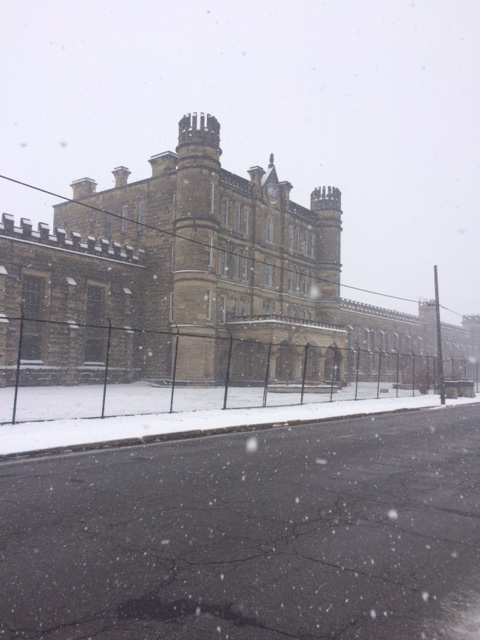
Somewhere toward the edge of Moundsville I turned a corner and encountered a formidable old stone wall.  Snow clung to the mortar, outlining each block of sandstone.  It stretched for a city block. 


When I turned the corner the front of the building appeared: Gothic, cold, frightening.  It looked like a smaller version of the old prison in Joliet.  It was the now-closed West Virginia State Penitentiary.  I had stumbled onto an institution with a storied past.


Built in 1876 and closed in 1995 it was the scene of 94 executions during its time.  In addition to those planned deaths, riots and murders were common within its walls.  When first built, it had its own working coal mine,  carpentry shop,  paint shop,  wagon shop,  stone yard,  brickyard,  blacksmith, tailor, and a bakery that taught inmates skills (while exploiting their labor) and made the prison financially self-sufficient.
But as the facility aged, policies on incarceration evolved, and overcrowding occurred the prison in Moundsville worsened.  A 1979 prison break saw fifteen prisoners flee its sandstone walls.  In 1986 a prison riot resulted in a two-day takeover by the inmates, four murders, and then Governor Arch Moore traveling to the prison to meet with gang leaders and agree to at least some of their demands.
And there it was;  cold and empty, all that death and violence, with so many stories to tell.  There were tours available that I would have loved to have taken.  But I had to go.  It was snowing harder than ever.

250 branched off Route 2 in the middle of town.  Just a little sign, and a steep climb up followed by a sharp curve.  250 would take you quickly up and out of the Ohio River Valley and put you into the Appalachians.  I traveled about a quarter-mile, the only car on the road, the only tracks, before turning around and heading back to Route 2.  The old guy with the laundry basket was right.  Route 250 was too dangerous on a day like this.  I had to hand it to him.  But it’s so much easier to admit you’re wrong when you don’t have to say it to the person who told you so.    

Tuesday, January 19, 2016

Road Trip # 2

I made it to Columbus Ohio that first day.

Altitude                743.9 feet
Latitude               40.33
Longitude            -88.43

I’m not going to say the rest of the day after Moraine View State Park wasn’t eventful.  But I was after all driving on the Interstate.  I wanted to stop at the Hen House in Mahomet for old time’s sake but didn't.  Hen Houses were the first chain restaurants we knew of on the new highway system they called the Interstate.  I 74 was built not far from our town when I was a kid.  Hen Houses used to be everywhere but few remain.  They’re still serving food out of the Hen House building in Carlock, or were last I knew.  Hen House buildings are something like tiny Quonset huts. I get sentimental about old buildings and places that are fading away.

The buildings around the exit for Westville and Attica looked bad.  Whereas Leroy hid its architectural sadness behind new steel sided buildings, the buildings visible from the highway at Westville and Attica needed paint at the least, probably needed tearing down.  What’s the future of rural towns?  When do they just call it quits?  I grew up on a farm near Danvers, a little town between Bloomington and Pekin, which purrs along nicely.  It’s even grown.  But these little towns on the decline; who finally pulls the plug?  I guess when no one will run for the village board, they close the school and post office, and the buildings have no value.  That could take a long time.

I was making the trip this year in a different Buick, six years newer than last year’s.  It is a 2006 Lucerne with the 3.8 V-6 and all the bells and whistles.  I wanted a LeSabre but they stopped making them in 2005.  The Lucerne is not as long, but it still offers a pretty good ride.  Nothing like those LeSabres though.  The great thing about this car, among other things, is that the gas gauge works, and it has a compass right in the dash.  I could have used both those features on last year's road trip. 
    
I stopped for something to eat around Indianapolis and a block past the off ramp a tall black man was dressed up as the Statue of Liberty twirling a sign for Liberty Loans.  He looked dreadfully cold.  Is that the lowest form of employment, acting as a human ad?  I suppose not.  The sight of him, bright teal cloth flapping in the cold wind, trying to smile in the cold, was disturbing.  Of course you can surmise anything if you stop your inquiry at sight alone.   I tried to get a picture but the traffic pushed me along, and he was quickly behind me.

I got a room at a Day’s Inn in Columbus.  After I checked in the room I called my wife.  She was concerned about a storm predicted for Indiana.  I told her I was pretty sure I was out ahead of it. I’d left Indiana hours ago.

I drove down the street to a Steak and Shake. When I got out of my car the wind was blowing fiercely.  Inside the restaurant, the place was completely deserted.  It was 7:30.

“Are you closing?”

“No we’re open till 11:00 but its dead.  I think it’s those storm warnings.”

They had shut down one grill.  Two waiters were cleaning even though the place looked spotless.  People take those warning way too seriously, I thought to myself.  I took a single steak burger with slaw and baked beans back to my room.  Not a bad first day but I always wish I could go further.
 

I was asleep at the drop of a hat.  

Saturday, January 16, 2016

Road Trip 2016 #1

January 11, 2016

2110 Caton Road, Ottawa, IL
Latitude               41.37    
Longitude            -88.85
Elevation             608 feet

I pulled out of the garage at exactly 7:00 a.m..  Everything was in the Buick.  I had made a fresh thermos of espresso, put two sandwiches together, added them to a little cooler, and kissed my wife goodbye.  I was off on a five-day solo drive to Florida.  I headed for Route 80.

Beside me were my new 2016 Road Atlas (large type) and an old Shakira spiral notebook.  I bought the notebook in a little bookstore in Cochabamba Bolivia while I was visiting my son Dean.  Was that 11 years ago?  I guess it was.  Wow.  The atlas was for figuring the route, the notebook to record what the route turned out to be.  I had no plan.  I had ideas, but the weather concerned me.  There was a storm predicted for where I was going.  The most basic route was this.  Go East to West Virginia, then go South to Florida.  In broad terms I would go South to Bloomington and turn left, then East to Wheeling West Virginia, and turn right, then end in Tampa Florida.  It wasn’t that simple, but that was the basic idea. 

It was to be a two-lane only road trip.  I did all two-lane roads last year, but I took a shorter and more direct route earlier in the year.   I stopped on my driveway to get my bearings on my I IPhone: longitude, latitude, elevation, using the handy free app “Just my Location”.  In addition to those physical facts, the Buick’s dashboard told me it was 9 degrees.  My biggest desire was to wander the hills of West Virginia on two-lane roads.  And there was this promised snow coming from the southwest.  So I caved and took to the interstate. 

It was there on the driveway that I decided to go west on 80 to I 39, south to Bloomington and I 55, east on 74.  I figured to follow I 74 as long as it was making a straight line to West Virginia.  I can be a purist at times, but on this trip, I decided to be pragmatic.

Let me say at the outset that I have nothing against eastern Illinois, Indiana and Ohio.  They’re fine states.  But West Virginia called.  And though it is true you can’t experience near the America on the interstate as you can on two-lane roads, it’s not impossible to get a feel for your surroundings from that always open, nicely engineered four-lane highway system that carries so much traffic.  It’s just harder because at first glance everything seems the same.

I got off at Leroy for no apparent reason.  I didn’t need gas, but I did need to take a leak.  I have little connection to Leroy.  Downstate relatives occasionally golf there.  For one fall I went to U of I football games in Champaign and we would stop at the nice gas stations by the interstate.  That’s where I made my first stop.  The big new Leroy BP had the same nicely displayed junk food and assorted items I would see on every off-ramp from there to Florida.
 
When I was a kid it was considered indelicate to mention you were taking a leak in the company of others.  Women would say they had to powder their noses.  In my family, men would say, inexplicably, “I have to see a man about a dog.”  Why these things pop up in my head I can’t tell you.  But after I saw that man about a dog I got back in my car.

I might have gone back on the interstate but I decided to cruise downtown Leroy to see how it was doing.  They’d been successful in developing new business by the highway.  Maybe that success had been replicated downtown. 

It hadn’t.  You can’t tell by looking if downtown Leroy is declining or making a comeback but whichever direction it is headed it was definitely at low ebb on January 11, 2016.  Very few cars on the street.  Vacant buildings, some of which may never be occupied again.  An occasional professional office.   Printed paper signs in storefront windows.  A beauty parlor.  Not a diner, a hardware store, not even a prosperous-looking bar. You can see what it once was, Leroy’s downtown.  It’s hard to imagine it will ever be that again.  I guess it was a trade rather than an addition to the town, that development on the interstate.
 
It doesn’t take long to scout these little towns.  I took a more substantial looking street that led out of town, which turned out to be Illinois 150, just to see what was on the other side of town when I a sign caught my eye

Terminal Moraine State Park

I have a thing for moraines, given that I feel an affinity for glaciers.  During my time at ISU my journey through the required natural science credits, which for graduation I determined would need to skirt both mathematics and chemistry, took me largely through Geography and Geology.  I took Earth Science, Weather, and Climate. That department seemed more like history than science. It was there I learned to appreciate glaciers.  They’re predictable but unstoppable, and relentless; leveling everything in their path.  The ultimate change agents, glaciers forever alter the world they encounter. And when they finally end, they leave a terminal moraine, the remains of the earth, rock, and whatever else it has amassed along the way.  I wanted to see it.

So I made my way to Terminal Moraine State Park.  If I knew it was there I had forgotten.  Among Illinois State Parks it’s not often mentioned.  As soon as I got away from the interstate, on the blacktop driving between empty snow-packed cornfields, I regretted not traveling the whole trip that way.  It was frigid and sparkly.  It’s flat out there in central Illinois.  You have to look closely to see rises in the terrain.   I was scanning the horizon as I turned into the park.    If I was near a terminal moraine I couldn’t tell.


There were gentle dips in the winding road that took me through Moraine View State Park.  Picnic tables were clustered under trees in places that must be lovely in the summer.  A deserted campground appeared around a curve.  They have a little lake there frozen solid.  There was something clustered in the middle of the lake.


Ducks, perhaps geese, were huddled together on a frozen pond.  Why would ducks sit on a frozen lake?  Patiently waiting for the thaw?  Reminiscing about better days?  It seemed odd.  When I have time I’ll try to figure that out. 

There was nary a soul so far in the park.  Not only that, my tires were making the only tracks on those snow-covered blacktop roads.  I was looking for a marker, a sign maybe, to lead me to the moraine, a viewing stand maybe, something. 

Rounding a corner I saw a building, tracks in the snow, and next to the building a pickup truck.  It looked to be the park office.  I parked, walked in the open door, and found a deserted room.  A counter with a scant smattering of pamphlets and the like was by the door.  I looked for a bell.  Finding none I called out?

“Hello?  Anybody home?”

From the far back, I heard he rustling of someone moving around.  A big guy in a hooded thermal sweatshirt and a fuzzy vest appeared in the doorway.  He looked surprised and asked me this question not like he’d said it many times before but as a genuine inquiry:

“Can I help you?”

“Yeah, I’m just wandering around, and I was interested in the moraine.  Is there a place in the park where I can view the moraine?”  I thought it a logical question, seeing as we were both standing in Moraine View State Park.
   
“No, not really.  The moraine is all around.  It’s this ridge here.  It runs all along, Leroy, Downs, you know.  It’s here, but it doesn’t really stand out so you can see it.”  He sounded serious, and a little apologetic. 

“I see.”

We both looked at each other.

“Well, thanks.”

“You bet.  Drive safe.”


And thus ended my first road trip diversion, A bust.  I got back in the Buick and made my way through Leroy to I 74.  I had to get to West Virginia.  

Tuesday, January 12, 2016

What Did You Expect?

Every time I sit down to write a piece about the squalor now called a budget process in Illinois something happens in the news that changes the story.  By the time I finish a piece it’s out of date.  So let’s start with the past in Springfield, that sleepy Central Illinois town where the people we elect to govern our state strive to act in our best interests.  Indulge me while I recall some history.

When Rod Blagojevich defeated Jim Ryan and was installed as governor of Illinois, most Republicans holding administrative jobs quit or were fired and Democrats slowly filled those posts.  I had never heard of the people taking important jobs in the social service arena I worked in nor had they heard of me.  By and large they were new to government.  That was because, as it later appeared, they bought those jobs through their political donations.
 
AFSCME rented a big office in view of the capitol building and put their acronym in huge neon letters on the outside so that legislators, even from their offices at night, and the governor himself, would be reminded who helped get them elected.  AFSCME and its cousin SEIU pumped lots of money into Democratic campaigns to get a leg further up in Illinois politics.  And they succeeded in doing so.

I was the director of a largely state funded private child welfare agency.  That put me in a community of people trying to reform a then (as now many would argue) dysfunctional state code agency - DCFS.  We met in expert panels on a variety of topics and problems within that system.  Not long after Blagojevich was elected union representatives began to attend the meetings.  That was new.  The union was there, among other things, to make sure that whatever solutions or changes we might propose in policy to better serve kids and families which might result in additional programs and thus staff (think jobs) was sure to include state employees, members of their union, along with the largely non union private agency community.  Under the Democrats unions gained the ability to insert themselves even at that level of decision making.  Supervisors unionized.  All but the top tier of administrators unionized.  Things changed.

Make no mistake, we had experienced chronic budget problems, delays and crises, nearly every year no matter which party was in control.  But when the Democrats achieved control of both the Senate and House in addition to the governor’s mansion something unexpected happened.  The problems shifted away from the Republicans and Democrats and migrated instead to being between the Speaker of the House and the Governor.  Occasionally the President of the Senate could be heard.  But it was a different dynamic.
 
And the people we elect to represent our districts?  If you lived where Democrats were elected you at times gained some insight or access to policy and decision making but even then the power was concentrated with the leaders.  Local reps and senators stayed busy helping constituents and bringing money back home, but the show was run from the top.  We took to calling the people who sat in most of the seats in the house and senate “mushrooms.”  They were kept in the dark and brought into the light only when they were ready for harvest, the crop being their votes. They would sit in their offices, reading the Capitol Fax for insight, until a budget deal was worked out and then they voted for the deal as instructed and everyone went home for the summer. Why?

Because Madigan and the party controlled the campaign money, and much of the money came from the unions.  If you voted the wrong way the party would withhold funds for your campaign or worse yet run someone against you in the primary.  That’s how it looked to me as an outsider.  I didn’t particularly care how it worked, I just had to learn and understand the system so I could work within it to get first a fair shake first for Illinois’ kids and families and next, a fair share of available resources for the Illinois Valley.
 
Rauner’s election represented an opportunity for change in Illinois.  Instead he seems intent on creating the same kind of tyranny he’s fighting against.  Buying votes from his own party.  Not tolerating divergent views.  Fighting fire with fire and all the while repeating the past.  Baby boomers learned the folly of that in the lyrics of a cynical old Who song Won’t get fooled again.

There's nothing in the streets
Looks any different to me
And the slogans are replaced, by-the-bye.
And the parting on the left
Are now parting on the right
And the beards have all grown longer overnight.

And that chilly ending

              Meet the new boss
              Same as the old boss

In LaSalle County we saw an example of what is happening in the now resurgent GOP up close.  At Shaker’s Lounge, an Ottawa bar north of Interstate 80 (good selection of craft beer BTW) Jerry Long, truck driver and previous Republican candidate for House Representative in the 76th district, who lost by a whisker to Democratic incumbent Frank Mautino, Deputy Majority Leader in the general election (337 votes out of 34,481 cast) arranged to meet Jacob Bramel, a 23 year old Air Force veteran from Marseilles who eerily looks like a young Adam Kinzinger.   Jacob previously announced his Republican candidacy for Frank’s seat a while ago, after Jerry Long told the media he had no interest in running for that post again.  But that all happened before Mautino’s bid to fill the recently vacated office of Illinois’ Auditor General.  His eventual appointment was accepted as all but a formality.  Mautino’s sure absence in our area’s House seat apparently changed Mr. Long’s mind.

He was coming to Shakers to tell young Jacob Bramel he was running in the primary, had the backing (think campaign funding) of Rauner and his people, and if he, Bramel, would withdraw from the election he would be looked upon favorably for future opportunities.  They met by the pool tables at Shakers, a good place for private conversation in a crowded bar, with all that necessary space around the tables.  I do not know if they were playing pool during the conversation, with pool cues in their hands or not, but the conversation did not go well.  Mr. Bramel did not want to go along, nor did he, and is running against Jerry Long in the primary.  Primary battles are always a messy, expensive, and needless proposition for parties who like to control the show.

But there you go, a near fight by the pool tables at Shakers for the right to work yourself into a chance to get elected to a job that’s a pain in the ass and pays $67,836 a year.  A fight between Republicans no less.  They used to be happy with just finding some chump to allow them to put his or her name on the ballot.  Republicans are intent under Governor Rauner to pick up seats in both chambers and may now have the money to do it.  Because most everything in Illinois is about the money.
 
Democrats control the House and Senate in Springfield and have since well, before George Ryan was sent to prison.  Amazingly they retained control even after Blogojevich was removed from office mid- term and also sent to prison.  Republicans have been on the sidelines for a long time in Illinois.  There are a lot of good people in Illinois government who happen to be Republicans.  They have to be sick about what’s happening but like good soldiers, or honest Chicago cops, they’re keeping their mouths shut.  I had always thought Republicans who held office in Illinois must take real pride in knowing they were elected despite being from a party that was terribly disorganized and had no money.   After that night of Shakers I’d say that has all changed.
 
The problem is that the campaign money belongs to is Rauner and people like him.  Before Christmas a downstate reporter, pointing out the criticisms leveled at both parties for failing to reach a budget, asked Governor Rauner if the feedback he was getting from people did not pressure him to pass a budget.  His reply, paraphrased because I can’t find the actual quote, was telling.

”On the contrary, the people I talk to: the heads of companies that are the largest employers in Illinois, along with investors and entrepreneurs, they all urge me to stay the course.”

Well hell Bruce, why didn’t you say so earlier?  If those folks want you to ruin government by not passing a budget, by not raising sufficient revenue, by letting priorities and policies for everyday people in Illinois flounder and fail you’d be nuts not to listen to them.  Those big employers and investors are the ones who really count, aren’t they?

People who have almost stopped talking about the budget crisis in Illinois, who simply shake their heads and walk away, sometimes I ask people who are outraged, like me, this question:

“What did you expect?”

I’ll tell you what I expected, and still expect.  I expect Governor Rauner and his administration to spend his four year term working hard to turn Illinois around.  I expected him to offers new ideas, exemplify flexibility, be pragmatic, win some and lose some, bring transparency, inject fiscal sense into the conversation, and incrementally, over four years, change the political culture in Illinois.  And I expect him in the end to tell the rich guys he just can’t accomplish everything they wanted.
 
On the other side of the aisle I expected Speaker of the House Madigan to resist but in the end accept the inevitable swinging back of the pendulum while hanging on to the best of what he achieved over a long run.  I expect him to find financially damaging holes in collective bargaining, the unemployment insurance system, worker’s compensation, state pensions (surely he knows where they are, he and the unions put them there) and in the end agree to changes those systems.  I expect him to risk pissing off Henry Bayer of AFSCME completely and moving Illinois to fiscal recovery while maintaining his focus on protecting the well being of the working class.
 
And while I’m spouting off let me say something to Eric Zorn of the Chicago Tribune, not only a good writer but also, as far as I can tell, a fair and compassionate guy.  Before Christmas he scolded Andrea Durbin of the Illinois Collaboration on Youth and  Scott Humphrey, CEO of One Hope United insisting they pick a side.

“Get in the game,’ he said.  ‘Make the argument for one side or the other. Point fingers.  Wave signs. Chant slogans. Cast a little blame already.”

Eric believes that by not being partisan advocates, for children in the case of Andrea Durbin and Scott Humphrey, amounts to not sufficiently advancing their cause.

“Right now,” Eric Zorn says “both sides in the standoff seem to believe that public pressure generated by this disintegration of the safety net will be felt most strongly by the other side and eventually cause them to capitulate. Democrats think the Republicans will cave if people get angry enough; Republicans think the Democrats will cave.

Those who are simply whipping up general anger and frustration therefore aren't hastening the day of compromise and reconciliation. Policy agnostics and neutral parties are sideline players, as are members of the "pox on them all" majority detected in recent statewide polling. Pushing on both factions at once keeps them the same distance apart…

What, exactly, do these advocates want?”

I’ll tell you want this advocate wants Eric, a budget.  Progress on fixing the problems that plague Illinois.  Sufficient revenue.  Direction.  And frankly, I want neither extreme.  We can’t afford business as usual with no change as Madigan would have us believe he can deliver nor can I stomach turning over Illinois government to the rich free market elite, Rauner being one of them, that apparently has our new governor’s ear.  I want compromise.  I want a hybrid.  I don’t want Illinois ala Blagojevich any more than I want Wisconsin or Kansas.  I want them both, Rauner and Madigan, to agree on and pass a budget, lose face among their supporters, lick their wounds, and start over next year.  And I want it done now.  

I was talking to a woman who administers state funded (mostly federal pass through) services for the elderly.  She described a pattern I didn’t know existed.

“One of our busiest times is right after Christmas.  Families come home, often from long distance, for what is perhaps an annual visit to elderly parents and grandparents.  When they get here and see the circumstances of their relatives up close, they often call our office seeking help.  Visiting nurses, possible placement into assisted living, any manner of things.  And often their elderly relatives resist.
We often advise them to start with Meals on Wheels.  It’s a simple, fairly non invasive service, but it puts an outsider in the home several times a week, they often form a relationship with the volunteer, and that starts the process.  It’s a simple and overlooked service that does much more than provide food.

The agency that delivers those meals in the Illinois Valley is not being paid because there is no budget.  They are also funded by counties, and have gone to the country where their main office is located for a further advance from them, but were recently denied.  They started adjusting to a lack of money by limiting meals to three days a week.  Starting January first they are also not accepting new clients.  So our primary tool, our gateway to service program, is no longer available to us.  It’s a problem.  A big one.”

I now serve on our local 708 board, which distributes dedicated local tax dollars to help the mentally ill, persons with disabilities, and those suffering from substance abuse.  Our local mental health provider has lost $750,000 in state funding for psychiatry to their mentally ill clients since July 1.  Without the psychiatric staffing that money affords them they cannot prescribe the psychotropic drugs their clients need to function.  They are spending rapidly from reserves.  To exacerbate that problem, it appears even if a budget is adopted, that funding will not be available going forward.

If you are chronically mentally ill in an urban area, taking your eligibility for psychiatric services to some other provider might be possible.  If you live in Ransom or DePue, not having psychiatric services at the local mental health center means you don’t get served.  There is no one else.   Far fewer mentally ill people in our rural area are now being served.  Psychiatrists are not flocking to our small towns to make up the gap, in fact they are fleeing.  The quality of services in the community I live in is rapidly declining.  And Eric Zorn wants me to ride one horse or the other in this race?  Which side could you possibly choose?  I’d rather walk.

I have to tell you something.  I don’t care about either party.  I care about them only to the extent that they could govern well.  And they aren’t.  I don’t have confidence they can.  They are risking the present, posturing politically, in order to gain an edge on their party’s future.  I don’t care about their future.  I care about old people being fed and schizophrenic people getting their meds.  In the end that’s what Illinois does.  It serves people.  I heard on the radio this morning the House has cancelled its legislative session next week because of a lack of work to accomplish.  I have no words for that really.

Since July I keep hoping that every time I leave Illinois there will be a budget in place when I get back.  I’m leaving for a road trip and a stay in Florida Monday to return sometime near the end of the month.  I doubt there will be a budget when I get back.  I don’t know how to end this post.  It’s like an existential play.  The main characters boast and bluff and laugh and howl and nothing changes.  It’s Jean Paul Sartre all over again.  Give me a story with an ending.  Please.

Wednesday, December 30, 2015

Baby in the Sun Remembered

If you are new to Dave in the Shack let me tell you how it came to be.  I was the director of Youth Service Bureau of Illinois Valley, a social service agency that serves troubled, abused, neglected and otherwise needy kids and their families.  It was hard work.  I realized at one point that I had to communicate what my organization did, what we valued, and why we mattered much better to everyone involved: my staff, my board of directors, our foster parents, donors, funders, and the community we served.  When we were a little organization I used to brag that we were “too small for rumor.”  You could put everyone in a room and tell them the same thing all at once.  We grew.  It got complicated.
 
When I realized how easy it was to share information by e mail I began sending out a weekly communiqué to a limited list in house.  Then we found Constant Contact and compiled an even bigger list.  At some point in 2007 I named it the Friday Update.  Then we created a YSB Face Book page and readership grew even larger.  When I retired in 2012 I hadn’t missed a Friday.

After retirement I managed to keep some of those readers when the Friday Update transitioned to Dave in the Shack.  I have since added new ones.  I now have the luxury of writing about absolutely anything, and I do.  If you’re reading this thank you.  I value your reads, likes, and comments.  As a conventionally unpublished author you are my audience.  You continue to make this effort worth doing for me.  

During this time between Christmas and the New Year I dove into a project I’ve put off for some time, rereading those old YSB posts.  It’s five years worth, over 250 posts.  I think I wasn’t ready to do it till now.  I knew I would find painful reminders of the kind of problems we encountered helping families, but I also was afraid I would discover how much I missed it.  My fear came true.  I remember the cases, the people, even the particular days so vividly.  I was so close to real life doing that work, so close to danger and joy, risk and reward, success and failure.  Since then things have evened out some here in the shack.  I wouldn’t go back, but it has been fun to visit.

I believe there may be some value in compiling the best of those stories to share with young social workers who are contemplating or have just entered the work of child welfare and youth development.  The field changes all the time, but aspects of the work will remain universal;  forming relationships, gaining trust, starting at the beginning and doing the right thing.  Maybe some of those stories could be helpful.  I’m going to find out. 

Today, for the last blog post in 2015, I want to share with you a Friday Update I read again last night for the first time since I wrote it in 2012.  These  winter holidays revolve around babies;  the Christ child in a manger , the new year represented by a bouncing baby wearing a sash, pushing out the year just ending  hobbling off as an old man.   The New Year is a chance at new birth.  That’s why we make resolutions.  It’s a fresh start, like a baby born into the world.  Along with sadness I tried to capture hopefulness in this brief and real encounter I once had.  I hope you feel it.
 
Baby in the Sun

I’ve been in more meetings than I’d like the past month; meetings with adults making arrangements, making decisions, planning, doing things that have to be done, all the while talking and concerning ourselves mostly with other adults.  It’s a trap that can take you away from the real work.  And then when you least expect it the real work sneaks up on you and captures your full attention.

It was one of those hot days.  Jackie, whose office is close to mine walked past my office to go out the back door, turned on her heel and filled my doorway.

“You should come out here and see this baby.”

“What baby?”

“We have a newborn in foster care.  You have to see it.”

Jackie rarely tells me I have to do anything, which I appreciate.  I was reviewing a policy about risk management.  If the truth were known I don’t care all that much about managing risk.  I prefer to take risk.  This policy implied the opposite; safety, containment, and protection.  I hate policies really.  They imply you do the same thing in every situation every time.  Who can say that?  More than that, who wants to do so?  I stood up and followed Jackie out the door.

The heat hit me hard in contrast to the air conditioning.  There were no clouds.  It was bright.  Standing by her van was Jami and in her arms was what appeared to be a vinyl covered box, like a small dresser drawer.

“Look,” Jackie said.

In the infant carrier was a perfect baby. She was dressed in a lime green onesie.  Her feet were bare.  Traces, just wisps of toenails were visible on each of her ten miniature toes.  Her calves were tiny and on them were short little shins.  Her knees were the size of thimbles.  Her arms were folded across her chest and she was sleeping.  Her nostrils flared slightly as she breathed.  Her skin was paper thin and white like a fine china plate.  I thought I could see through her eyelids.  Dark hair covered her head and in the midst of it a barrette held a tiny tuft of hair with a lime green bow.  Each fold in her ear was perfectly formed.  She breathed in, held her breath for just a moment, and then sighed.  Her mouth moved to one side then returned, and her hand moved up to touch her cheek.

“She’s beautiful.” I said.

Jackie, Jami and I stood looking at her without speaking.  When we began to talk we didn’t look at each other but rather at this perfect baby.

“What’s her name?”

“She doesn’t have a name yet.”

“Why not?”

“The mother hasn’t chosen one.”

“How old?”

“Three days.”

“She seems so small.  Was she premature?”

“Full term and healthy. Just little.”

I wanted to touch her skin but I was afraid I’d wake her.  I didn’t really want to go on with the conversation, find out the rest of the story, but I knew I would.  It’s the dark side of babies in foster care.

”The Mom?”

“Drugs in her system at the time of the birth.”

“Where is she?”

“With a boyfriend not the father.  They’re about to be evicted.”

The baby turned her head and for a moment moved her arm down to her side before bringing it back by her face.  I thought I saw a faint smile.  I thought of my own beautiful daughter, born nearly twice the size, now 28 and making her own way in life.  We look forward to her visits home.

“Heroin?” I asked.

“Yeah.”  It seems like its heroin so often now.

“She’s told us she doesn’t think she can quit.  She’s tried before she says.”

I look at the baby.  Her toes move just a little.

"But her Mom will name her right?”

“We think so.  She has another day.  If she doesn’t the hospital picks a name.”

“She should have a name her Mom gives her.  It may be the only thing she ever gets from her Mom, but she should get that don’t you think?

“I think her Mom will do that.  She’s talking to us.  We’re trying to get her to agree to treatment, if we can find an opening.”

There have been so many cuts to drug treatment programs that finding a bed in a treatment center when you need it, when the addict is ready to go, is something of a crapshoot.  Successful treatment and months and months of clean drug tests is the only way this mother will regain custody of the perfect baby in the infant car seat, now in her third day of life, sleeping in the summer sun outside the YSB office among social workers.
 
“The father?”

“Not identified.”

“Family?”

“Not coming forward and the Mom is not helping.  The baby has been to the doctor and is going back to one of our foster homes.  It’s tough for them.  She didn’t sleep too well the first night.  She has a tiny tummy and seems agitated.  But then again, she’s only three days old.”

God help her I thought.  And then I thought it again, a silent prayer.  Really God.  Please help her, and her mother, and us.  Help YSB make the right decisions, say the right things, chart the right course here at the beginning of her life.  Help her mother, or her father whoever and wherever he may be, find the strength and the will to parent this girl.  Help our foster parents love her and care for her but not so much that they can’t release her to her family when or if they prove themselves able.

But most of all help this tiny girl, this little human being.  Her life is so uncertain.  Let it be a full and wonderful life.  Let her experience family, and friends, and all the good things that exist in the world. 


That little girl, wherever she is, will turn four in 2016.  I may be retired but I still think of those kids and families.  All the time really.  I hope this little girl is in preschool.  I hope she’s well fed, loved, warm, and looking forward to kindergarten.  I hope she talks a blue streak and does not know the particulars of her circumstance that day when we looked at her in bright sun and pondered her future.  I hope her days unfold like a rich and exciting book.  When she is my age it will be 2076, America’s Tricentennial.  I hope she looks back then at her years on earth with satisfaction and joy.  I hope you do too.  Happy New Year.

Wednesday, December 23, 2015

Snickers

I was the only male nurse’s aide in the place.  They assigned me most every day to the segregated men’s wing.  I made their beds, helped them shower, took them to the basement dining hall, emptied their bedpans, persuaded them to sign over their Social Security checks, brought snacks to their room, did all the things nurse’s aides do.  It was 1977. I was back from a trip to South America and profoundly broke.  The nursing home job came available first.  I took it and liked it.  I learned a lot there.

One of the things I learned was the depth to which people can be alone.  One of the guys on my wing was Ted Becker.  Ted was a bachelor farmer whose parents were both dead.   When Ted was sixty, years after he had moved out of his parent’s farmhouse due to its poor condition and into a mobile home by the machine shed, he suffered a debilitating stroke in his tiny trailer living room.  At the time Ted was morbidly obese.

The story, as told by the other nurse’s aides (which well could have been rumor) was that the EMT’s had a difficult time getting him out of the trailer.  Ted couldn’t walk, they could barely pick him up, and the gurney, with Ted on it, wouldn’t fit through the door.  They used a power saw to enlarge the doorway.  Those are the kind of indignities I hope are never rumored about me.  When Ted left the hospital following his stroke he came to the nursing home, recovered somewhat, and never returned to normal life.  That was four years before I came to work there.

“Ted was morbidly obese?” I asked.

“That was before we put him on a diet” one of my co-workers said proudly.  “He was over four fifty when he came in.”

I looked at Ed down the hall, slumped and scrawny in his tall back chair.  He couldn’t have weighed more than 160 pounds soaking wet.  That would explain the huge folds of skin that draped from his body in the shower.  Though undoubtedly healthy it also struck me as cruel somehow.

The tall back wheel chairs had a tray fixed in front that kept the patients confined or controlled depending on how you looked at it.  Ted couldn’t have gotten up by himself anyway, but the tall chair with the tray did help him sit straight.  Ted slumped to his right side.  I straightened him up several times each day.

Everything on Ted's right side-face, hand, arm, leg, foot-was fairly useless.  The stroke had taken away his speech.  Occasionally he would grunt but not often.  He got a lot done with his left side though.  He could get his left foot just beyond the lower platform of his chair and propel himself slowly down the hall.  If he could get the left side of his chair to the rail that ran the length of the hall he could pull himself even faster.  Try as I might I could not picture Ted as a fat man.

“I guess that explains why he’s so hungry” I said.

Ted was beyond hungry.  He was ravenous.  You had to have a strong stomach to watch Ted eat.  Think Labrador Retriever and a bowl of dog food. The guy was crazy to eat.  He absolutely coveted the snack cart I brought around mid afternoon.  You had to watch him like a hawk.  If you did you would see him inching towards it, pushing with that left foot, and if he succeeded in getting close to it with his left hand, it was an all out attack. 
  
It wasn’t only food.  Ted would stuff toilet paper in his mouth.  Try to eat Kleenex.  The guy would eat anything.   Before you know it his mouth would be absolutely stuffed with whatever was within his reach.  He was in constant danger of choking.  Unashamed, constant, ravenous gluttony defined Ted’s existence there.  Without speech, the means to express himself, or the ability to walk food was his currency, his goal, his life’s desire.

I soon realized that no one visited Ted.  The nurse’s aides from the area thought he might have had a sister that moved away, but no one knew anything about Ted’s family.  And Ted couldn’t tell us.  So he lived his days in the nursing home as a solitary soul.  The meaning of that didn’t fully sink in till Christmas.
 
Except for the dementia patients (Alzheimers was not a diagnosis then), nothing brightens the life of a nursing home resident like visitors, presents, or mail.  Christmas was a time when all those things increased.  Around the holidays residents went to their family’s homes, and if that was not possible the families visited, brought food and brightly wrapped presents, decorated their rooms, sat and talked, and brought the grand kids, most of whom looked bored and scared at the same time.  But Ted got none of that.

In addition to in person visits, the old people in the nursing home who were lucky got cards from family and friends, old neighbors, you name it.  I did mail call for my guys on the wing and I’d walk down and back that sad hall each morning handing out envelopes, opening them for the guys if they could not.

Every day Ted looked hopefully from behind his tray.  The skin on Ted’s face sagged and made his eyes look bigger.  He had soulful blue eyes.  He looked up hopefully.  There was never mail for Ted.

“Not today Ted,” I said as cheerily as I could.

The few days before Christmas were the heaviest card days.  I had a big basket of mail to pass out.  When I came to Ted’s room he was there, slumped over in his chair wearing a plaid flannel shirt with drool on it, khakis, and his black Chuck Taylor high tops.  The Chucks were good for Ted because he was incontinent at times, and when he had accidents we could easily wash the canvas shoes.   I had dressed him.  His eyes were glued to the mail as if it was a pan of brownies.

 “Ted you got a card today.”

His eyes grew big.  I straightened him up.  He fumbled with the envelope with his one working hand and when he couldn’t open it I opened it for him.  It was a card from the nursing home administrator.  Everyone got the same cheap card.  She had her signature stamped inside.  But to add a personal touch she wrote “Ted” before the cheesy Christmas message.
 
“Look Ted, she wrote your name” I said.

Ted looked up at me and his eyes filled with tears.  He cried openly.  Stroke victims will do that.  Ted had gotten a Christmas card and he was crying for joy that someone remembered him.  It was from a nursing home administrator who rarely left her office and didn’t know Ted from a bale of hay.  But it was everything to Ted.  I think that was the moment I knew I had to get out of that job.  It was just too sad.

Thankfully on Christmas Eve I didn’t have to work.  I had bought a few presents and got ready to drive to my parent’s farm house in Danvers.  My parents were both alive then and I was looking forward to seeing my brothers and sisters and the nieces and nephews.  Christmas on the farm is a whole other story but I love Christmas more than any other holiday.  Before I left town I got gas on the South side near the nursing home.  It was before you could pay at the pump so I went inside to pay with cash.  There was a candy counter there.  As I was paying I looked down through the glass top at the candy bars and as the kid was handing me my change said

“Give me a couple of those Snickers too, would you please?”

It was dark when I parked on the street by the nursing home and walked across the yard to the side door.  I made my way up the back stairs to my guys’ wing. It was that quiet time after dinner but before lights out.  I went down the hall to Ted’s room.  He was slumped in his chair, sleeping.  Ted didn’t have a TV like most of the guys.  He didn’t have anything really but clothes.  His one and only Christmas card was thumb tacked to his bulletin board.
 
I turned on Ted’s bed lamp rather than the overhead light.  The rooms then were bright and stark; florescent overhead lights, white walls, shiny linoleum floor, hand cranked metal bed, metal nightstand, and a Formica tray on a stand that rolled over the bed.  To make things worse it was too hot in those rooms, radiators cooking, air not moving, and always the smell of urine.  Christmas Eve in the nursing home.  May we all be spared such a fate.
 
“Wake up Ted I’ve got something for you.”

I gave him a minute to open his eyes and get used to me being there before straightening him up in his chair.

“Ted I’ve got something for you but you are going to have to cooperate.  It’s not on your diet and I don’t want you telling a bunch of people I’m giving you this.  But you strike me as a guy who can keep his mouth shut.  Can you do that?”
Ted may have gotten the joke but could smile only crookedly so I couldn’t tell.  I had his attention however.   When I took the Snickers out of my coat pocket his eyes lit up.

“OK Ted, I want you to eat this slow so you don’t choke, you understand?”
When he realized what was about to happen he literally began to drool.  I got some Kleenex out of his night stand and wiped his chin.  With my Swiss Army knife I cut a small piece of the Snickers and put it on his tray.  His left hand flashed out and the chunk of candy bar was in his mouth almost before I knew what happened.  He stared at me as if I was going to dig it out of his mouth as I had done so often with other things before.

“Ted I want you to chew that slow and swallow it before I give you more.”  He did.

I cut off another piece.  We repeated that five times with the first candy bar. 
“You feel OK Ted?”  He nodded enthusiastically.

“You don’t feel sick do you?”  He shook his head vigorously in the negative.  I wiped his chin with the Kleenex again.

I took out the second candy bar.  We did it again.  I can’t say he slowed down much, but I think he began to savor the bites a little more.  That could have been my imagination.  I wiped his chin once more. 

“This is the last piece Ted and then I have to go.”

I laid the remaining piece of Snickers on his tray but he didn’t take it.

“What the hell Ted, aren’t you going to eat that?”  He just stared at me.

“Ted it’s yours.  Eat it.  I brought it for you.”
 
He didn’t move.  His left hand hung down by his side.  Then he brought his hand up, pointed his finger at the piece of Snickers, and pointed to me.  I couldn’t figure out what he was doing.  He kept pointing at the candy and then pointing at me.  Then I realized he wanted me to have the last piece.  The guy who would eat the envelope his only Christmas card came in was sharing his candy bar with me.  I was dumbfounded.
 
I ate it.  Just Ted and I in a barren nursing home room with a single dim light.  He looked at me closely as I chewed the Snickers, his eyes bright.  I looked back at him.
   
I think people that don’t or can’t talk; babies, those who don’t know your language, stroke victims, all try to express themselves with their eyes.  And sometimes if you pay close attention they succeed.  Or is that just us giving words to their expressions?  We don’t know.  I thought that night Ted talked to me.  I think he said thanks.  I think he wished me a Merry Christmas too.  You could see it in his eyes, his poor old big blue eyes.

“Merry Christmas to you too Ted.”  I said.  “And thank you.”

That was my only Christmas in the nursing home.  I left in the spring.  Ted died the next year.  Choked on not one but many ham sandwiches.  I suspect someone didn’t watch the snack cart closely enough.  I never forgot Ted, or the kindness in his eyes that Christmas Eve.  If we let it, Christmas brings out the best in all of us.


Merry Christmas.